

The last article settled trade receivables and trade payables, and you can now read a personal account on either side. This one goes back to the transactions themselves and to two accounts that have appeared from day one without ever being properly defined: purchases and sales. What belongs in these two accounts and what does not is the starting point for cost of goods sold and gross profit later on, and one wrong entry carries through the whole income statement.
What counts as a purchase?
Most students assume that anything the business buys is a purchase. It is not. In accounting, "purchases" has a narrow meaning: goods bought in order to be resold at a profit. Anything bought for the business to use itself — a computer, tables and chairs, a van, stationery — never goes into the purchases account.
Purchases: goods a business buys in order to resell them at a profit, either as they are or after processing. 1. Purchases is an expense-type account and is always recorded on the debit side. 2. Assets or supplies bought for the business to use itself are not purchases. 3. Buying for cash or on credit makes no difference: it is still purchases, and only the other entry changes.
It is the phrase "resold at a profit" that decides the answer, not the item itself. The same private car is a purchase in a car dealer's books, because it came in to be sold again. In a cha chaan teng's books it is not a purchase but a non-current asset, because it was bought to deliver takeaway. So the first question to ask when reading a question is: what business is this company actually in?
- A fashion shop takes in a batch of new coats to put on the rail — purchases.
- A supermarket buys cases of soft drinks from a supplier to stock the shelves — purchases.
- A furniture factory buys timber, works it into furniture and sells it — purchases.
- A car dealer orders several cars from the manufacturer to sell on — purchases.
- A computer for the office — a non-current asset, recorded in the equipment account.
- A van for deliveries — a non-current asset, recorded in the motor vehicle account.
- Stationery and cleaning supplies — an expense, recorded in the stationery or sundry expenses account.
- A machine used to make the goods — a non-current asset, recorded in the machinery account. Being connected to the goods does not turn it into a purchase.
And what counts as a sale?
Sales works in exactly the same way, with the direction reversed. Sales is the revenue a business earns from selling the goods it deals in. Note the word "goods". When a business sells something it had been using itself — an old desk, an old van — the money it takes in is not sales, because that item was never held for resale.
Sales: the revenue a business earns from selling goods, meaning the things it held for resale in the first place. 1. Sales is a revenue-type account and is always recorded on the credit side. 2. Selling a non-current asset is not recorded as sales. 3. Selling for cash or on credit makes no difference: it is still sales, and only the other entry changes.
So how is the sale of a non-current asset recorded? The full treatment has to wait for the articles on depreciation and disposal. At this stage one rule is enough: leave the sales account alone. Debit the money received, or what the buyer now owes, and credit the account of the asset itself so that it leaves the books — because the business really does have one asset fewer, rather than one more sale.
Which side each account always sits on
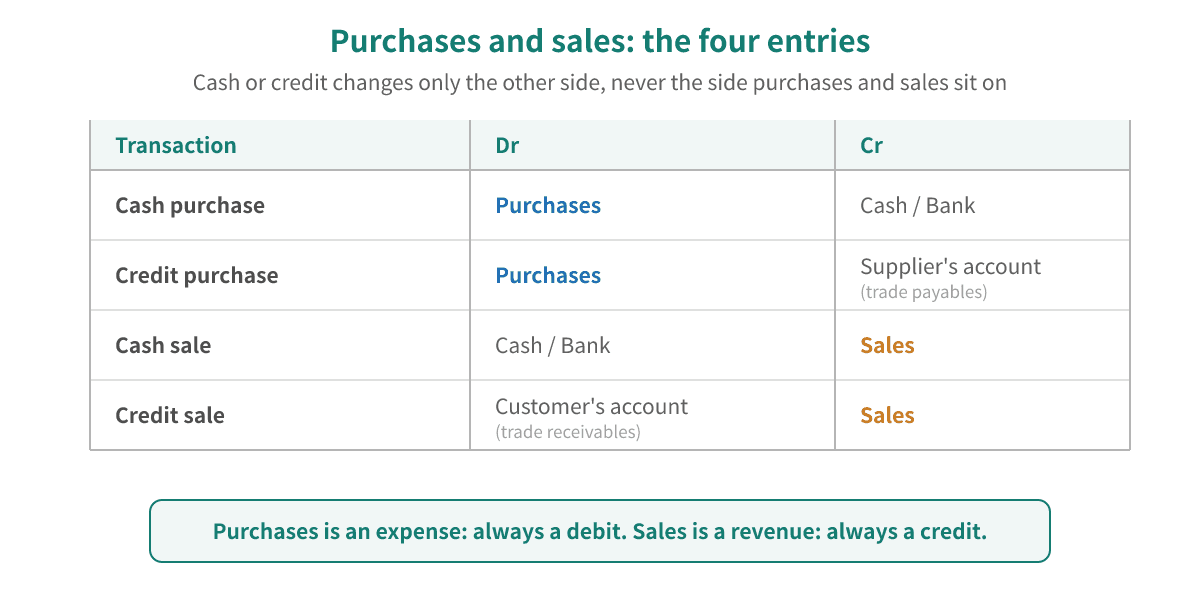
This is the easiest step to remember and the one most often got wrong. Purchases is an expense, and an increase in an expense is a debit, so purchases is always on the debit side and never appears on the credit side at all. Sales is a revenue, and an increase in a revenue is a credit, so sales is always on the credit side. Buying for cash or on credit has no effect on which side purchases sits. All that changes is the other entry: for a cash transaction it is cash or bank, and for a credit transaction it is that person's personal account.
Four entries, worth learning by heart: 1. Cash purchase — Dr Purchases; Cr Cash / Bank. 2. Credit purchase — Dr Purchases; Cr the supplier's account (trade payables). 3. Cash sale — Dr Cash / Bank; Cr Sales. 4. Credit sale — Dr the customer's account (trade receivables); Cr Sales.
Worked example: Tai Shing Trading Company in April
Take Tai Shing Trading Company from the last two articles, a business that buys and sells goods. There are six transactions in April, and two of them are traps:
- Apr 2, 2020: Bought $28,000 of goods for cash.
- Apr 7, 2020: Bought $65,000 of goods from Wing Fat Company on credit.
- Apr 11, 2020: Made cash sales of $40,000.
- Apr 15, 2020: Sold $85,000 of goods to Chan Tai Man on credit.
- Apr 20, 2020: Paid $12,000 by cheque for a computer for the office.
- Apr 26, 2020: Sold an old desk that was no longer in use to Lee Kee for $3,000 on credit.
The first two are both purchases. On Apr 2, debit Purchases $28,000 and credit Cash $28,000. On Apr 7, debit Purchases $65,000 and credit Wing Fat Company's account $65,000. Both go to the debit side of the purchases account, and the only difference is on the other side: one was paid for on the spot, and the other is owed to Wing Fat Company as trade payables.
The next two are both sales. On Apr 11, debit Cash $40,000 and credit Sales $40,000. On Apr 15, debit Chan Tai Man's account $85,000 and credit Sales $85,000. In the same way, both go to the credit side of the sales account, and again the difference is on the other side: one was paid for on the spot, and the other is owed by Chan Tai Man as trade receivables.
The last two are the ones the exam is really after. The computer bought on Apr 20 cannot go into purchases: Tai Shing Trading Company does not sell computers, and this one was bought for its own use, so debit the equipment account and credit Bank. The old desk sold on Apr 26 cannot go into sales either, because that desk was never held for resale. And since what was sold on credit is not goods, what Lee Kee owes is accounts receivables rather than trade receivables: debit Lee Kee's account $3,000 and credit the furniture account $3,000.
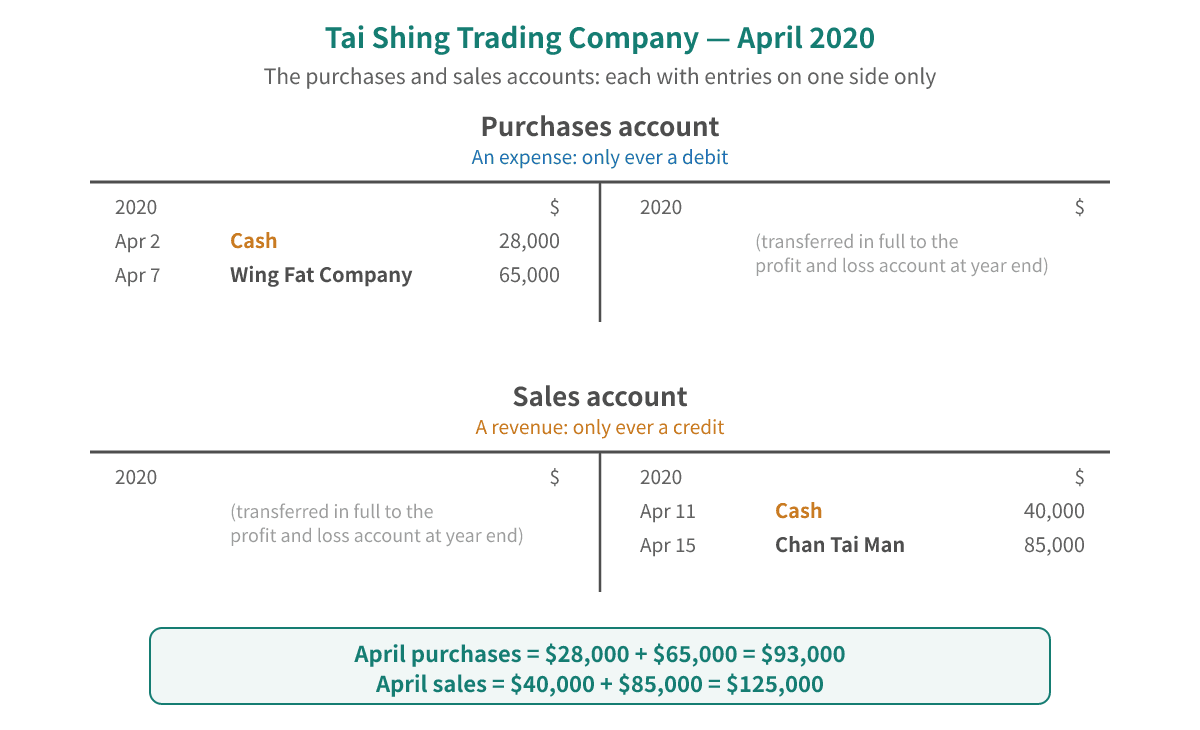
The two accounts in the figure look unusually bare, because each of them has entries on one side only. The purchases account has two debits adding up to $93,000, and the sales account has two credits adding up to $125,000. The computer and the desk appear nowhere at all — they went to the equipment account and the furniture account instead. Notice too that every line names the account on the other side of the entry, so you can see at a glance whether an amount came from a cash transaction or a credit one.
Why these two accounts matter so much
At the year end, purchases and sales are not balanced off the way a personal account is. Each is transferred in full to the profit and loss account. Sales goes at the very top of the income statement, as its first line, and purchases is the main component of cost of goods sold. Sales less cost of goods sold gives gross profit, and gross profit less expenses gives net profit. So getting that $28,000 wrong on Apr 2 costs more than the marks for the entry: gross profit, net profit and the statement of financial position all go wrong with it.
Why one wrong entry runs all the way through: 1. Sales − cost of goods sold = gross profit. 2. Cost of goods sold is built mainly out of purchases. 3. So treating an asset as a purchase overstates cost of goods sold and understates gross profit, while treating an asset sale as a sale overstates revenue and overstates gross profit. Either way the error runs to the bottom of the statement.
The exam rarely asks for the definition. It buries two or three traps in a list of transactions and watches whether you pick them out. Build the habit while you practise. When you see "bought", ask first whether this company makes its living selling that item: if it does, record purchases; if it does not, record the asset or the expense instead. When you see "sold", ask the same question: if it does, record sales; if it does not, leave the sales account alone. One smaller trap as well: carriage and transportation insurance on goods bought do not go straight into purchases. They have accounts of their own, which the article on cost of goods sold will come to.
With purchases and sales settled, the next article takes their other half: goods sold that the customer sends back, and goods bought that turn out to be wrong and go back to the supplier. These are returns outwards and returns inwards. Neither is simply deducted inside the purchases or sales account — each gets an account of its own. Why it is done that way, and how it pulls on receivables and payables, is the next article. Keep an eye on our blog!
Is BAFS easy or hard? The cliché answer: easy to learn, hard to master. In the PY100 BAFS Accounting series, a tutor with extensive BAFS teaching experience explains the accounting knowledge you should know but don't — and the things you think you know but actually don't. The series will run to 100 articles covering S.4 to S.6 BAFS accounting, so students can preview or revise whenever they need.
PY Education also offers BAFS tutoring courses, where our experienced tutor teaches you BAFS knowledge and exam techniques in one go — common public-exam question types and traps, our signature handwritten BAFS notes, plus plenty of past papers to drill until you're exam-ready. BAFS? Not that hard, really.
Learn more: DSE BAFS tutoring
To republish this article, please email [email protected].