
The last article drew the line between purchases and sales, and left Tai Shing Trading Company with $93,000 of purchases and $125,000 of sales for April. Business is rarely that tidy. Goods arrive damaged, the wrong thing gets ordered, the wrong model gets delivered. This article is about returns: goods we send back to a supplier, and goods a customer sends back to us. How each is recorded, and how each moves trade receivables and trade payables.
Two kinds of return, in opposite directions
Which return you are looking at depends on where you are standing. We bought goods from a supplier and send them back — the goods travel outwards from our shop, so these are returns outwards. The other way round, we sold goods to a customer and the customer sends them back — the goods travel inwards to our shop, so these are returns inwards. The names describe nothing but the direction of travel: outwards is us sending goods back to someone else, inwards is someone else sending goods back to us.
1. Returns outwards: goods we bought and have sent back to the supplier. 2. Returns inwards: goods we sold that the customer has sent back to us. 3. Goods bought for cash and goods bought on credit can both be returned, and so can goods sold either way. 4. Each has an account of its own, and neither is deducted inside the purchases or sales account.
Why not just deduct them inside purchases and sales?
The first instinct is usually this: the goods went back, so why not simply credit the purchases account? The final figure would indeed be the same, but accounting does not do it that way, because doing so throws away information.
Three reasons for the extra accounts: 1. The original figures survive. The owner wants to know how much was bought and how much was sold over the whole year, so purchases and sales must stay intact. 2. The scale of returns stays visible. Large returns mean a problem with the quality of goods bought or with the ordering process, and burying them inside purchases hides that from everyone. 3. The income statement lists them separately. Sales and returns inwards appear on two lines, and net sales is what is left after the deduction.
The four entries
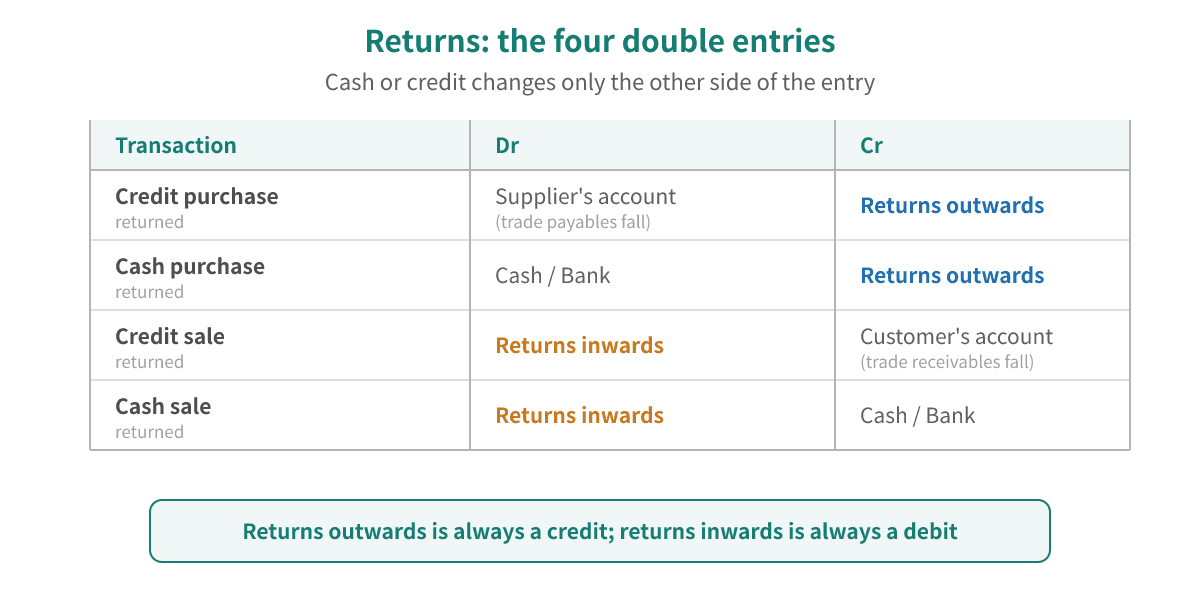
The entries are not hard if you hold on to one idea: a return reverses the original transaction. A credit purchase debits Purchases and credits the supplier, so returning those goods goes the other way — debit the supplier, because we now owe less, and credit Returns outwards, because the purchases account must be left alone. If the goods were bought for cash there is no supplier balance to reduce, because we never owed the supplier anything: they refund the money instead, so debit Cash or Bank and credit Returns outwards exactly as before. Sales work the same way round. Goods sold on credit and sent back debit Returns inwards and credit the customer, because the customer now owes less; goods sold for cash and sent back debit Returns inwards and credit Cash or Bank, because we refund the money.
The four entries: 1. Credit purchase returned — Dr the supplier's account (trade payables fall); Cr Returns outwards. 2. Cash purchase returned — Dr Cash or Bank; Cr Returns outwards. 3. Credit sale returned — Dr Returns inwards; Cr the customer's account (trade receivables fall). 4. Cash sale returned — Dr Returns inwards; Cr Cash or Bank. Remember the sides: returns outwards is always a credit and returns inwards is always a debit, the exact opposite of purchases and sales.
Worked example: Tai Shing Trading Company in April, continued
Take the same April as the last article. On Apr 1, Tai Shing Trading Company still owed Wing Fat Company $60,000, and Chan Tai Man still owed Tai Shing Trading Company $95,000. Six things happened in April involving those two:
- Apr 7, 2020: Bought $65,000 of goods from Wing Fat Company on credit.
- Apr 15, 2020: Sold $85,000 of goods to Chan Tai Man on credit.
- Apr 18, 2020: Returned $9,000 of the goods bought on Apr 7 to Wing Fat Company as damaged.
- Apr 24, 2020: Chan Tai Man returned $5,000 of goods as the wrong model.
- Apr 28, 2020: Paid Wing Fat Company $50,000 by cheque.
- Apr 30, 2020: Received a cheque of $100,000 from Chan Tai Man.
Start with Wing Fat Company. The $9,000 of goods returned on Apr 18 is debited to Wing Fat Company's account and credited to Returns outwards. Debiting Wing Fat Company means we owe them $9,000 less, because we never kept those goods. The $50,000 cheque on Apr 28 is debited to the same account.
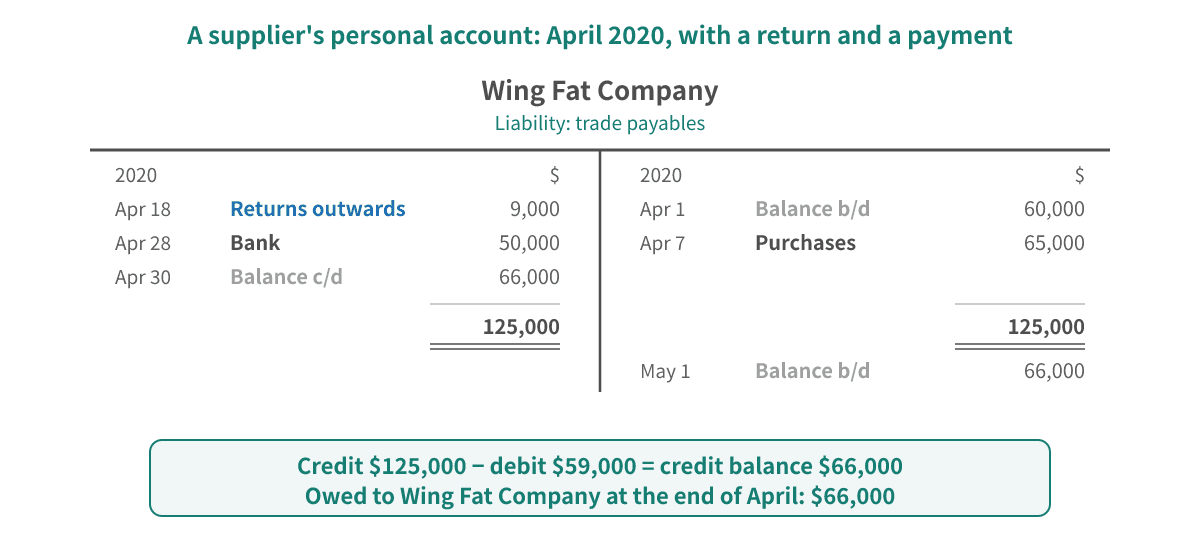
The figure runs the whole closing routine. The credit side comes to $125,000 while the debit side only reaches $59,000, so a balance c/d of $66,000 goes on the debit side — the smaller one — and both sides then total $125,000 and are double-ruled. The $66,000 comes back to the credit side on May 1 as a balance b/d, and that is what Tai Shing Trading Company owes Wing Fat Company at the end of April. Notice that the $9,000 of returns outwards appears in this account once, and the $65,000 in the purchases account has not moved at all. Had that batch been bought for cash on Apr 7, the return would never touch Wing Fat Company's account: it would debit Bank and credit Returns outwards, with the returns outwards side exactly the same.
Chan Tai Man's account works identically, in reverse. The $5,000 of goods he returned on Apr 24 is debited to Returns inwards and credited to his account, so he owes us $5,000 less. His $100,000 cheque on Apr 30 is credited to the same account.
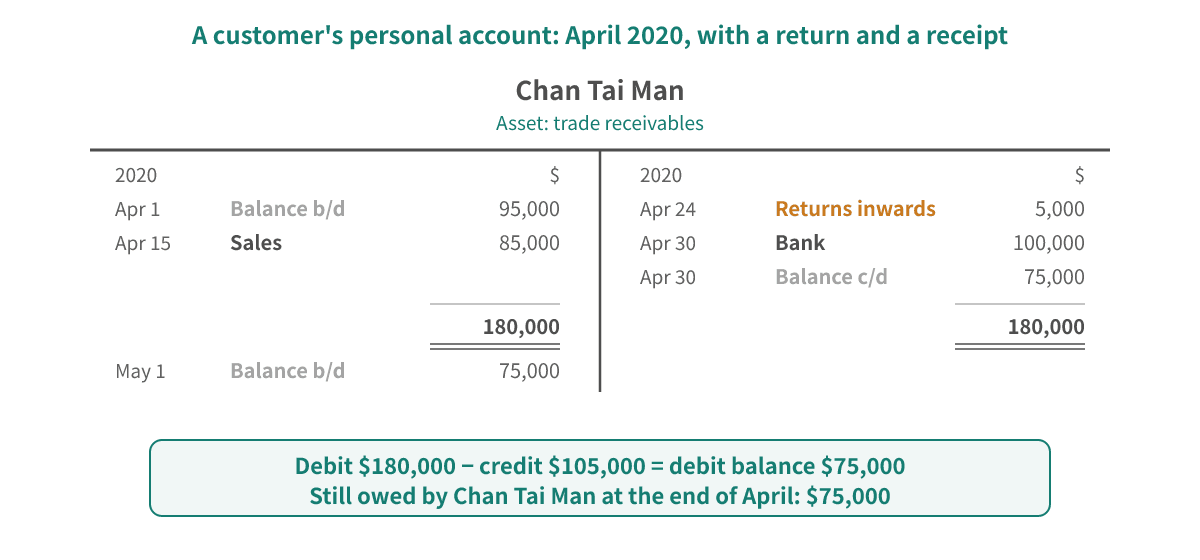
The debit side comes to $180,000 and the credit side to $105,000, so a balance c/d of $75,000 goes on the credit side and both sides total $180,000. The $75,000 returns to the debit side on May 1 as a balance b/d, which is what Chan Tai Man still owes at the end of April. Again, the $85,000 in the sales account has not been touched.
Net purchases and net sales
So where do returns outwards and returns inwards end up? They are transferred to the profit and loss account at the year end, but not as a line standing on their own. Each is deducted from the account it belongs to. Sales less returns inwards gives net sales; purchases less returns outwards gives net purchases, which is what goes into cost of goods sold. Using Tai Shing Trading Company's April figures: sales of $125,000 less returns inwards of $5,000 gives net sales of $120,000, and purchases of $93,000 less returns outwards of $9,000 gives net purchases of $84,000.
1. Net sales = sales − returns inwards. 2. Net purchases = purchases − returns outwards. 3. Cost of goods sold is built from net purchases, not from purchases. Miss that step and the gross profit is wrong.
Three mistakes come up again and again. The first is reversing the direction: seeing the word "return" and debiting Returns outwards. Wrong — returns outwards is something coming back to us, so it is always a credit. The second is taking the short cut of crediting the purchases account directly and skipping the returns account. The arithmetic works, but the income statement then cannot produce the separate lines for returns outwards and returns inwards, and a question asking for them separately earns nothing. The third is confusing a return with a discount. A return means the goods really went back and the quantity fell. A discount means the goods were kept and only the price came down. They are different events, and putting one in the other's account carries the error through the whole set of figures.
Discounts are the natural next step. Beyond returns, the price on a credit transaction is pulled about by two kinds of discount: one for buying in quantity, and one for paying early. The next article takes the first of them — the trade discount — and why it leaves no trace at all in the books while the exam still expects you to calculate it. Keep an eye on our blog!
Is BAFS easy or hard? The cliché answer: easy to learn, hard to master. In the PY100 BAFS Accounting series, a tutor with extensive BAFS teaching experience explains the accounting knowledge you should know but don't — and the things you think you know but actually don't. The series will run to 100 articles covering S.4 to S.6 BAFS accounting, so students can preview or revise whenever they need.
PY Education also offers BAFS tutoring courses, where our experienced tutor teaches you BAFS knowledge and exam techniques in one go — common public-exam question types and traps, our signature handwritten BAFS notes, plus plenty of past papers to drill until you're exam-ready. BAFS? Not that hard, really.
Learn more: DSE BAFS tutoring
To republish this article, please email [email protected].