
The last article ended on a line about the sole proprietorship: because there is only one person it is fast and free, and because there is only one person it is small and exposed. The most direct way to deal with the capital and the risk is to bring in another person. This article is about the partnership — which problems get better once there is a partner, and which new ones appear.
What is a partnership?
A partnership is two or more people putting up capital and running a business together in order to share the profit. They are the partners. Partnerships in Hong Kong are governed by the Partnership Ordinance. As with a sole proprietorship, you apply to the Business Registration Office of the Inland Revenue Department for a Business Registration Certificate within one month of starting business. There is no company incorporation and no requirement to publish accounts.
Partnership: a business in which two or more people put up capital and run it together in order to earn a profit. 1. The partners share the profit and bear the losses between them. 2. A general partnership is not a separate legal entity: in law the partners and the business are not separate. 3. Every partner bears unlimited liability.
So on paperwork alone, a partnership is about as easy to start as a sole proprietorship — quick, cheap and free of outside control. That convenience has a price, and the price is below.
Unlimited liability, and joint and several as well
A partnership, like a sole proprietorship, is not a legal entity, so debts the business cannot repay are pursued against the partners' personal property with no upper limit. A partnership adds one more layer: the liability is joint and several. That means a creditor does not have to chase each partner for a share. The creditor can pick whichever partner has the money and claim the entire debt from that one person. The partner who pays then has to recover the others' shares from them — and if the others really have nothing, that partner carries the lot.
Joint and several liability: every partner is liable for the whole of the partnership's debts. 1. A creditor may claim the entire amount owing from any one partner. 2. The partner who pays must then recover the others' shares from them afterwards. 3. So choosing a partner means taking on their business judgement and their creditworthiness as well.
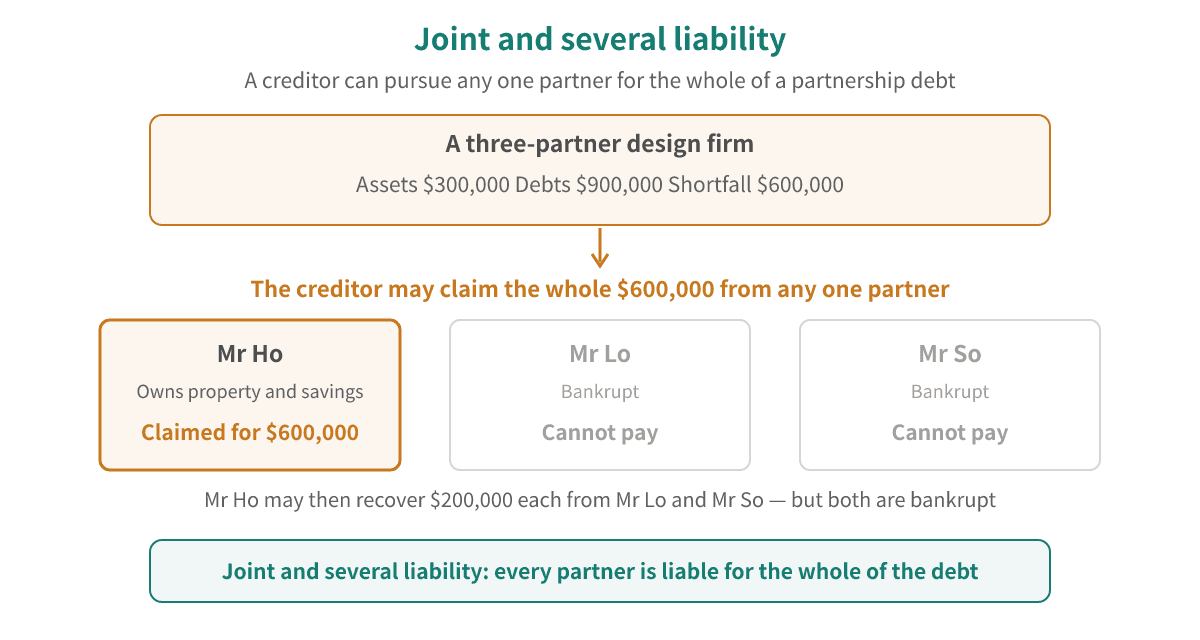
The figure works through an example. Mr Ho, Mr Lo and Mr So run a design firm as partners, sharing profits and losses in equal thirds. The business fails owing $900,000, and selling everything it owns raises only $300,000, leaving $600,000 unpaid. Of the three, only Mr Ho has property and savings. The creditor does not have to split the claim three ways: it can go straight to Mr Ho for the full $600,000. Once he has paid, Mr Ho can in theory recover $200,000 each from Mr Lo and Mr So — but both are bankrupt, so the $600,000 ends up being carried by him alone. That is the biggest risk in a partnership: your loss is not caused only by your own decisions.
What about a limited partnership?
Hong Kong also has the limited partnership, governed by the Limited Partnerships Ordinance and registered with the Companies Registry. It has two kinds of partner: general partners and limited partners. A limited partner's liability is capped at the amount of capital they contributed, so however badly things go they cannot lose more than that. In exchange, a limited partner may not take part in managing the business, and taking part turns their liability back into an unlimited one. In any case there must be at least one general partner, and that partner still bears unlimited liability.
Limited partnership: a partnership registered with the Companies Registry that has at least one general partner and at least one limited partner. 1. The general partner manages the business and bears unlimited liability. 2. The limited partner only contributes capital, is liable only up to that contribution, and may not take part in management.
The advantages
- More sources of capital: several people contribute, so the starting capital is far larger than a sole proprietor's and expansion is much easier.
- Division of work: one partner on the books, one on sales, one on production, instead of one person doing everything.
- Risk is shared: a loss is not carried by one person alone.
- Decisions get discussed: more people thinking means fewer things missed.
- Still simple to set up: one business registration certificate, no incorporation, and no accounts to publish.
- Easier to borrow than a sole proprietorship: the bank looks at the combined creditworthiness and assets of all the partners.
The drawbacks
- Unlimited liability, and joint and several at that: a debt one partner runs up can be paid in full by another.
- Mutual agency: a contract signed by any partner within the ordinary course of business binds every partner.
- The profit is shared: what the business earns no longer belongs to one person.
- Slower decisions and more scope for disputes: disagreements have to be talked through, and a deadlock holds up the whole business.
- Short life: when a partner dies, withdraws or goes bankrupt, the partnership is dissolved at once.
- Capital is still limited: only so many people can be brought in, and raising money on any scale means becoming a limited company.
Mutual agency: within the ordinary course of business, every partner is an agent of the whole partnership. 1. A contract one partner signs binds all of them. 2. So when one partner makes a bad decision, the other partners bear the consequences too.
How does the exam ask it? As in the last article, forms of ownership is comparison territory — "Explain two advantages of a partnership over a sole proprietorship", or a scenario in which a sole proprietor plans to take on a partner and you must explain what the change would bring. Every point has to be written as a comparison to earn its mark. Do not write "more sources of capital"; write "a partnership is financed by two or more partners, so it has more capital than one sole proprietor's savings". Do not write "it is risky"; write "partners bear unlimited liability which is joint and several, so if one partner cannot pay, the others must make up the shortfall". Then tie each point back to the scale, the capital and the risk in the scenario.
A partnership solves the sole proprietorship's problems of capital and workload, but the biggest risk of all — unlimited liability — is not solved. Being joint and several, it is harder to pin down than before. Genuinely cutting the line between the business and its owners means finding a separate "person" in law to carry the debts. The next article is about limited companies: why a company can owe money in its own right, and why its shareholders can only ever lose so much. Keep an eye on our blog!
Learn more: DSE BAFS tutoring
To republish this article, please email [email protected].