
The last article ended on an unsolved problem. A partnership deals with capital and with workload, but unlimited liability is still there, and it is joint and several: one partner's mistake can be paid for in full by another. The only way to genuinely cut the line between a business and its owners is to find a separate "person" in law to carry the debts. That person is the limited company.
A limited company is a separate legal entity
Article three defined a legal entity while covering the sole proprietorship: an organisation the law treats as a person in its own right, able to own assets, sign contracts, borrow, sue and be sued in its own name. A limited company is the classic example. Becoming one is not simply a matter of opening for business. You apply to the Companies Registry, meet the requirements of the Companies Ordinance, and receive a Certificate of Incorporation. From that moment there is one more "person" in law. After that, like a sole proprietorship or a partnership, the company still applies for a Business Registration Certificate.
Limited company: a business incorporated with the Companies Registry and separate in law from its shareholders. 1. The company owns its own assets, owes its own debts and signs its own contracts. 2. The company continues to exist however many shareholders come and go. 3. A shareholder's liability is limited to the amount of the shares they took up.
Legal personality brings three very practical consequences. First, the company's assets and the shareholders' assets are entirely separate: the company's van is not a shareholder's van. Second, the company does not end when a shareholder dies, withdraws or goes bankrupt. That is perpetual succession, and neither a sole proprietorship nor a partnership has it. Third, a shareholder can sell their shares to someone else and the business carries on, with nobody having to start a new one.
Limited liability: how much can a shareholder lose?
Limited liability follows directly from legal personality. If the company is a person in its own right, the company's debts are the company's own and not the shareholders'. So when a company loses so much that it cannot pay, the creditors can only pursue the company. If they cannot recover from it, they bear the loss themselves. The most a shareholder can lose is the money they put into their shares.
Limited liability: a shareholder's liability for the company's debts is limited to the amount of the shares they took up. 1. Debts the company cannot repay are not pursued against a shareholder's personal property. 2. The worst case for a shareholder is that the shares become worthless and the money invested is lost. 3. This is the biggest single difference between a limited company and a sole proprietorship or partnership.
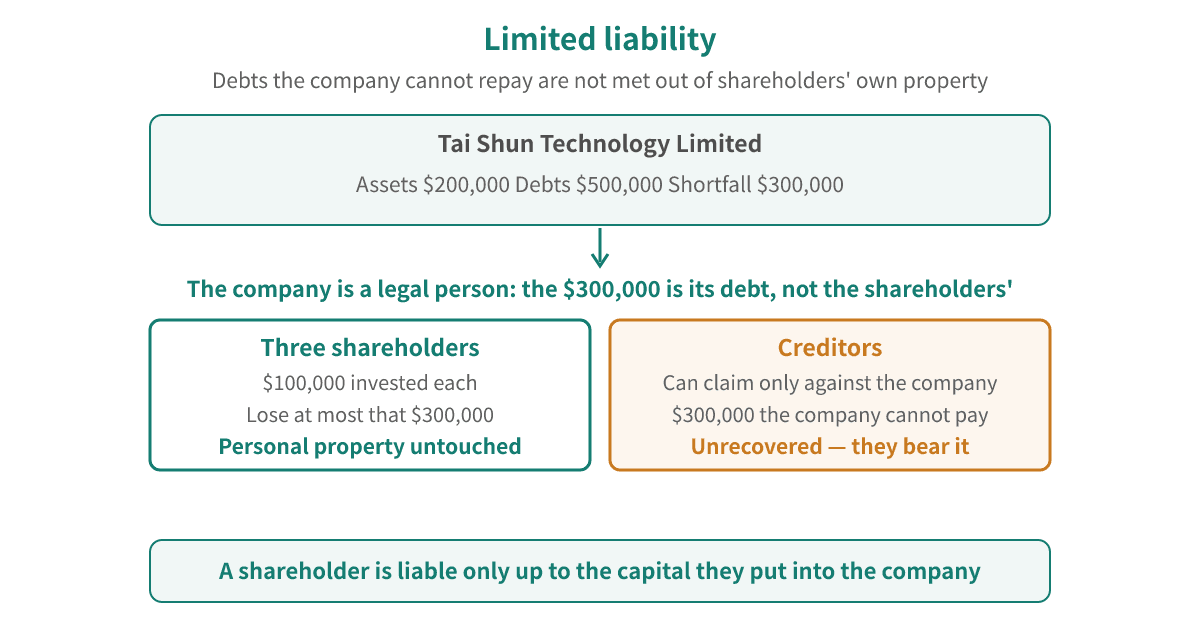
The figure deliberately uses the same numbers as Mr Chan's cha chaan teng in article three, so the two can be set side by side. Tai Shun Technology Limited has $200,000 of assets against $500,000 of debts, a $300,000 shortfall exactly as before. The difference is what happens next. Mr Chan has to meet the shortfall out of the flat he lives in and his car. The three shareholders of Tai Shun Technology do nothing at all: the $100,000 each of them invested is gone, and that is where it stops. The $300,000 falls on the creditors. So limited liability does not make the risk disappear. It moves the risk from the shareholders to the creditors. Once you see that, it becomes obvious why a bank lending to a small company so often wants the owner's personal guarantee as well.
Private companies and public companies
Limited companies come in two kinds, and the difference is whether the shares can be sold to the public. Start with the private limited company, which is what the great majority of Hong Kong companies are:
- The articles restrict the transfer of shares, so a shareholder cannot simply sell up.
- Members are limited to 50, not counting employees.
- It cannot invite the public to subscribe for shares, and it cannot list.
- At least one shareholder and at least one director, and at least one director must be a natural person.
- Fewer disclosure requirements, so competitors cannot see the accounts.
The other kind is the public limited company. The name is easy to read as meaning "listed company", but the two are not the same: a company traded on the exchange is always a public limited company, while a public limited company need not be listed at all. Its features are:
- Shares transfer freely.
- There is no limit on the number of members.
- It may invite the public to subscribe for shares, and may apply to list on the exchange.
- Audited financial statements are filed with the Companies Registry and can be read by anyone.
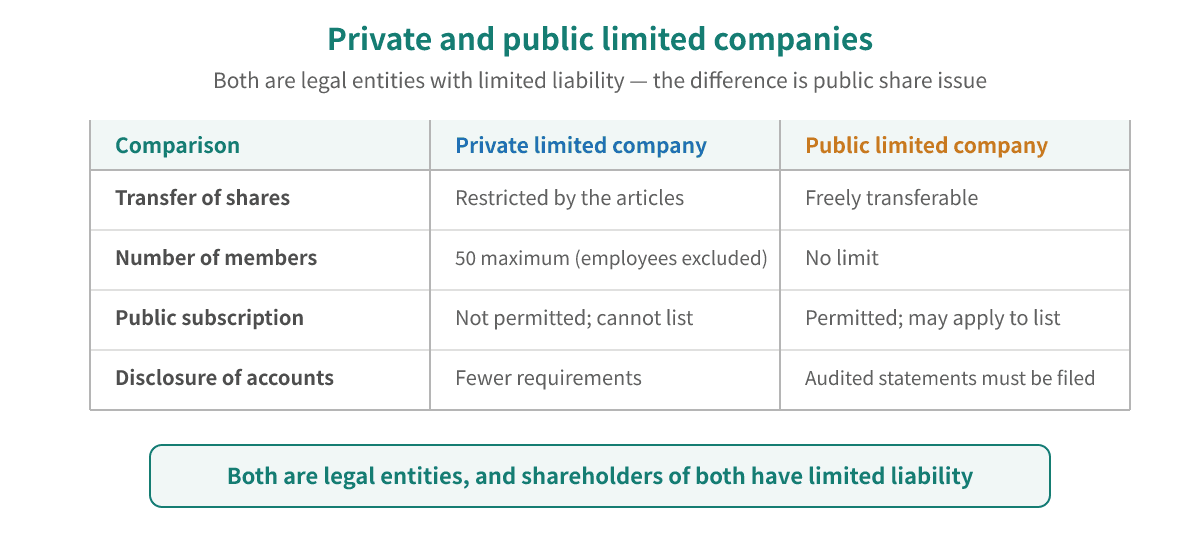
1. Private limited company: the articles restrict share transfers, members are limited to 50, and it cannot invite the public to subscribe. 2. Public limited company: shares transfer freely, there is no limit on members, and it may invite the public to subscribe and may list. 3. Both are legal entities and both give shareholders limited liability. The difference is in raising capital and in disclosure.
The advantages
- Limited liability: a shareholder loses at most what they invested, and personal property is safe.
- Strong ability to raise capital: shares and debentures can be issued, and banks lend more readily.
- Perpetual succession: shareholders leave or die and the company carries on.
- Shares change hands easily: a shareholder who wants out sells the shares instead of winding the business up.
- Professional management: the company can afford specialist directors and managers rather than one owner doing everything.
- Scale: buying and producing in volume costs less per unit, so economies of scale are within reach.
The drawbacks
- Complicated and expensive to set up: incorporation, articles of association, and professional help to prepare them.
- Governed by the Companies Ordinance: an annual general meeting, an annual return, and audited accounts.
- Less privacy: a public company's financial statements are open to anyone, competitors included.
- Slower decisions: more layers, and important matters need a board meeting or even a general meeting.
- Ownership is separated from management: shareholders do not run the business, and managers may not always put shareholders' interests first.
- A public company's shares trade openly, so it can be taken over.
Separation of ownership and management: the shareholders own the company, but directors and managers make the day-to-day decisions. 1. The advantage is that professionals can be brought in to run the business. 2. The drawback is that managers' objectives may not match the shareholders', which is what the board and the disclosure rules exist to control.
How does the exam ask it? The commonest form is a conversion scenario: a sole proprietor or a partner plans to turn the business into a private limited company, and you have to explain what the change would bring. Two things to remember when you answer. First, every point has to be written as a comparison. Do not write "it can raise capital"; write "a limited company can raise capital by issuing shares, far more than a sole proprietor can raise from personal savings and borrowing". Second, the point that earns most is always liability: "after the change the shareholders are liable only up to the capital they put in and their personal property cannot be claimed against, whereas before the change the owner bore unlimited liability". Then tie the answer back to the scenario — how far the business wants to expand, and how much risk it can carry.
With sole proprietorships, partnerships and limited companies all covered, the framework for comparing forms of ownership is complete. But choosing a form only answers how a business exists. A second question is how it ought to behave — what a company should and should not do to its staff, its customers and the society around it while it earns its money. The next article is about business ethics: why a company that breaks no law can still make decisions everyone condemns. Keep an eye on our blog!
Learn more: DSE BAFS tutoring
To republish this article, please email [email protected].