
The last article ended on a question: does everything have to be traded off? Almost everything, but not quite everything. Economics sorts all goods into two classes, and the line between them is scarcity: free goods on one side, economic goods on the other. This article draws that line, and explains why "free" in economics is not the "free" you use every day.
Go back to scarcity, from article one. Scarcity does not mean there is a small amount of something. It means there is not enough of it for what people want. So deciding which class a thing belongs to is not a matter of how many tonnes of it exist. It is one question: at a price of zero, is the quantity supplied enough for the quantity people want? If it is, the thing is a free good. If it is not, it is an economic good.
Free good: a good of which the quantity supplied already exceeds the quantity demanded at a price of zero. 1. It is not scarce, so anyone can have as much as they want. 2. Taking more of it leaves nobody with less, so it carries no opportunity cost. 3. Nothing has to be rationed, so it has no price and nothing to allocate.
Economic good: a good of which the quantity demanded exceeds the quantity supplied at a price of zero. 1. It is scarce, so someone has to be chosen to get it. 2. Taking one more leaves someone else with one fewer, so it carries an opportunity cost. 3. Because it must be allocated it has a price, and in a market the price decides who gets it.
The line is most often drawn wrongly in one place: treating "it costs me nothing" as "free good". Free Wi-Fi, the tissues on a café table, the gift handed out at the start of term — you paid nothing for any of them, and every one of them is an economic good. Somebody else paid. The connection, the tissues and the gift all had to be produced out of resources, and resources spent on them cannot be spent on anything else. Paying nothing does not mean there was no cost. It means the person paying was not you.
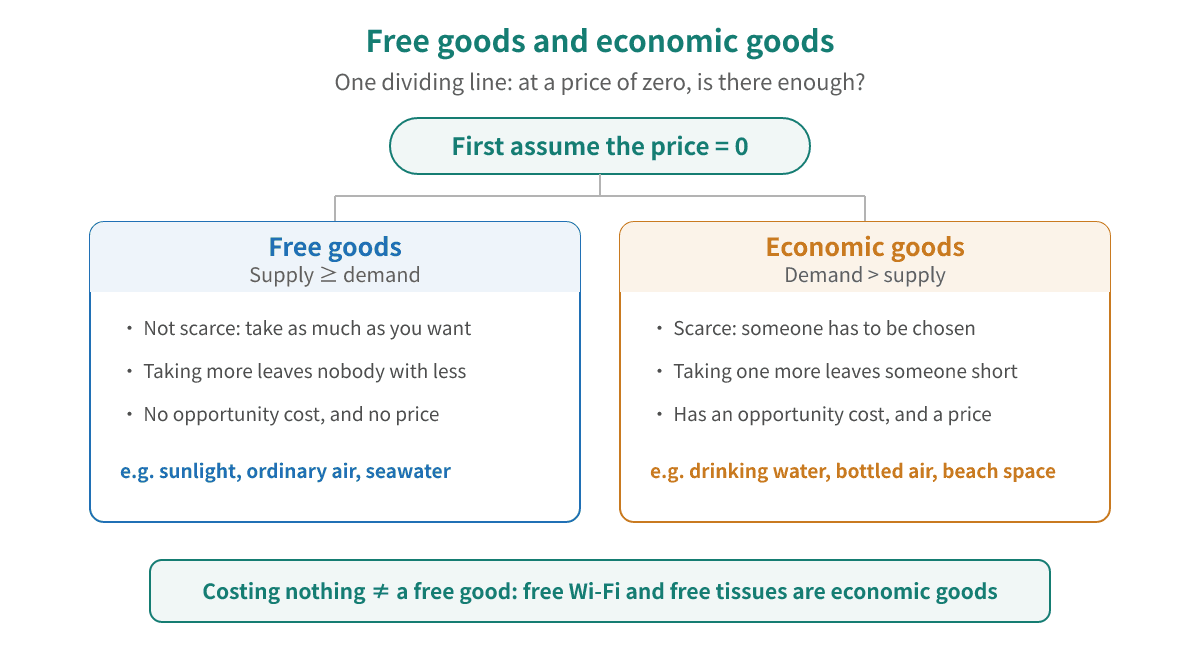
The figure puts the test and both sets of features side by side. The first step is the one that matters: the comparison must be made at a price of zero. Raise the price of any economic good high enough and nobody will want it, which looks like supply exceeding demand — but the good is still scarce and still has to be allocated. Only at a zero price does the test tell you anything.
Air is the standard example. The air you are breathing now is a free good: there is as much as anyone wants, and two extra breaths leave the student next to you with nothing less. Add one condition and it becomes an economic good — the bottled air a diver carries, the oxygen in a hospital, the cooled air out of an air conditioner in summer. Each has to be produced out of resources, and each has a price. So the two classes are not labels stuck on objects. They depend on time, place and circumstance: the same thing beside a reservoir and in the middle of a desert can give two different answers.
Classifying a good in three steps: 1. Assume the price is zero. 2. Ask whether, in this place and at this time, the quantity supplied is enough for everything people want. 3. Enough means a free good, with no opportunity cost. Not enough means an economic good, which carries an opportunity cost and has to be allocated by price or by some other rule.
Exam questions usually give a list and ask which items are free goods and which are economic goods. Do not write the class on its own; write the reason with it — "at a price of zero the supply of seawater still exceeds the demand for it, so seawater is a free good". One more place marks get dropped: genuine free goods are rare. Sunlight is usually safe. A beach is not: in summer a beach is packed, the space ran out long ago, and it is an economic good.
With the two classes apart, what is left to deal with is the pile of economic goods — the ones that do have to be chosen between. An economy has only so many resources, so it has to answer three questions at once: what to produce, how to produce it, and who gets what is produced. The next article is about those three basic economic questions, and why no economy, whatever system it runs on, can avoid them.
Learn more: DSE Economics tutoring
To republish this article, please email [email protected].