

For compound inequalities, “and” keeps the overlap, while “or” keeps values satisfying either condition. This distinction also helps us write solutions to quadratic inequalities. Finding two roots is only the start. We must find where the quadratic expression is positive, negative or zero, then select the ranges the question requires.
A quadratic inequality has one unknown with highest power two after collecting all terms on one side and leaving zero on the other. Its standard form is , or the same form with , where . Its solution set contains every real value that makes the original inequality true. A boundary value makes the collected quadratic expression equal to zero.
Example 1: why choose between the roots?
Solve . First collect all terms on one side. A sign test compares an expression with zero, so we cannot use it directly while the other side still contains a nonzero constant.
- Add 4 to both sides: . Adding the same number leaves the direction unchanged.
- Use factorisation: . The two constants have product 4 and sum negative five.
- Solve the boundary equation . This gives or . Mark these values in order on a number line to form three intervals.
- For , both factors are negative, so their product is positive. For , one is positive and one negative, so the product is negative. For , both are positive, so the product is positive.
- We need a negative product or zero. Take the middle interval and include both boundaries, where the product is zero. The answer is . Both conditions must hold.
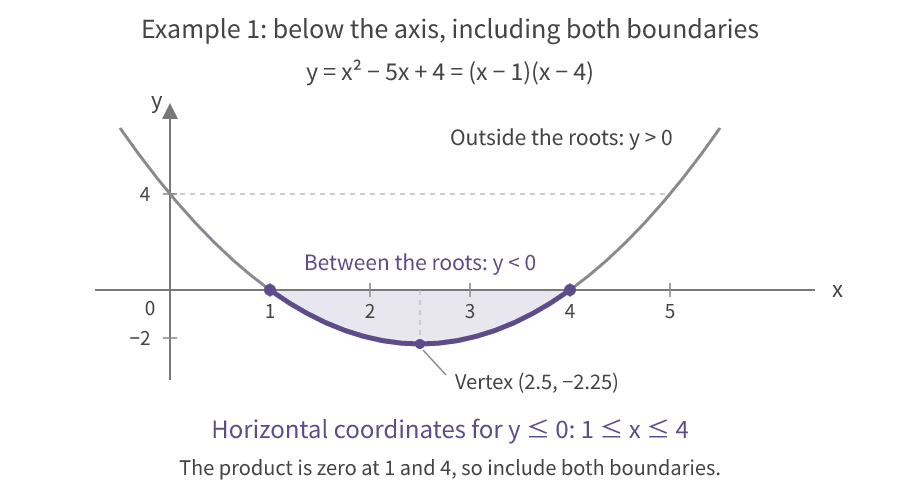
Diagram: the parabola explains the choice in step five. Below the horizontal axis, ; on the axis, . The horizontal coordinates of the purple section, including its two intercepts, form the solution set. Write a range of horizontal coordinates, not a range of heights.
Sign rule for two distinct real roots: for with and , the product is positive outside the roots, negative between them and zero at either root. When , the positive and negative regions swap. Include the boundaries only when the inequality allows equality.
Build a sign table instead of guessing
A sign table lists the boundary values in order and records the sign of each factor and their product in every interval. A linear factor changes sign at its own root. Within an interval containing no further roots, the product cannot change sign.
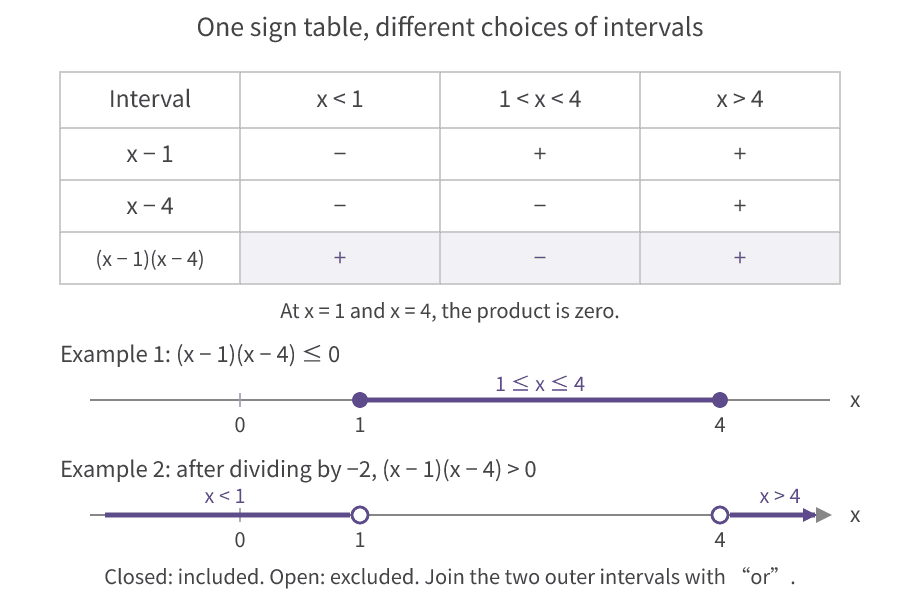
Diagram: the product row explains step four of Example 1. The first number line shows the answer in step five. You can test one value from each interval, such as 0, 2 and 5, to check the signs. Find all boundaries first; a few random tests cannot establish the complete solution. Substituting into the original inequality gives , which agrees with the middle interval.
Do not divide both sides of directly by . That factor may be positive, negative or zero. A negative divisor would reverse the sign, and division by zero is undefined. Looking at both factors in each interval avoids losing solutions.
Example 2: a negative leading coefficient
Solve . Divide by a known negative number first to make the leading coefficient positive. Then we can use the same sign table.
- Divide both sides by negative two and reverse the sign: . The original inequality excludes equality, so keep excluding it.
- Factorise to get . The boundaries remain 1 and 4, with the product signs shown in the table.
- Select the two outer intervals, where the product is positive. The answer is . Either condition is enough. Both boundaries are excluded, so the second number line uses open circles.
Check in the original inequality: gives , which is true. The middle value gives , which is false. Each boundary gives , so both must be excluded. Use “or” here. A chain demanding a value below 1 and above 4 at the same time would have no solutions.
What if roots repeat, or there are no real roots?
A repeated root occurs when the two roots of a quadratic equation are equal, as in . There is only one distinct boundary value. The square is positive on both sides of that root, so its sign does not change as we cross it.
A square is always nonnegative. Thus has the single solution , while has no solution. Allowing equality changes the answer. Do not force a three-interval table onto a case with just one distinct root.
No real roots in the boundary equation does not mean no solution to the inequality. For example, . Therefore holds for every real number, while has no solution. Decide whether the expression stays positive or stays negative over the real numbers.
Try one and check the endpoints
Solve . Factorise to get , with boundaries . The answer is . Also check equality and any restrictions. If Example 1 asked only for integer solutions, we would list 1, 2, 3 and 4. Without that restriction, retain the full real interval.
We can now use a curve's height to judge signs and read off the matching horizontal coordinates. Next, we will introduce functions and their notation: how an input determines an output. This will prepare us to study quadratic function graphs in more detail.
Learn more: DSE Mathematics tutoring
To republish this article, please email [email protected].