

Building on quadratic inequalities, consider a new question: as changes, how does the value of change? Solving an inequality means finding inputs that meet a condition. We will now study the rule that turns an input into an output, then connect that rule to a graph.
What makes a rule a function?
A function is a rule that assigns exactly one output to every allowed input. Different inputs may share an output. A single input must never have two different outputs.
We can name a rule . The notation , read as “f of x”, means the function value: the output when the input is . It does not mean . For example, the rule below says to square the input, then subtract 1.
The domain is the set of all allowed inputs. The range is the set of outputs actually obtained from those inputs. List a repeated output only once in the range.
First restrict the domain to . Calculate an output for each input to produce the mapping diagram below. Five inputs need not give five different outputs. We must calculate the results before listing the range.
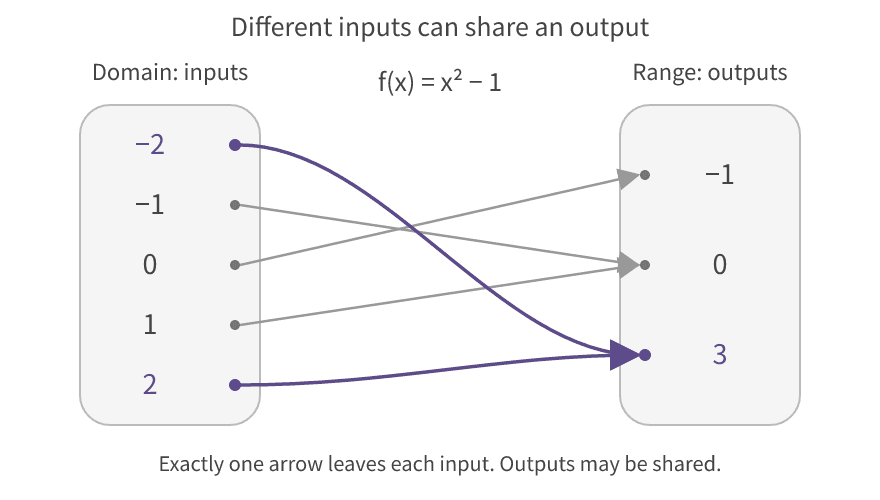
The diagram shows and 2 both leading to 3. The range is . Two arrows arriving at the same output are allowed. Check the arrows leaving each input: a rule fails to be a function if one input leads to two different outputs.
Worked example: substitute a negative input
Now allow any real input and keep the rule . Find , then find all real values of for which . The first task gives an input and asks for its output. The second gives an output and asks which inputs produce it.
- Replace with the whole input in brackets: .
- Square first: . Compare this with , where the minus sign is outside the square. The brackets matter.
- Subtract 1 to get the answer: . The input is negative two; the output is 3.
For , do not put 3 into the brackets. It is the required output. We need every input whose square, minus 1, equals 3. Replace the function notation with the rule and solve the resulting equation.
- The rule gives , so the equation is .
- Add 1 to both sides: . Remember that both a positive and a negative number can have this square.
- Since , all the answers are or .
Check both: and . Giving only positive two would miss a solution. By contrast, answers a different question: what is the output for input 3?
Read inputs and outputs from a graph
The graph of a function consists of all points . The horizontal coordinate is the input; the vertical coordinate is the output. Every vertical line meets a function graph at most once. For an input in the domain, it meets the graph exactly once.
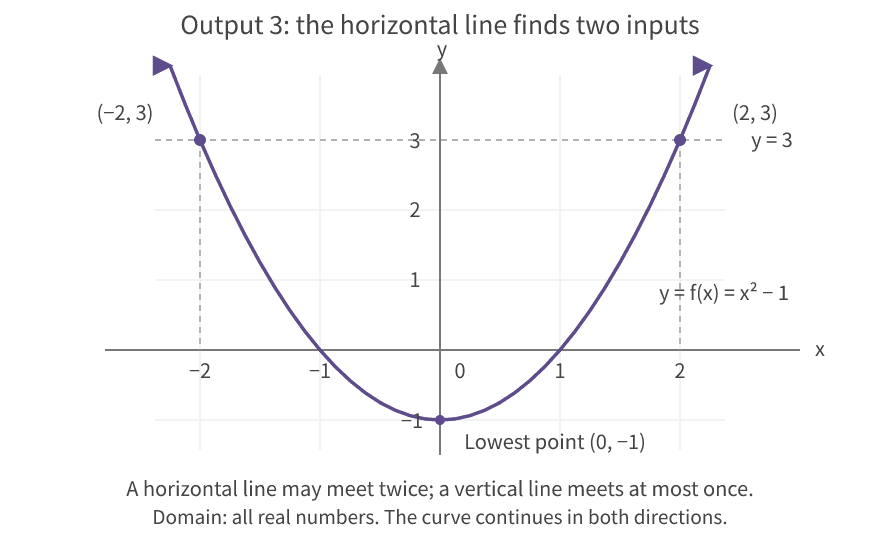
The two intersections with show the two inputs found in the example. Here the domain is all real numbers, and the curve continues in both directions. Since , we have . Every value at least negative one can be reached, so the range is . It is no longer just the three outputs in the mapping diagram.
This also connects to inequalities. Asking for means finding the inputs where the graph is above the horizontal axis. Solving gives or . The algebra and the graph describe the same condition.
Check whether the input is allowed
Domain restrictions: follow any domain stated in the question. With real numbers and no further restrictions, a denominator cannot be zero, and the expression inside a square root cannot be negative. Check the input before evaluating the function.
For example, requires . Thus is undefined; it is not zero. For , we need , giving . Changing the domain of a formula can also change its range.
- An input can be an expression. For example, . Square the whole input.
- Multiplying outside the function doubles the output: . This is different from doubling the input.
- Before calculating, ask whether you have been given an input or asked to find inputs for a particular output. Then check the domain.
You can now read function notation, evaluate a function and find inputs from a graph. Next time, we will study quadratic functions and their vertices. Completing the square will locate the lowest or highest point accurately from the formula.
Learn more: DSE Mathematics tutoring
To republish this article, please email [email protected].