
The last article split the cost of a decision into two parts: the explicit cost you actually pay out, and the implicit cost of using resources you already own. This article settles the question it left open. Why does the same snack shop earn $340,000 in an accountant's eyes and only $48,000 in an economist's? Neither of them has made a mistake. They are simply measuring with two different rulers: accounting cost and economic cost.
Accounting cost looks at the books. An accountant works to a strict rule: an amount can only be recorded if there is documentation behind it — an invoice, a receipt, a contract, a bank record. Anything without a document cannot be entered, so accounting cost counts only money actually paid out. That is exactly the explicit cost from the last article. An economist asks a different question: what did you give up in total to open this shop? Because the question is about what was given up, the answer includes more than the money paid out. It also includes what your own resources could have earned.
1. Accounting cost: the money actually paid out in a decision, documented and recorded in the books. It is the explicit cost. 2. Economic cost: the whole value given up by a decision, which is the explicit cost plus the implicit cost. 3. Economic cost is always greater than or equal to accounting cost, and the gap between them is the implicit cost.
Two rulers for cost means two figures for profit. Revenue less accounting cost is accounting profit — the last line of the income statement. Revenue less economic cost is economic profit, and that is what economics means when it says "profit".
1. Accounting profit = revenue − accounting cost. 2. Economic profit = revenue − economic cost = accounting profit − implicit cost. 3. The gap between the two profits is always the implicit cost.
Back to May's snack shop. Revenue for the year is $1,000,000. What she actually paid out is rent of $180,000, stock of $300,000, wages of $150,000, and utilities and sundries of $30,000, which comes to $660,000. Every dollar of that $660,000 has a document behind it, so it is the accounting cost. $1,000,000 less $660,000 leaves an accounting profit of $340,000, and that is the figure on the statement her accountant hands her.
An economist asks one more question: what else did you give up to mind this shop? She resigned from a job paying $280,000 a year, and she took $400,000 of savings out of a deposit to buy stock and fit out the shop, giving up $12,000 of interest for the year. Together that is $292,000. $660,000 plus $292,000 gives an economic cost of $952,000. $1,000,000 less $952,000 leaves an economic profit of only $48,000.
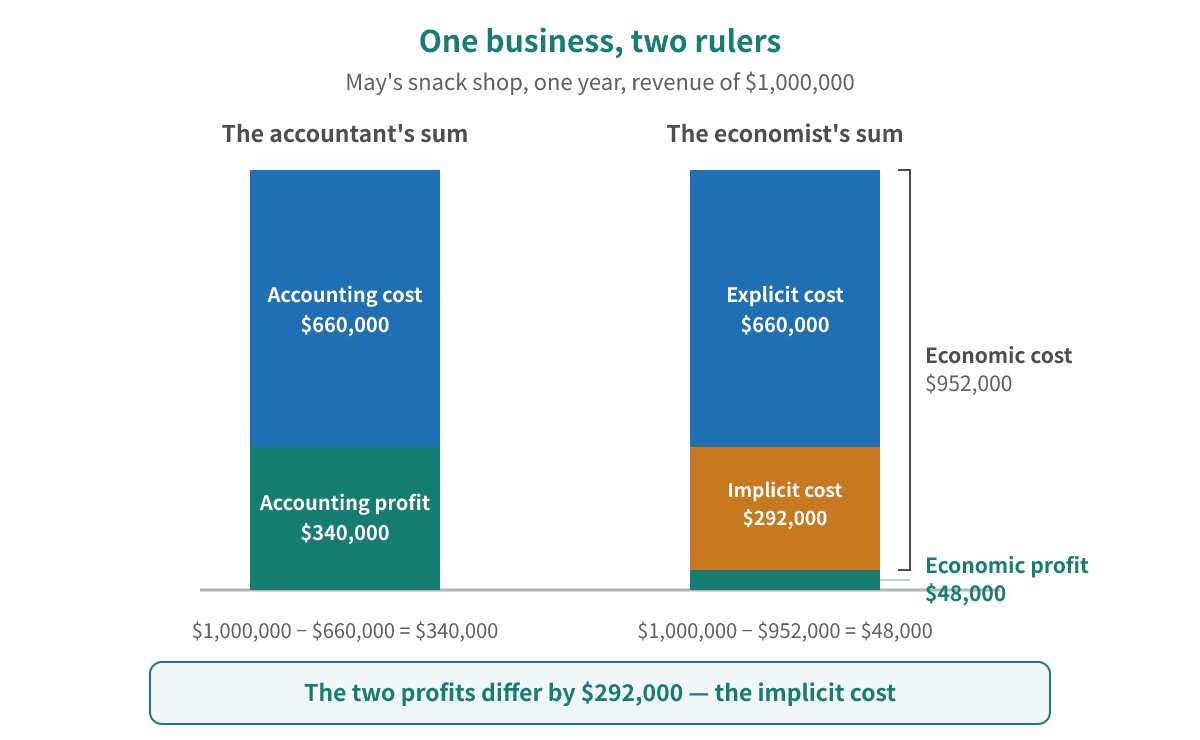
The figure puts the two rulers side by side. Same $1,000,000 of revenue, same shop, same year. The only difference is that the accountant's ruler is $292,000 shorter. Both figures are correct, because they answer different questions. Accounting profit answers "is this business making money?" Economic profit answers "is this business worth doing?"
Economic profit has one more very useful reading: it measures how much better off you are than the next best option. May's economic profit of $48,000 means that running the shop leaves her $48,000 better off than staying in her job. It does not mean she cleared $48,000 for the year. So an economic profit of exactly zero does not mean she worked for nothing. It means the shop is exactly as good as the job — what she earns in the shop is just enough to cover what she gave up. Economics calls that earning normal profit.
Reading an economic profit: 1. Greater than zero — this decision beats the next best option and is worth continuing. 2. Equal to zero — as good as the next best option, which means normal profit is being earned. 3. Less than zero — the next best option beats the current one, so switch.
So which one does the exam want? Unless the question says the word "accounting", cost and profit in economics always mean economic cost and economic profit. Two traps catch students constantly. The first is seeing the word "cost" and adding up the explicit costs only. Leave out the implicit cost and the answer has quietly become the accounting cost, and the rest of the question goes wrong with it. The second is seeing an accounting profit and writing "it is making money, so carry on". An accounting profit of $340,000 looks handsome, but if the implicit cost is $400,000, the economic profit is negative $60,000 and the right answer is to stop.
That completes the set of cost concepts: opportunity cost, sunk cost, explicit and implicit cost, accounting and economic cost. All five articles have circled the same fact — choose one thing and you have to give up another. The next article takes that fact head on and looks at choice and trade-off: why scarcity always forces a choice, and where a trade-off differs from an opportunity cost.
Learn more: DSE Economics tutoring
To republish this article, please email [email protected].