
The first seven articles have all been about measuring cost. Now turn the question around and ask something more basic: why does anyone have to measure a cost at all? Because they have to choose. This article is about the two things underneath the whole subject — choice and trade-off.
Go back to article one. Scarcity means resources are limited while human wants are unlimited, so resources can never satisfy every want. Since they cannot, you cannot have everything, and you have to decide where the resources go. That decision is choice. So in economics a choice is not a matter of preference. It is what scarcity forces on you. Remove scarcity and choice disappears with it: if resources were so plentiful you could never use them up, you would simply take as much as you liked and never have to choose.
1. Scarcity: resources are limited and wants are unlimited, so resources cannot satisfy every want. 2. Choice: under scarcity, deciding which use the limited resources go to. 3. No scarcity, no choice — in economics these two always appear together.
Choose one thing and the others fall away by themselves. That is a trade-off. A trade-off means that having more of one thing requires having less of another, because there are only so many resources and both cannot be had in full. So a trade-off describes a relationship: which options you gave up, and how much of them.
Trade-off: giving up one thing in order to have more of another. 1. A trade-off is about what you gave up, and it can be a whole set of options. 2. An opportunity cost is about what the highest-valued of those forgone options was worth, and it is a single figure. 3. So the trade-off is the situation, and the opportunity cost is its price.
Take an example. Ken has one free Saturday and four options, and he can put a value on each of them: a shift at the tutorial centre paying $600 for the day; a day out with his girlfriend, worth $400 to him; basketball with friends, worth $250; sleeping at home, worth $150. He takes the shift.
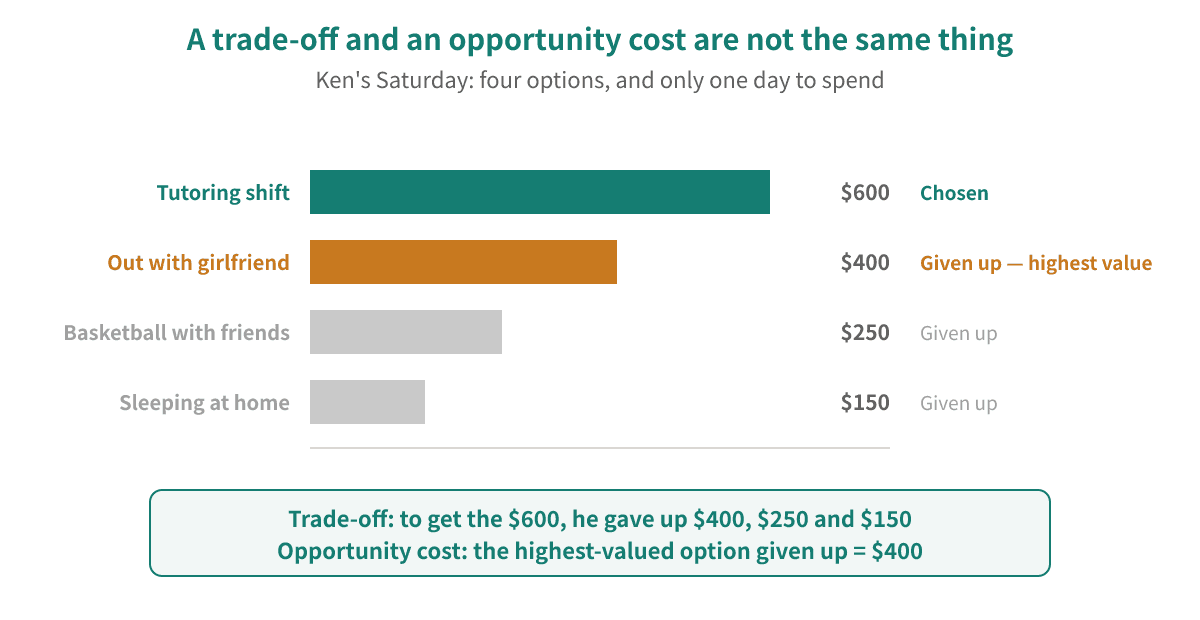
The figure lays it out. His trade-off is this: to get that $600, he gives up his girlfriend, basketball and sleep — three things at once. But his opportunity cost is not $400 plus $250 plus $150. Why not? Because even if he skipped the shift, he could still only do one thing with the day, and the best he could have chosen is the $400 option. That $400 is what he genuinely gave up, so the opportunity cost is $400. This is where students most often go wrong: adding up every option they gave up. Nobody could ever have had that total.
One more thing to straighten out: a trade-off is rarely all-or-nothing. Ken does not have to work the whole day. He could do four hours for $300 and spend the other four with his girlfriend. His question then stops being "which one?" and becomes "how much of each?" Most real decisions are like that: not study or sleep, but how long to study and how long to sleep. That is why economics works at the margin — what one more hour of the shift adds, against what that hour would otherwise have been worth. If the gain is bigger than what is given up, carry on.
Making a choice, in three steps: 1. List every option actually open to you. 2. Pick out the highest-valued option among those you are giving up — that is the opportunity cost. 3. Compare the marginal benefit of the option you are taking against its marginal cost. If the benefit is larger, do it; if it is smaller, do not.
Two common misunderstandings, settled here. The first is thinking there is always a "costless" option. There is not. Even doing nothing is a choice, it still means giving up the other options, and it still has an opportunity cost. If Ken sleeps all day, he gives up the $600. The second is thinking that money has to be involved for something to be a trade-off. It does not. Time, health and friendships are all scarce, and all involve trade-offs. Reading for one more hour the night before an exam may cost you an hour of sleep, and that is a trade-off in exactly the economic sense.
Individuals face trade-offs and so do societies. An economy has only so much land, labour and capital: use more of it to build hospitals and there is less left to build schools; move more people into farming and fewer are left in industry. One thing is still missing, though. Does everything have to be traded off? If something is so abundant that you can take as much as you want without leaving anyone else with less, there is nothing to choose between and no opportunity cost at all. The next article draws that line — free goods and economic goods: which things are genuinely free, and why so many things that cost no money are not free in the slightest.
Learn more: DSE Economics tutoring
To republish this article, please email [email protected].