
Last time, we used the relationship between roots and coefficients to find information about quadratic equations. Now we turn from finding individual roots to finding a range. A temperature below a given limit, for example, can have many possible values. As promised, we will solve linear inequalities, show their solutions on number lines and explain why negative multipliers change the direction of the sign.
A linear inequality in one unknown contains just one unknown, whose highest power after simplification is one. An example is . Its solution set contains every value of the unknown that makes the inequality true. Unless the question sets another restriction, we solve over the real numbers.
Read the four signs carefully: means less than, and means greater than. The signs and mean less than or equal to and greater than or equal to. Those last two allow equality. Thus includes 3, but excludes it. That small extra line changes the solution set.
Which operations reverse the sign?
Rules for inequalities: 1. Adding or subtracting the same number on both sides leaves the sign unchanged. 2. Multiplying or dividing both sides by the same positive number leaves the sign unchanged. 3. Multiplying or dividing both sides by the same negative number reverses the sign. Keep equality if it was allowed originally. Never divide by zero.
Start with . Multiply both sides by , and we get . On a number line, the number farther right is greater. Multiplying by reflects each point across zero. The left-to-right order reverses, so the comparison must reverse too. Other negative multipliers also scale the distances from zero, but they still reverse the order.
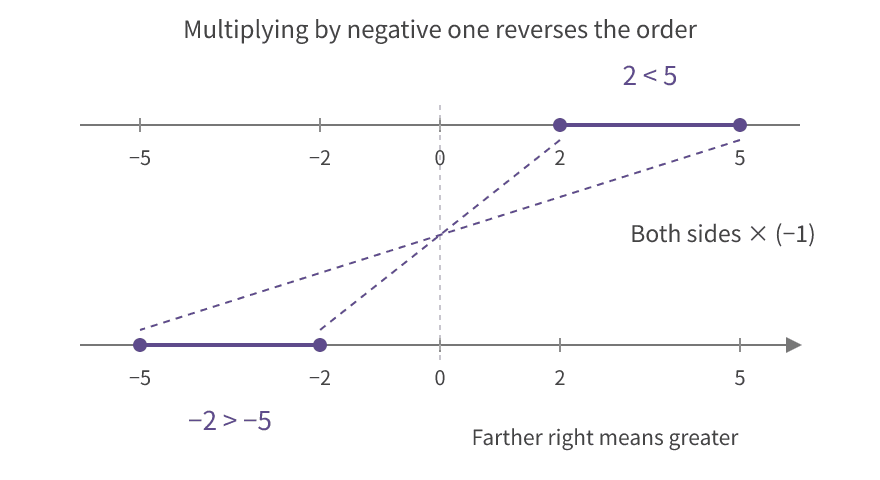
Diagram: the upper line marks 2 and 5; the lower line marks their images after multiplication by . Dashed connectors pair each point with its image. The trigger is multiplying or dividing both sides by a negative number. A minus sign appearing in an expression is not enough. Subtracting 3 from both sides moves both points three units left and preserves their order.
Example 1: a negative number outside brackets
Solve . Expand the brackets, then leave the term containing the unknown on the left. Watch the signs during expansion and the direction when dividing by a negative number. Keep an inequality sign at every step; do not replace it with an equals sign.
- Multiply each term in the brackets by negative three: , since . This only rewrites the left side. We have not multiplied both sides by negative three, so the inequality sign stays unchanged.
- Subtract 3 from both sides: . Subtracting the same number does not reverse the sign.
- Divide both sides by negative six. Reverse the sign at this step: . Less than or equal to becomes greater than or equal to.
- Simplify to get . The answer includes negative two and every real number greater than negative two. It is not just one value.
Check the boundary in the original inequality. At , the left side is , so equality is allowed. Inside the range, gives . Outside the range, gives , which fails the original condition. Substitution helps catch mistakes. The equivalent steps above establish the complete solution set.
Example 2: exclude the boundary
Solve . This inequality does not allow equality, so we must not add an equality bar during the working. The subtraction on the left does not itself require a sign reversal.
- Add 5 to both sides to cancel negative five on the left: . Keep the sign unchanged.
- Divide both sides by positive 4: . The sign still stays unchanged.
- Simplify to get . This means every real number below 3, excluding 3 itself.
Test the boundary: gives , which is false. That is why 3 is excluded. By comparison, gives , as expected for a value inside the range.
Draw each solution on a number line
Number-line representation: 1. A closed circle includes the boundary value. Use it for greater than or equal to, or less than or equal to. 2. An open circle excludes the boundary value. Use it for greater than or less than. 3. A ray to the right shows larger values; a ray to the left shows smaller values. Its arrow means the solution continues in that direction.
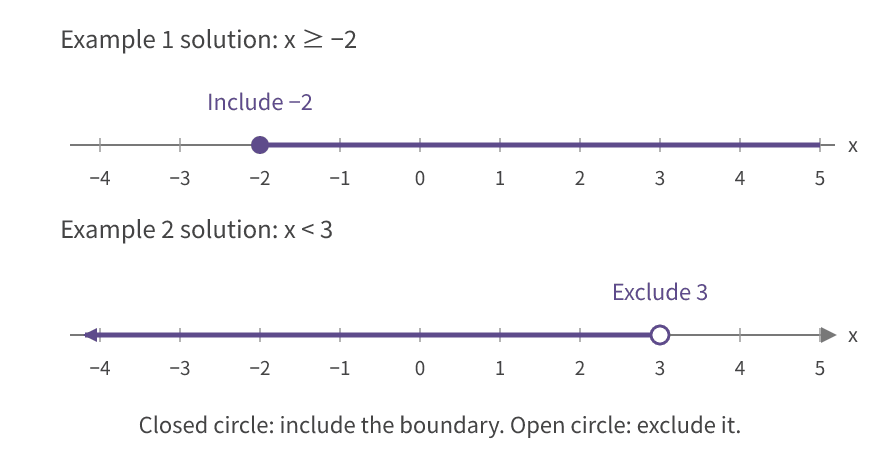
Diagram: the upper line shows the final step of Example 1, . Fill the circle at negative two and draw right. The lower line shows Example 2, . Leave the circle at 3 open and draw left. These are separate answers to separate questions; do not combine them. Choose a value on a purple ray and test it in its original inequality to check the direction.
Three final checks
- Before multiplying or dividing, check whether the number is positive or negative. Do not divide by the unknown when its sign has not been established.
- If you swap the left and right sides, change how the sign reads. The two forms below express the same relationship.
- If the question asks for integer solutions only, select the integers within the range. For , these include . Without that restriction, keep decimal and fractional solutions too.
Try . Subtract 5 from both sides to get , then divide by negative two to obtain . Your number line should have an open circle at negative two and a ray pointing left. Next time, we will study compound inequalities: how do the ranges differ when both conditions must hold, compared with when either condition may hold?
Learn more: DSE Mathematics tutoring
To republish this article, please email [email protected].