

Last time, we solved single linear inequalities and drew their solutions on number lines. As promised, we now combine conditions. An age rule might require someone to reach a minimum age and stay below a maximum. After solving each condition separately, which numbers should we keep? First decide whether every condition must hold or whether at least one is enough.
Compound inequalities join two or more inequalities with AND or OR. The solution set contains every value that satisfies the combined conditions. Unless the question states another restriction, consider all real numbers.
What do AND and OR mean?
1. AND requires every condition to be true. Keep the overlap of the solution sets, called their intersection. 2. OR requires at least one condition to be true. Keep every number in any of the solution sets, called their union. A number satisfying both conditions also qualifies for OR.
Example 1: solve AND . Solve each inequality first, then keep the common range. The first condition involves division by a negative number, so remember to reverse the inequality sign.
- Subtract 1 from both sides of the first inequality: . The sign stays unchanged.
- Divide both sides by negative two and reverse the sign: . This solves the first condition.
- Add 2 to both sides of the second inequality: . The sign stays unchanged.
- Divide both sides by positive 3: . This solves the second condition.
- Both conditions must hold, so the answer is . Include negative one but exclude 3.
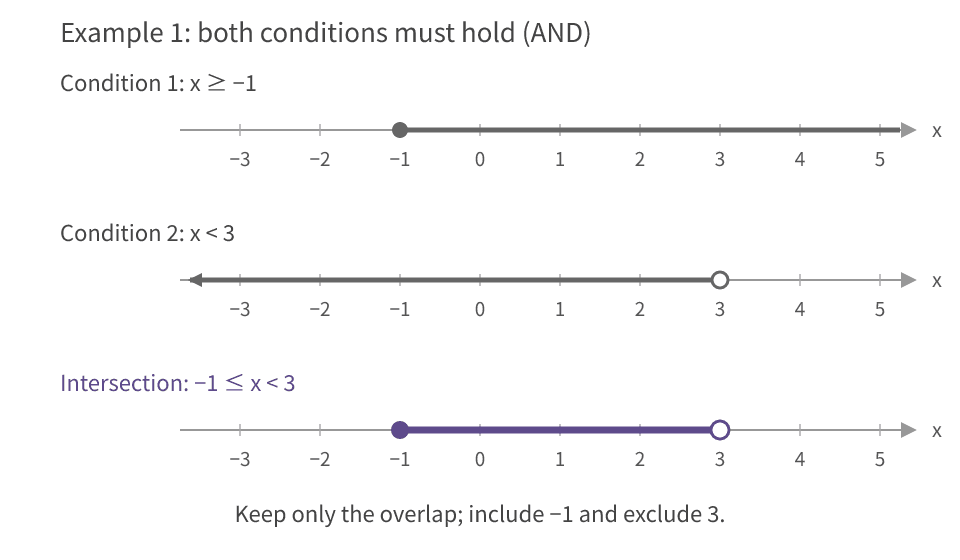
Diagram: the grey rays show the separate solutions. The purple segment shows the intersection selected in the final step. Negative one meets both conditions, so its circle is closed. Three fails the second condition, so its circle is open. Substituting into the original inequalities gives and . Both are true. Substituting into the second gives , so we must exclude 3.
Does OR also mean keep the middle?
Example 2: solve OR . One true condition is enough. They need not both hold. Solve them separately, then keep every number covered by either range.
- Subtract 3 from both sides of the first inequality: . Keep the sign unchanged.
- Divide both sides by positive 2: . Keep this range.
- Subtract 5 from both sides of the second inequality: . Subtraction does not reverse the sign.
- Divide both sides by negative one and reverse the sign: . Keep this range too.
- The answer is OR . Keep the word OR between the ranges. The middle is excluded.
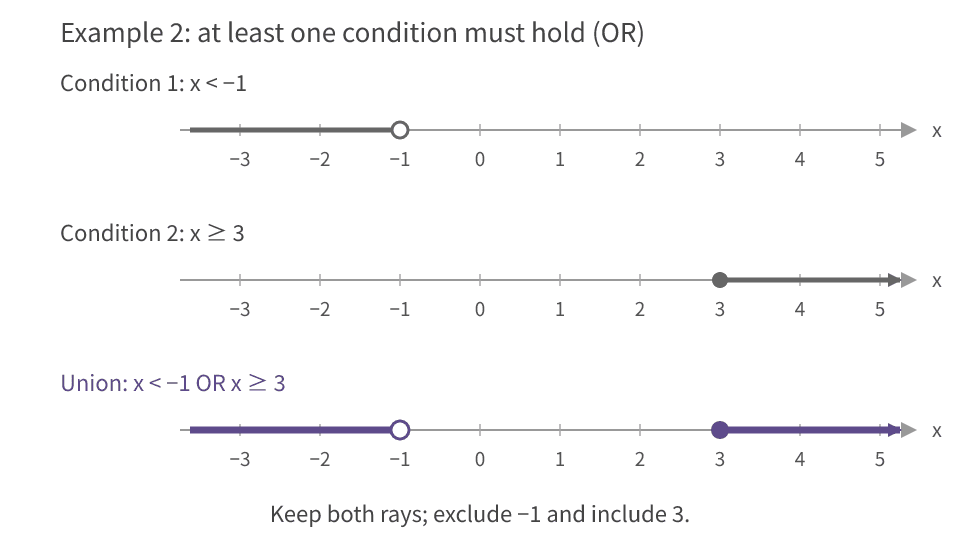
Diagram: the final step takes the union, keeping both rays. At , the second inequality gives . That is enough even though the first condition is false. At , we get and . Both are false, so the gap must stay empty. Do not join these ranges into a chained inequality, which would require both conditions at once.
How do we solve a chained inequality?
A chained inequality, such as , requires the middle expression to satisfy both comparisons. It means AND. Every operation must apply to all three parts, rather than just the middle and right parts.
- Subtract 1 from all three parts: . Remember to subtract 1 from negative three too.
- Divide all three parts by positive 2: . Neither sign reverses. This is the answer.
Check the boundaries. Substituting gives , whose left comparison is false. Substituting gives , which is true. If only integer solutions are requested, select from the range. Otherwise, keep fractional and decimal values too.
No solution, all real numbers or just one point
No solution means that no value satisfies the combined conditions. All real numbers means that every real value satisfies them. Judge the combined requirements, rather than whether each separate inequality has solutions.
- For AND , the ranges do not overlap. There is no solution.
- For OR , the ranges together cover the entire number line. The answer is all real numbers.
- For AND , the only common value is . An intersection can be a single point.
Do not memorise AND as the middle and OR as the outside. If both rays point right, their intersection also points right. Draw each range first, then take the overlap or union according to the joining word. Finally, check whether each boundary satisfies the combined conditions.
Your turn: divide all three parts by a negative number
Solve . When dividing by a negative number, reverse both inequality signs. Write the complete line first, then rewrite it in increasing order.
- Subtract 5 from all three parts: . The signs stay unchanged.
- Divide all three parts by negative two: . Reverse both signs and keep the existing equality bar.
- Rewrite in increasing order. The answer is . Substituting gives , which is true. Substituting gives , which is false.
We can now combine solution sets and handle their boundaries. Next time, we will study quadratic inequalities. When the unknown has a squared term, how can the roots divide the number line into regions where the expression is positive or negative?
Learn more: DSE Mathematics tutoring
To republish this article, please email [email protected].