

At the end of the last article, we said that expressions like and have a fixed pattern. The cross-method can factorise them. But if you recognise the pattern, you can use a formula and write the answer in one step. These formulas are called identities. This article covers three groups: perfect squares, the difference of two squares, and the sum and difference of two cubes. You will use them again and again when you simplify algebraic fractions and solve equations.
Identity: an equation that is true for every value you substitute. 1. An equation is only true for some values. For example, is only true when . An identity is true for every value, for example . 2. So reading an identity from left to right is expanding, and reading it from right to left is factorising.
Perfect squares: the middle term is 2ab
Perfect square identities: and . 1. The first and last terms must both be squares. 2. The middle term must be exactly 2 times the product of the two bases, that is . 3. If the middle term is negative, use a minus sign in the bracket.
Why is this true? Use the area model from the expansion article. is a square with side . and 9 are the squares in two corners. The two purple strips are each, and together they make the middle term . In a square the two strips are always the same size, so the middle term is always , not .
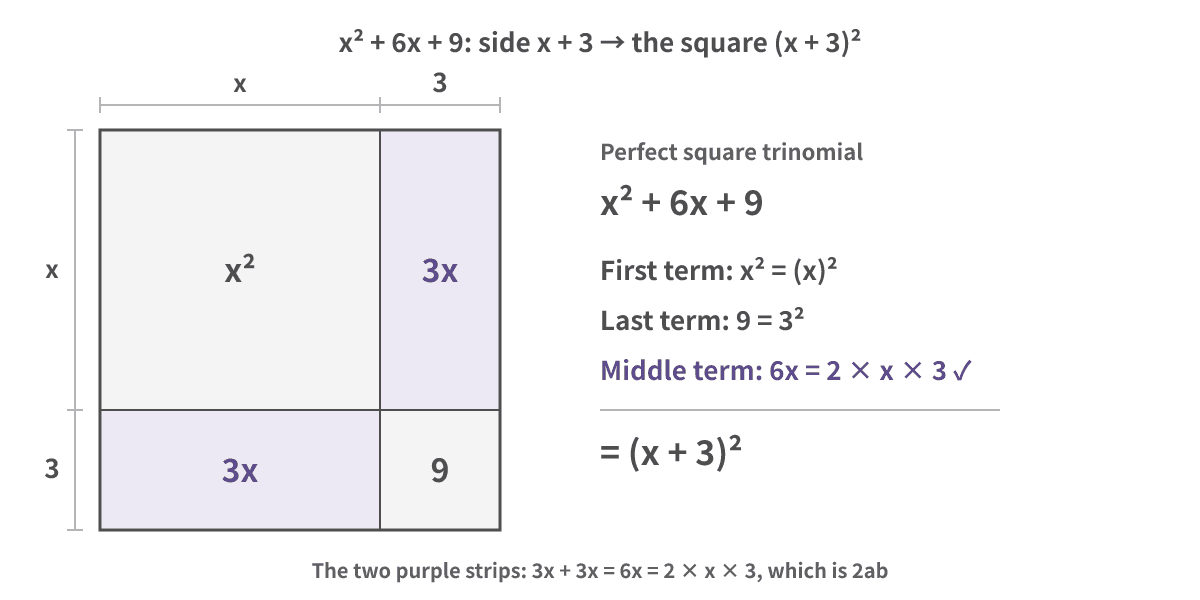
To spot a perfect square, check all three terms. Take . , , and . The middle term is negative, so . The most common mistake is to check only the first and last terms. In both are squares, but , not . So it is not a perfect square. If the last term is negative, as in , it cannot be a perfect square either, because a square is never negative.
Difference of two squares: one square minus another
Difference of two squares: . 1. There are only two terms. Both are squares, with a minus sign between them. 2. One bracket has a plus and the other has a minus. The bases in the two brackets are the same. 3. A sum of two squares, , cannot be factorised using real numbers.
Why does become ? Look at the figure below. Take a square with side and cut a small square off one corner. The area left is . Turn the purple strip at the bottom and move it to the right. Now the pieces form a rectangle with length and width . The area never changed, so the two expressions must be equal.
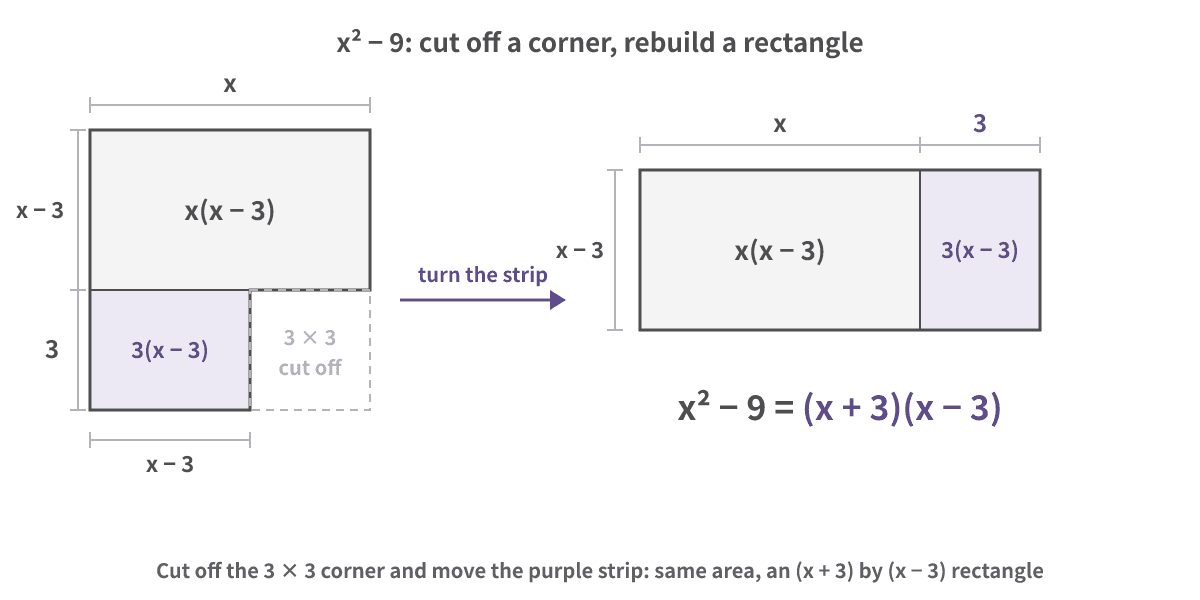
When you use it, first write each term as a square. For example, . Students often drop the coefficient and write . That expands to , which is not the original expression. Some questions need the identity twice: . can be split again, but is a sum of two squares. It cannot be split, so leave it as it is.
Sum and difference of two cubes: same, opposite, always positive
Sum and difference of two cubes: and . 1. Same: the sign in the first bracket is the same as in the original expression. 2. Opposite: the sign of the middle term in the second bracket is the opposite. 3. Always positive: the last term of the second bracket, , is always positive.
You do not need to memorise these blindly. Expand once and you will see why. Take the difference of two cubes:
The four middle terms cancel in pairs, and only the first and last are left. That is why the middle term of the second bracket is , not . With , the middle terms would not cancel. This is where students go wrong most often. They see and , think of a perfect square, and write out of habit.
Example: common factor first, then the cubes
Factorise .
- Look for a common factor first. 16 and 54 are both even, so take out 2: .
- Write the two terms in the bracket as cubes: and . So and , and this is a difference of two cubes.
- Use the identity. The first bracket takes the same minus sign as the original: .
- Work out the second bracket term by term. The middle term is , not : .
- Do not forget the 2 at the front: .
Check: put into the original expression: . Put it into the answer: . They match. Can be factorised further? Its first and last terms are and . A perfect square would need a middle term of , but it only has , so it is not one. The cross-method finds no whole numbers either. So this is the final answer.
To sum up: take out any common factor first, then count the terms. With two terms, look for a difference of two squares, a sum of two cubes or a difference of two cubes. With three terms, check for a perfect square: the first and last terms are squares and the middle term is . If none of these fit, go back to the cross-method. Next time: algebraic fractions. In , the top factorises to and the bottom to . Cancel and you get . The identities in this article are what make that possible.
Learn more: DSE Mathematics tutoring
To republish this article, please email [email protected].