
The last article covered liabilities and introduced equity (capital). This time we continue with revenue, expenses and drawings.
Equity / Capital
“Residual value of assets after deduction of liabilities.”
By definition, equity increases either because total assets rise or because total liabilities fall. Two simple examples show how equity increases:
1. Total assets increaseThe easiest example is selling goods. When we sell goods we collect money from customers; this inflow of assets raises total assets, so equity rises accordingly.
- Cash increases.
- Net assets increase.
- Equity increases.
2. Total liabilities decreaseThe second example is the owner settling the company's debts. When the owner uses personal assets — for example a private bank account — to repay the company's debts, total liabilities fall, so equity rises accordingly.
- Trade payables decrease.
- Net assets increase.
- Equity increases.
These examples show how equity increases — but they also reveal a problem. If every effect flows into a single equity figure, it becomes hard to tell apart the impact of the company's trading performance, the owner's capital injections, and the owner's withdrawals. That is why equity is split into four accounts: the capital account, the revenue account, the expense account and the drawings account.
1. Capital accountThe capital account mainly records the owner's capital injections: when the owner puts in new funds, the capital account balance rises. Businesses generally settle accounts annually, summarising the whole year's revenue and expenses into profit and loss; at year end, the capital account records the year's profit or loss and the year's total drawings in one entry.
2. Revenue accountThe revenue account mainly records the extra value earned from external transactions — selling goods, collecting rent, interest on time deposits and so on. It accumulates the total earned across all such transactions and feeds into profit and loss at period end. The revenue account therefore does not show how many assets the business holds at any moment — it shows the total the business has earned over a period.
3. Expense accountThe expense account mainly records the costs paid out to earn revenue — buying goods, paying wages, the company's utilities. It accumulates the costs across all such transactions and feeds into profit and loss at period end. The expense account therefore does not show what the business currently owes — it shows the total costs the business has incurred over a period.
4. Drawings accountThe drawings account mainly records the total assets the owner takes from the business for personal use — paying the owner's personal electricity bill with company cash, or letting the owner's family use a company car. It accumulates all such withdrawals and settles the total drawings at period end.
Words alone may not make this easy to grasp, so here is a simple chart summarising how the four accounts work together:
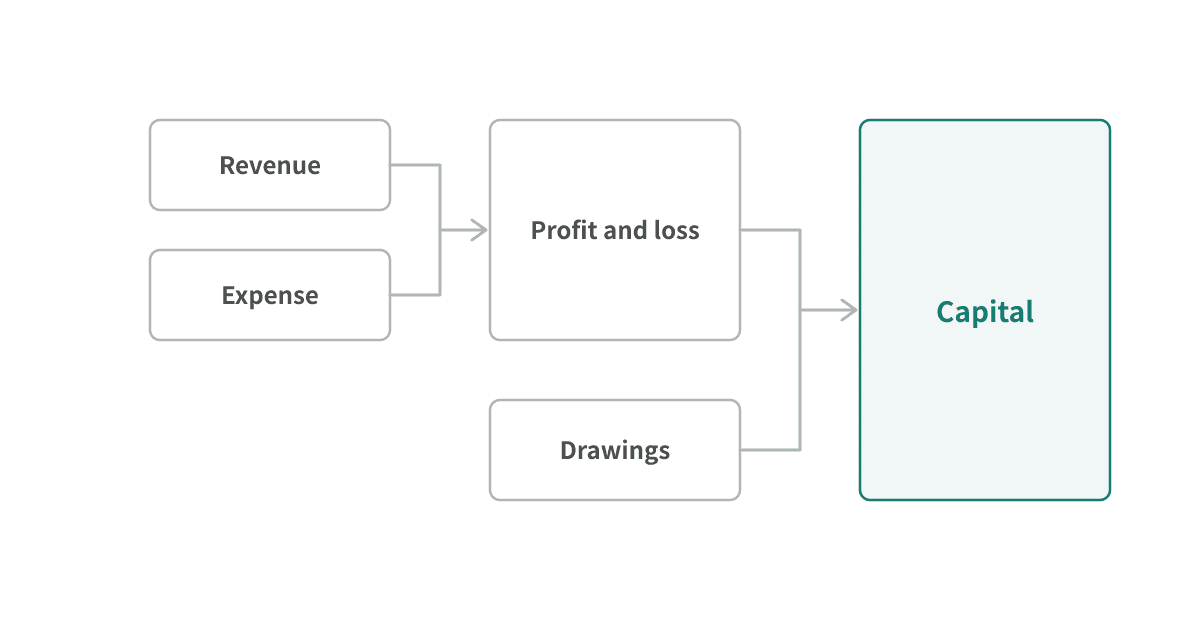
Within each year, the company's external gains and losses are recorded in the revenue account and expense account respectively, then summarised at year end into profit and loss and posted to the capital account. The owner's total drawings for the year are likewise posted to the capital account at year end. The capital account thus runs in a continuous cycle — recording each year's profit or loss and drawings, and updating the total investment year after year.
With this third article we have finally covered the basic elements of accounting. The next article begins with everyday transactions, recording their effects in T-accounts. Follow our blog and relearn what accounting really is.
Is BAFS easy or hard? The cliché answer: easy to learn, hard to master. In the PY100 BAFS Accounting series, a tutor with extensive BAFS teaching experience explains the accounting knowledge you should know but don't — and the things you think you know but actually don't. The series will run to 100 articles covering S.4 to S.6 BAFS accounting, so students can preview or revise whenever they need.
PY Education also offers BAFS tutoring courses, where our experienced tutor teaches you BAFS knowledge and exam techniques in one go — common public-exam question types and traps, our signature handwritten BAFS notes, plus plenty of past papers to drill until you're exam-ready. BAFS? Not that hard, really.
Learn more: DSE BAFS tutoring
To republish this article, please email [email protected].