
The last article explained what credit transactions are and introduced trade receivables and trade payables. This one does for credit what article six did for cash: it takes a full example and records credit purchases, credit sales and both settlements in T-accounts, step by step.
Three things to settle before you write anything
Credit transactions look complicated, but before recording one there are really only three things to settle. First, the recording date is the date of the transaction, not the date the money arrives. The moment the goods leave the door, sales and trade receivables go into the books; when payment comes in is a separate matter. Second, trade receivables and trade payables are not one big account. Every customer and every supplier trading on credit gets an account of their own, named after them. So when a question says "Wing Fat Company account", it means "how much is still outstanding between us and Wing Fat Company". Third, whether the thing bought on credit is goods changes what the account is called — we come back to that in the fifth transaction.
Three rules for recording a credit transaction: 1. The recording date is the date the transaction happens, not the date it is settled. 2. Every customer or supplier trading on credit gets a separate account, named after them. 3. A debit balance on that account means they owe us; a credit balance means we owe them.
Example: February at Tai Shing Trading Company
Illustration Record the following transactions for Tai Shing Trading Company in the ledger accounts.
- Feb 3, 2020: Bought goods on credit from Wing Fat Company, $80,000.
- Feb 8, 2020: Sold goods on credit to Chan Tai Man, $120,000.
- Feb 15, 2020: Paid $50,000 to Wing Fat Company by cheque, settling part of the debt.
- Feb 20, 2020: Received a cheque of $70,000 from Chan Tai Man, part of what he owed.
- Feb 25, 2020: Bought a motor vehicle on credit from Lee Fung Motors for $150,000.
1. Feb 3, 2020
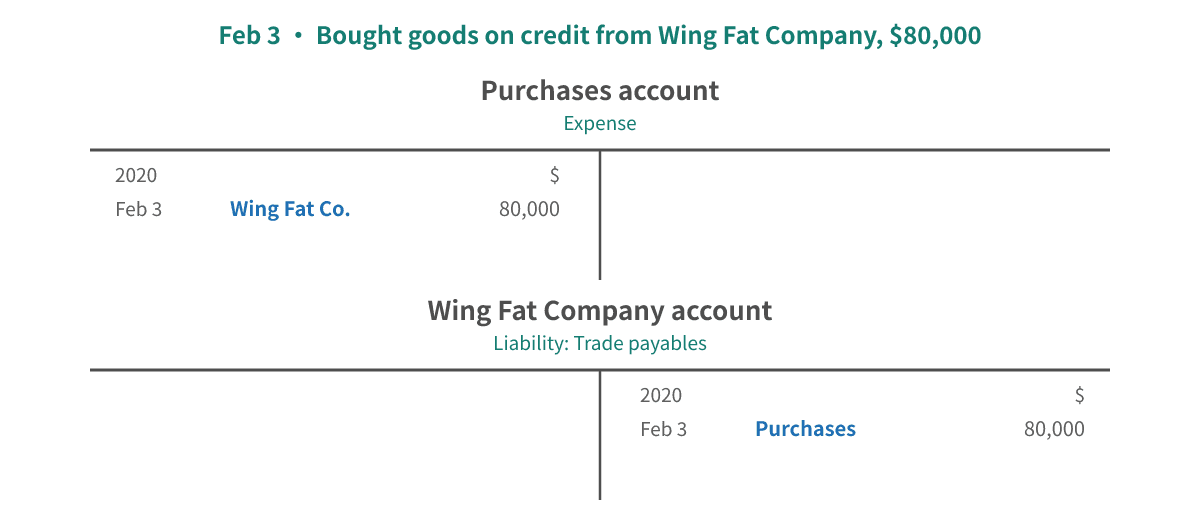
Bought goods on credit from Wing Fat Company for $80,000.
The only difference between this and a cash purchase is that we have not paid yet. Goods bought for resale still go into the Purchases account: expense increases, so we debit it. But the credit side is no longer Cash or Bank. It is an account called "Wing Fat Company": liability increases, and that balance is our trade payables. One thing worth noting — article six said a cash transaction does not record the third party's name. Credit is the opposite. Without the name you would not know who to chase or who to pay.
2. Feb 8, 2020
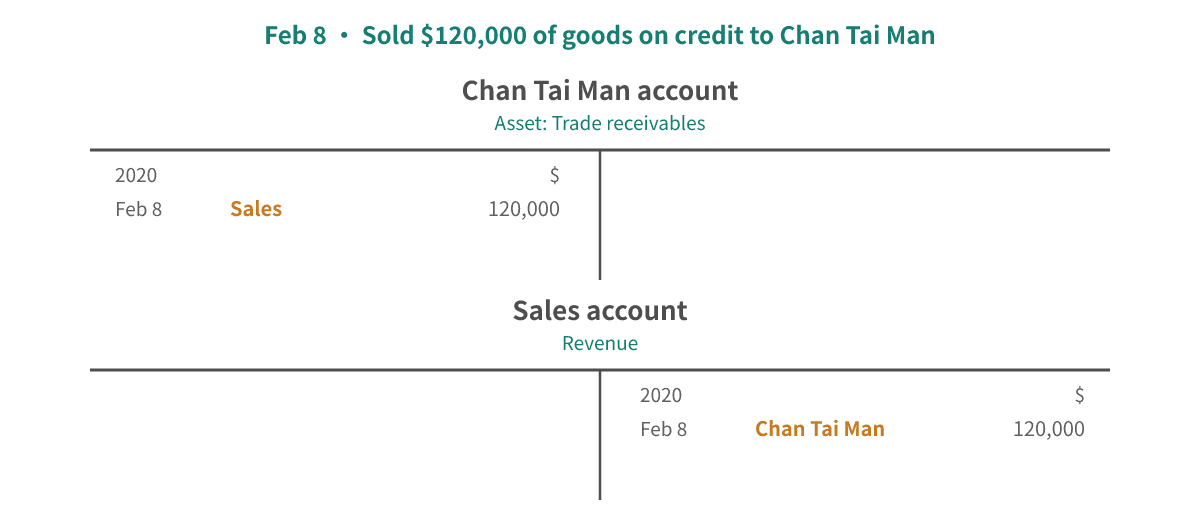
Sold goods on credit to Chan Tai Man for $120,000.
The selling side works the same way. Goods sold still go into the Sales account: revenue increases, so we credit it. The money not yet received is debited to an account called "Chan Tai Man": asset increases, and that balance is our trade receivables. Note that at this moment we have received nothing at all, yet the sale must already be recorded, because the goods have been handed over. The earning happened on the day the goods were sold.
3. Feb 15, 2020
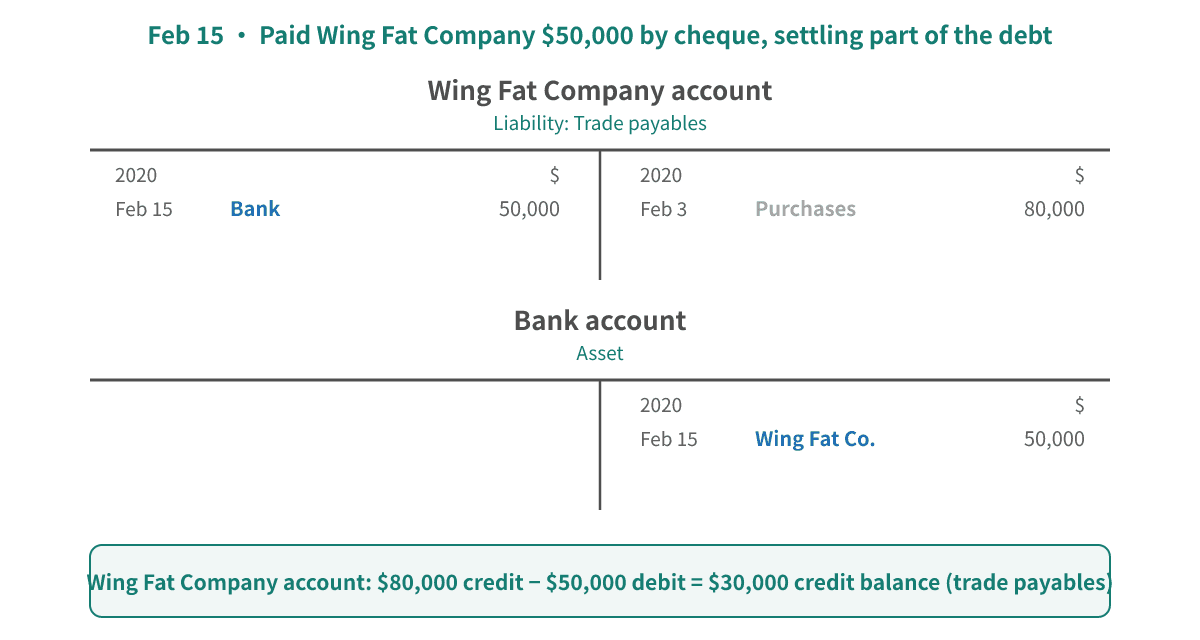
Paid $50,000 to Wing Fat Company by cheque.
Now for settlement. Paying by cheque reduces Bank, so asset decreases and we credit the Bank account. At the same time what we owe Wing Fat Company falls, so liability decreases and we debit the Wing Fat Company account. Notice that only part of the debt is settled. The credit side of the account holds $80,000 and the debit side now takes $50,000, leaving $30,000 outstanding. That $30,000 is the trade payables we still owe Wing Fat Company at the end of February. Note too that this entry has nothing to do with purchases: the goods were bought on Feb 3, and what moves now is only the debt and the bank balance.
4. Feb 20, 2020
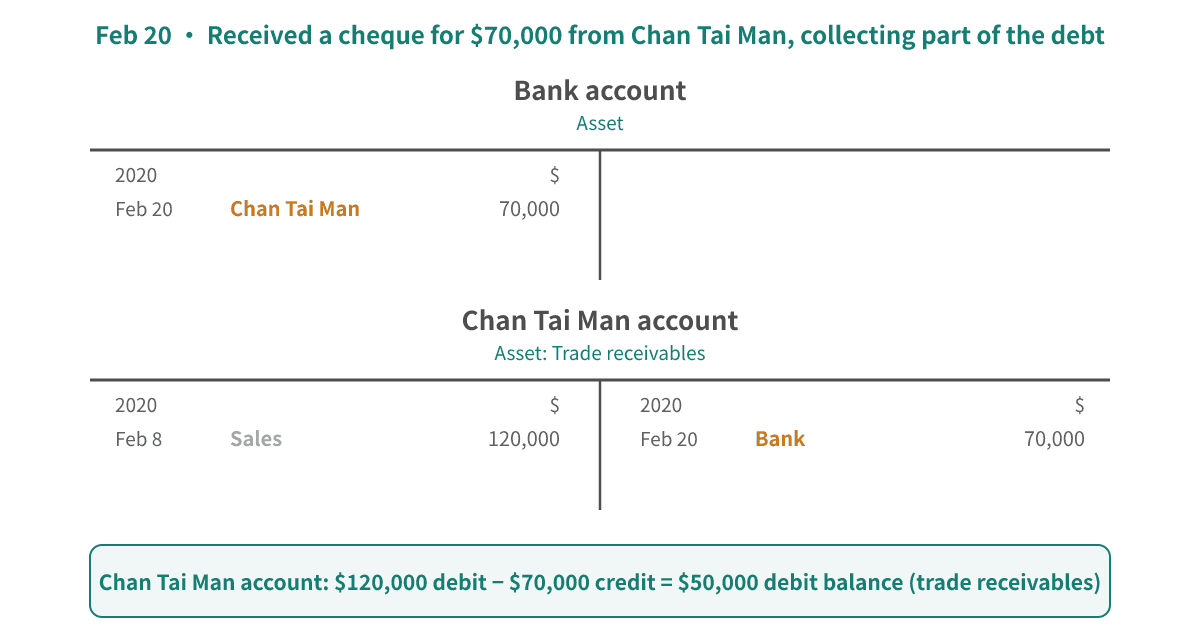
Received a cheque of $70,000 from Chan Tai Man.
Receiving money follows the same logic: Bank increases, so asset increases and we debit the Bank account; what Chan Tai Man owes us falls, so we credit his account. One point to hold on to — no sale is recorded on the day the money arrives. The sale went in on Feb 8, when the goods were sold. Record it again on collection and revenue is counted twice, which is one of the commonest traps in the exam. The debit side of his account, $120,000, less the credit side, $70,000, leaves $50,000: he still owes us $50,000.
5. Feb 25, 2020
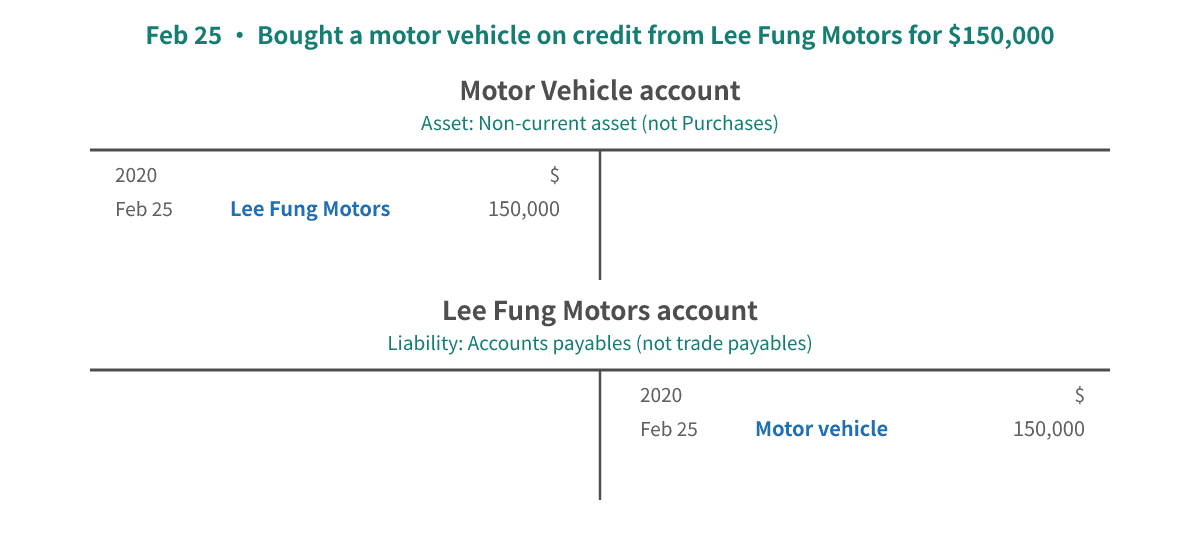
Bought a motor vehicle on credit from Lee Fung Motors for $150,000.
The last transaction is the point held over from earlier: what you buy on credit need not be goods. The vehicle is bought to run the business, not to resell, so the debit goes to the Motor vehicle account and not to Purchases — Purchases holds only goods bought for resale at a profit. And because the debt does not arise from buying goods, the Lee Fung Motors account credited here is not trade payables but accounts payables. Both sit under current liabilities in the statement of financial position, but the two names must not be mixed up. Using the wrong one costs marks.
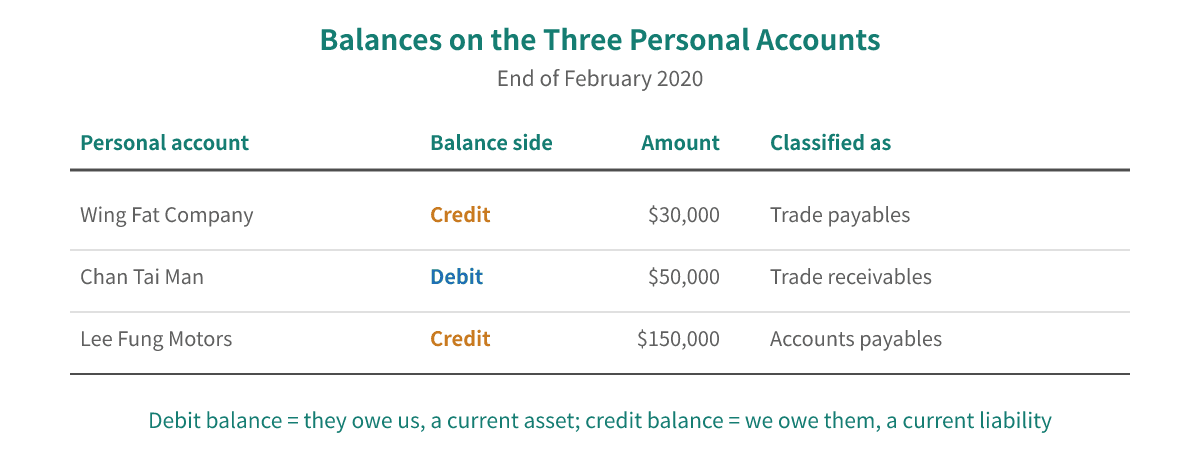
End of February: what is outstanding on each personal account
Five transactions have left Tai Shing Trading Company with three personal accounts. Which side the balance falls on tells you who owes whom: a debit balance means the other party owes us, which is an asset; a credit balance means we owe them, which is a liability. There is nothing to memorise here — it follows from the definitions of asset and liability in articles one and two.
The two pairs of names for credit debts: 1. Trade receivables / trade payables — debts arising from selling or buying goods on credit. 2. Accounts receivables / accounts payables — debts arising from selling or buying anything other than goods on credit, a non-current asset for example.
Two mistakes come up again and again. First, the wrong name: trade receivables and trade payables are only for goods sold and bought on credit; anything else on credit is accounts receivables or accounts payables. Second, the wrong side: beginners easily swap "they owe me" and "I owe them". Work it back from asset and liability — what the other party owes us is an asset and always sits on the debit side; what we owe them is a liability and always sits on the credit side. And note that debtor and creditor refer to the people. The accounts are not named that way.
The recording itself is not hard. The hard part is settling three questions first: is this goods or not, is the entry dated on the transaction or on the payment, and what should the account be called. Get those right and the entries for a credit transaction will follow. The next article is about trade receivables and trade payables in their own right — how one customer's account reads from the start of a month to the end, and how the two names appear in the statement of financial position. Keep an eye on our blog!
Is BAFS easy or hard? The cliché answer: easy to learn, hard to master. In the PY100 BAFS Accounting series, a tutor with extensive BAFS teaching experience explains the accounting knowledge you should know but don't — and the things you think you know but actually don't. The series will run to 100 articles covering S.4 to S.6 BAFS accounting, so students can preview or revise whenever they need.
PY Education also offers BAFS tutoring courses, where our experienced tutor teaches you BAFS knowledge and exam techniques in one go — common public-exam question types and traps, our signature handwritten BAFS notes, plus plenty of past papers to drill until you're exam-ready. BAFS? Not that hard, really.
Learn more: DSE BAFS tutoring
To republish this article, please email [email protected].