
The last article recorded five credit transactions and ended with three personal accounts and their balances. This article is about the names those balances carry — trade receivables and trade payables. How do they build up? What does one customer's account look like read from the start of a month to the end? And how do the two of them finally appear in the statement of financial position?
Two names: one an asset, one a liability
First, get the direction of each name straight. We sell goods to a customer on credit and the customer has not paid, so the customer owes us. That money will turn back into cash later — a resource bringing future benefit — so it is an asset, called trade receivables. The other way round, we buy goods from a supplier on credit and have not paid, so we owe the supplier. That is an obligation we have to meet, so it is a liability, called trade payables. In a trading company these are often the two largest items among current assets and current liabilities, which is why the exam returns to them so often.
1. Trade receivables: amounts not yet collected from customers for goods sold on credit; a current asset of the business. 2. Trade payables: amounts not yet paid to suppliers for goods bought on credit; a current liability of the business.
Next comes the easiest place to lose marks: the word "trade". Trade receivables and trade payables cover goods bought and sold on credit only — that is, things bought to be resold at a profit. If what was bought on credit is not goods, such as the motor vehicle in the last article, the debt is accounts payables instead. Sell a non-current asset on credit and what the buyer owes us is accounts receivables.
Telling credit debts apart: 1. What was bought or sold on credit is goods — trade receivables / trade payables. 2. What was bought or sold on credit is not goods — accounts receivables / accounts payables. 3. Debtor and creditor refer to the people, not to the names of the accounts.
One customer's account, from the start of the month to the end
Trade receivables is not one account. It is the total of a set of personal accounts, one for each customer trading on credit, each named after that customer. Whatever balance is left at the end of one month is carried down into the start of the next and written as "balance b/d". The month's credit sales and receipts are then entered one by one, and at the end of the month the two sides are netted off to show what the customer still owes.
Take Tai Shing Trading Company and Chan Tai Man from the last article. At the end of February his account carried a debit balance of $50,000. Two things happened in March:
- Mar 5, 2020: Sold a further $90,000 of goods to Chan Tai Man on credit.
- Mar 18, 2020: Received a cheque of $45,000 from Chan Tai Man.
The credit sale is debited to his account, taking what he owes from $50,000 to $140,000. The receipt is credited to his account: $140,000 less $45,000 leaves $95,000 owing at the end of March. Notice that the Sales account moved only once all month, on Mar 5. Nothing was recorded as a sale on Mar 18 — all that happened was that trade receivables turned into money at the bank.
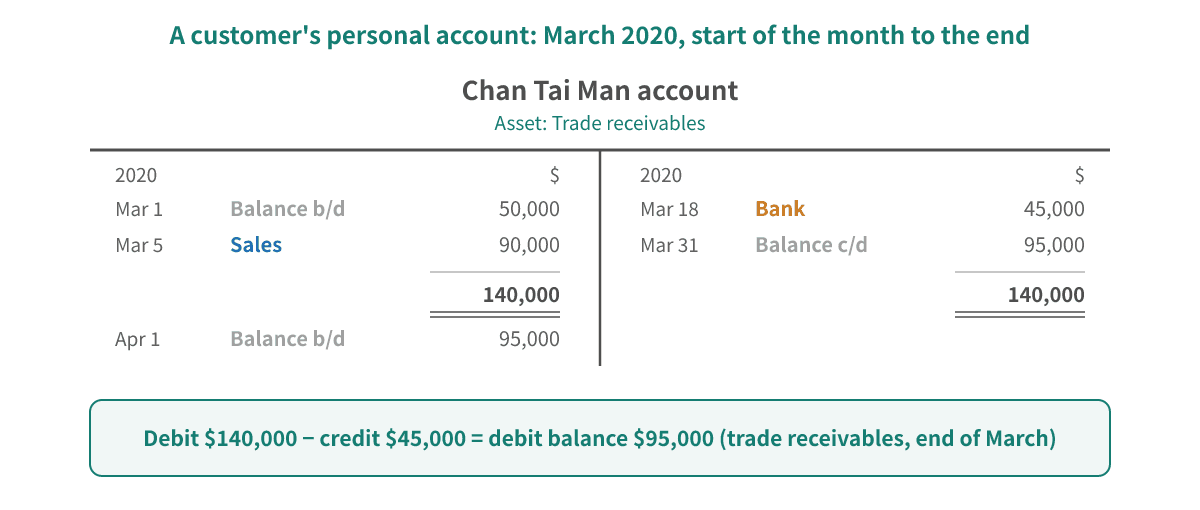
The figure shows a typical customer account. The debit side on the left holds everything that increases what he owes — the balance brought down and the credit sale. The credit side on the right holds what he has repaid — the money received. The debit side is larger, so the balance sits on the debit side, and that $95,000 is Chan Tai Man's share of trade receivables at the end of March.
Reading a personal account: 1. Debit side larger — a debit balance, they owe us, so it is a receivable. 2. Credit side larger — a credit balance, we owe them, so it is a payable. 3. The balance only tells you what is still outstanding; it does not tell you how much business was done that month.
The supplier side: identical, in reverse
A supplier's account reads in exactly the same way, only in the opposite direction. At the end of February, Tai Shing Trading Company still owed Wing Fat Company $30,000, sitting on the credit side. In March: on Mar 9 it bought another $70,000 of goods from Wing Fat on credit, which is credited; on Mar 22 it paid Wing Fat $40,000 by cheque, which is debited. $30,000 plus $70,000 less $40,000 leaves $60,000 owing at the end of March.
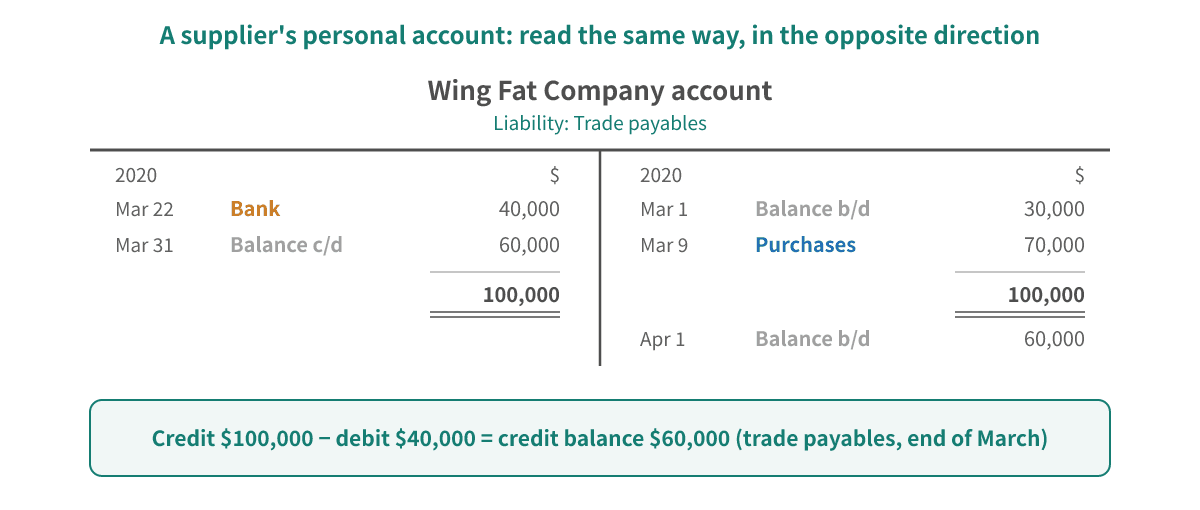
One thing here is worth thinking about: the same transaction is a mirror image in the two sets of books. The $70,000 credit purchase on Mar 9 is, in Wing Fat Company's own books, a $70,000 credit sale, debited to a "Tai Shing Trading Company account" that Wing Fat keeps — and therefore Wing Fat's trade receivables. So the same amount is trade payables on one side and trade receivables on the other. Whenever you read a question, settle this first: whose books are we standing in?
How they appear in the statement of financial position
At the month end we do not list every customer separately. The debit balances on all the customer accounts are added together, and that total is the "trade receivables" figure under current assets. The credit balances on all the supplier accounts are added together, and that total is "trade payables" under current liabilities. Suppose that at the end of March, besides Chan Tai Man, Tai Shing Trading Company is also owed $40,000 by Lee Siu Ming, and besides Wing Fat Company it owes $25,000 to Hang Cheong Company.
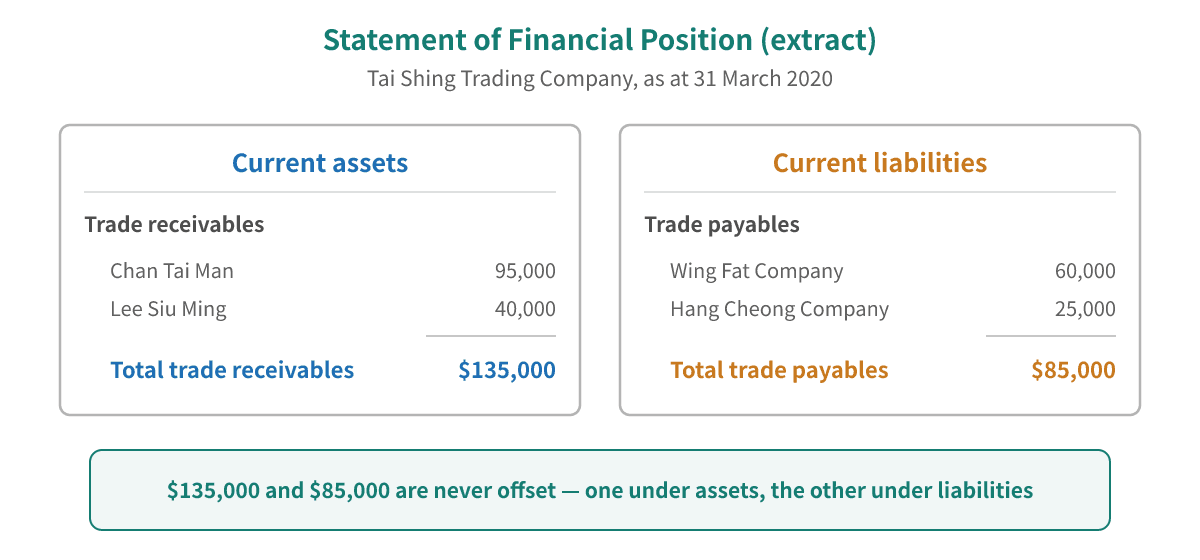
Reporting rules: 1. Trade receivables = the sum of the debit balances on all customer accounts, shown under current assets. 2. Trade payables = the sum of the credit balances on all supplier accounts, shown under current liabilities. 3. The two figures must never be offset against each other; they are always shown separately, on the asset side and the liability side.
That completes the groundwork on credit transactions. The next article goes back to the transactions themselves and looks at purchases and sales — what actually counts as a purchase and what does not, and why those two accounts are the starting point of the whole income statement. Keep an eye on our blog!
Is BAFS easy or hard? The cliché answer: easy to learn, hard to master. In the PY100 BAFS Accounting series, a tutor with extensive BAFS teaching experience explains the accounting knowledge you should know but don't — and the things you think you know but actually don't. The series will run to 100 articles covering S.4 to S.6 BAFS accounting, so students can preview or revise whenever they need.
PY Education also offers BAFS tutoring courses, where our experienced tutor teaches you BAFS knowledge and exam techniques in one go — common public-exam question types and traps, our signature handwritten BAFS notes, plus plenty of past papers to drill until you're exam-ready. BAFS? Not that hard, really.
Learn more: DSE BAFS tutoring
To republish this article, please email [email protected].