
This article opens the PY100 BAFS Business Management series. The Accounting series teaches you how to record what a business does; the Economics series teaches you how a market works. This series is about the thing in the middle — the business itself. It will run to 100 articles covering the S.4 to S.6 BAFS compulsory part and the Business Management elective. We start with a question that looks easy: what is a business?
What is a business?
Start with people. People have wants: good food, clothes, a place to live, a holiday. But nobody grows their own rice, raises their own chickens and builds their own house just to eat dinner. Instead, one person grows rice, another runs a restaurant, another moves the goods, and everyone exchanges through money. That process of specialising and exchanging is business. So business is more than "making money". It is a chain of activities carried out to satisfy human wants: someone produces goods and services, someone moves them from the producer to the consumer, and each of them earns a profit along the way.
Business: all economic activities that satisfy human wants by producing and distributing goods and services, and that earn a profit in doing so.
The words "goods" and "services" in that definition mean different things. Goods are tangible products. You can hold them, store them in a warehouse, and sell tomorrow what you made today: a cup of milk tea, a phone, a pair of trainers. Services are intangible. They have no physical form, they cannot be stored, and production and consumption usually happen at the same moment: the waiter taking your order, the hairdresser cutting your hair, the tutor explaining a topic. Many businesses provide both. The forty dollars you pay in a cha chaan teng buys a plate of char siu rice — a good — together with the service of being waited on.
1. Goods: tangible products; they can be stored, and production and consumption can happen at different times. 2. Services: intangible work; they cannot be stored, and production and consumption usually happen at the same time.
Profit: what keeps a business going
The last part of the definition is profit. Profit is what is left over in a period once the business subtracts all its costs from the revenue it took in. The arithmetic looks trivial, but it is the backbone of the whole BAFS course: the Accounting series teaches you to measure those two figures accurately, and this series teaches you how to widen the gap between them.
Profit: the amount left after subtracting cost from revenue over a period. Revenue greater than cost is a profit; cost greater than revenue is a loss.
Why must a business make a profit? Because one that does not cannot survive. Rent, wages and suppliers have to be paid every month, and a business that loses money will eventually close. Profit is also the owner's reward for taking a risk: they put their own savings into the shop and could lose all of it, so there has to be a return to make it worth doing. Note, though, that profit is not a company's only goal. Businesses also pursue survival, growth and market share, and they have to consider the interests of stakeholders — customers, employees and the wider community. That is corporate social responsibility, the subject of articles eleven and twelve. And some organisations never aim at profit at all, such as government departments and charities; article six covers them.
How a business works
Whether a company sells food, property or electronics, the skeleton of its operation is the same: it puts resources in, transforms them, and sells the goods and services that come out. Take an example. In one month a cha chaan teng pays $30,000 in rent, $40,000 in wages and $20,000 for ingredients and utilities — $90,000 of cost in total. The kitchen turns the ingredients into meals, the staff take orders and serve, and the food and drinks sold bring in $120,000. Revenue of $120,000 less cost of $90,000 leaves a profit of $30,000 for the month.
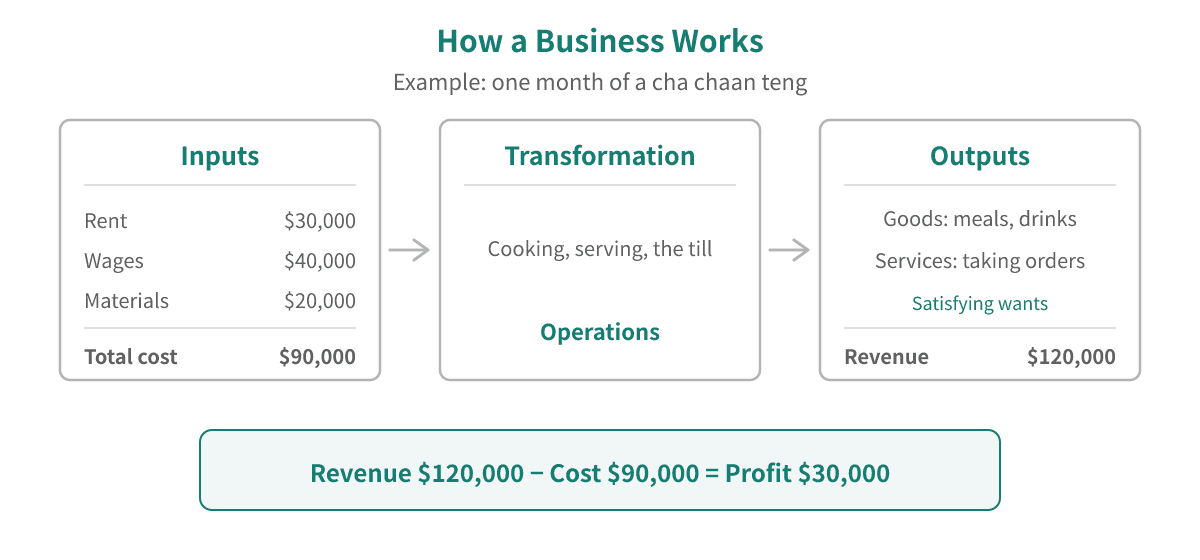
The figure above lays that flow out. Look at the two ends: what the inputs cost is the cost, what the outputs sell for is the revenue, and the difference between them is the profit. So the question "is this shop making money?" can always be split in two — is the revenue too low, or are the costs too high? When an exam question asks how a business could improve its performance, the answer almost always sits on one of those two sides.
The functions of a business
One person running a street stall can do everything: buy the stock, cook, take the money and keep the books. Once a business grows, the work has to be split into groups and handed to different departments. These areas of work are called business functions, and six of them come up again and again:
- Operations management: planning the production process, controlling quality and inventory, and actually turning inputs into outputs.
- Marketing management: finding out what customers want, then deciding the product, the price, the distribution and the promotion.
- Human resources management: recruiting, training, appraising and setting pay, so that the right people do the right jobs.
- Financial management: raising funds, allocating them, controlling cash flow and judging whether an investment is worth making.
- Information management: collecting, storing and analysing data to support the decisions other departments make.
- Risk management: identifying the risks a business faces and deciding whether to bear them, reduce them or transfer them — by buying insurance, for example.
Business functions: the areas of work a company divides itself into in order to reach its goals — operations, marketing, human resources, finance, information and risk management.
Exam questions like to give you a situation and ask which function it involves, or how two departments work together. So do not memorise six names; remember what each function actually does. For example: the sales data the marketing department collects is organised and analysed by the information management department before management can use it to set a price; the human resources department hires an accounts clerk on terms set by what the finance department needs; the risk management department assesses the fire risk in the kitchen and advises operations on how to handle it. The six functions are linked, and no single one of them can run a business on its own.
This article defined what a business is, why it has to make a profit, and how a company divides the work inside it. The next article comes at the subject from the other direction and classifies business activity itself — from extracting raw materials and manufacturing them to wholesale, retail and the many kinds of service — looking at the part each type plays in the chain. Keep an eye on our blog!
Learn more: DSE BAFS tutoring
To republish this article, please email [email protected].