
The last article defined what a business is and broke a company down into its six business functions. This one comes at the subject from the other direction: instead of looking inside one company, it classifies business activity across the whole economy. Start with a bowl of rice. How many different kinds of business does a grain of rice pass through on its way from the field to your bowl?
The three levels of production
Follow the rice. A farmer grows it, which takes something out of nature. A mill then hulls it into white rice, bags it and puts a brand on it, which turns a raw material into a finished product. After that a wholesaler buys it in bulk, a supermarket puts it on the shelf, a lorry delivers it and a bank settles the payments, and only then do you buy that bag of rice. The three steps are completely different in nature, so business activity is classified along exactly those three steps.
The three levels of production: 1. Primary production: activities that take raw materials directly from nature, also called the extractive industries. 2. Secondary production: activities that process raw materials into finished goods. 3. Tertiary production: activities that produce no goods at all, but provide services.
Primary production, or the extractive industries, takes resources out of the land, the ground and the sea: farming grows rice and vegetables, fishing catches fish, forestry cuts timber, and mining extracts coal and metals. These industries have one thing in common — they create nothing out of thin air. They only take out resources that already exist, which is why weather, geography and how much of a resource is in the ground matter so much to them. Hong Kong has very little land, so primary production is a tiny share of its economy.
Secondary production takes what primary production produces and processes or assembles it into something people can actually use. Manufacturing is the clearest example: a flour mill grinds wheat into flour, an electronics factory assembles chips and a casing into a phone. Construction counts as secondary production too — putting up buildings, repairing bridges and laying roads all turn cement and steel into something usable. Note that after secondary production the goods are usually worth more than the materials that went in. That increase is what "value added" means.
Tertiary production makes no goods at all; what it provides is services. This level splits into two groups: commerce and direct services. Commerce deals with how goods get from the producer to the consumer. Direct services are the services that meet people's needs directly — a doctor treating a patient, a lawyer arguing a case, a teacher explaining a topic, a hairdresser cutting hair. Hong Kong's economy is dominated by tertiary production: finance, trade, logistics and tourism all sit at this level.
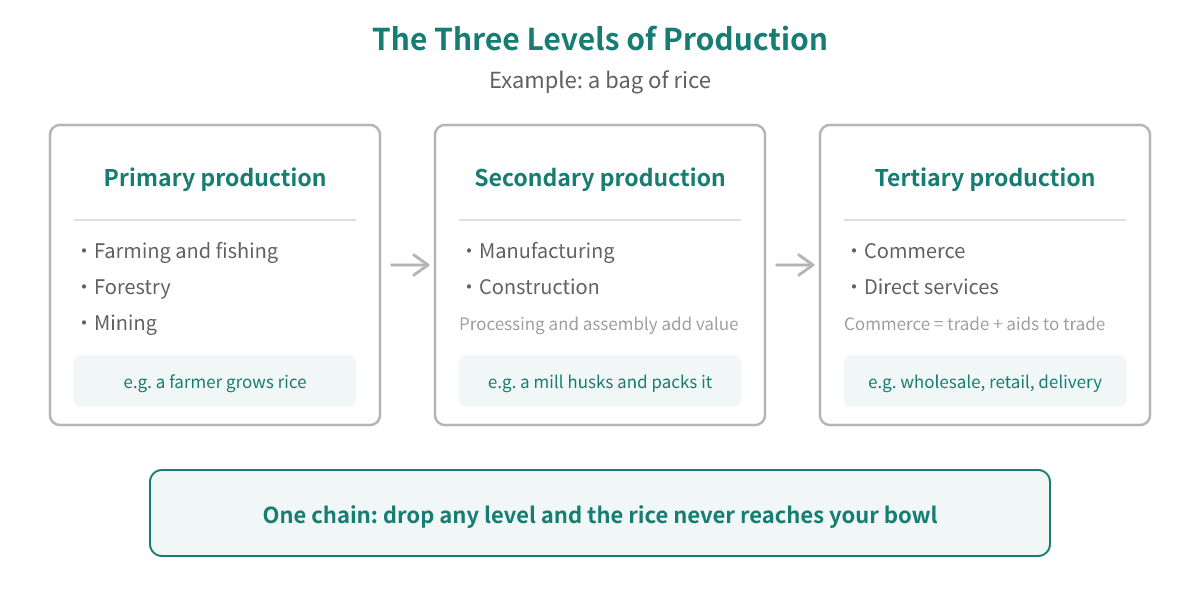
The figure sets the three levels out from left to right. Notice that they are not three separate industries but one chain. Without primary production there are no raw materials for secondary production to work on; without tertiary production to move and sell the goods, finished stock is stuck in the factory and never reaches a consumer. Take any one level away and the chain breaks.
What is inside commerce?
Of the three levels, commerce is what the exam asks about most. Many students think commerce simply means buying and selling, but buying and selling is only half of it. Commerce has two parts: trade, which is the buying and selling itself, and the aids to trade, which are everything that makes buying and selling possible. Without the support, trade cannot happen at all. When you order a shirt online, it is not enough that somebody is willing to sell it. A courier has to deliver it, a payment platform has to move the money, insurance has to cover the shipment, and advertising had to tell you the shirt existed.
Commerce: the part of tertiary production that brings goods from the producer to the consumer. 1. Trade: the buying and selling of goods itself. 2. Aids to trade: the services that support the buying and selling of goods.
There are six aids to trade. The easiest way to remember them is to follow one shipment as it makes its way safely and punctually to you:
- Transport: moving goods from one place to another, closing the distance between production and consumption.
- Warehousing: storing goods until they are sold, closing the gap in time between production and consumption.
- Banking and finance: handling payments and providing loans, so neither side has to carry cash around.
- Insurance: transferring the risk of fire, theft and damage in transit away from the business.
- Communication: passing orders, quotations and delivery arrangements between buyer and seller.
- Advertising: telling consumers what is for sale, where to buy it and why it is worth having.
Trade itself is usually classified twice over. The first classification asks whether the goods cross a border: buying and selling within one place is home trade, and buying and selling across borders is foreign trade, which divides further into import, export and re-export. Re-export is stock that comes into Hong Kong, is not consumed here, and is shipped on to a third place. The second classification asks where the business sits in the chain: a wholesaler buys in bulk, breaks the quantity down and sells to retailers; a retailer sells directly to you and me.
Classifying trade: 1. Home trade: buying and selling within the same place, divided into wholesale and retail. 2. Foreign trade: buying and selling across a border, divided into import, export and re-export.
A word on Hong Kong itself. Primary production here is close to zero, and most secondary production moved to the mainland after the 1980s. Almost all the economic activity that remains is tertiary: finance, trade and logistics, professional services and tourism — the four pillar industries. So nearly every business you see in Hong Kong sits in tertiary production, and that is where most exam scenarios come from.
This article classified business activity from one end of the chain to the other: which businesses take the raw materials, which process them, and which get them to you. The next article moves from classification to the forms a business can take. The same shop can be run by one person alone, by several people together, or as a limited company. The first of those, and where most people start, is the sole proprietorship. Keep an eye on our blog!
Learn more: DSE BAFS tutoring
To republish this article, please email [email protected].