
The last article classified business activity and showed what each kind of business does. This one turns to the forms of business ownership. The same cha chaan teng can be run by one person alone, by several people together, or as a limited company. The three forms differ sharply in who puts up the money, who manages it, who carries the liability and who takes the profit or the loss — and the exam loves asking you to explain the advantages or disadvantages of one form over another. We start with the simplest, and the one most people begin with: the sole proprietorship.
What is a sole proprietorship?
A sole proprietorship is a business where one person puts up the money, makes every decision and carries everything. That person is the sole proprietor: the capital comes out of their own pocket, day-to-day running is up to them, all the profit is theirs, and when the business loses money nobody shares the loss. Most of the businesses you see around you — a market stall, an upstairs tutorial centre, a small estate cha chaan teng, a one-person online shop — are sole proprietorships. It is by far the commonest form of business in Hong Kong.
Sole proprietorship: a business owned, financed and run by one person. 1. The proprietor takes all the profit alone, and bears all the loss alone. 2. The business is not a separate legal entity: in law the proprietor and the business are the same person.
Setting one up involves the least paperwork of the three forms. There is no company incorporation, no minimum capital, and no requirement to publish accounts. All the law asks is that within one month of starting business you apply to the Business Registration Office of the Inland Revenue Department for a Business Registration Certificate and pay the fee. Rent a shop, buy some stock, put up a sign, and you are trading.
In law, the owner and the business are one person
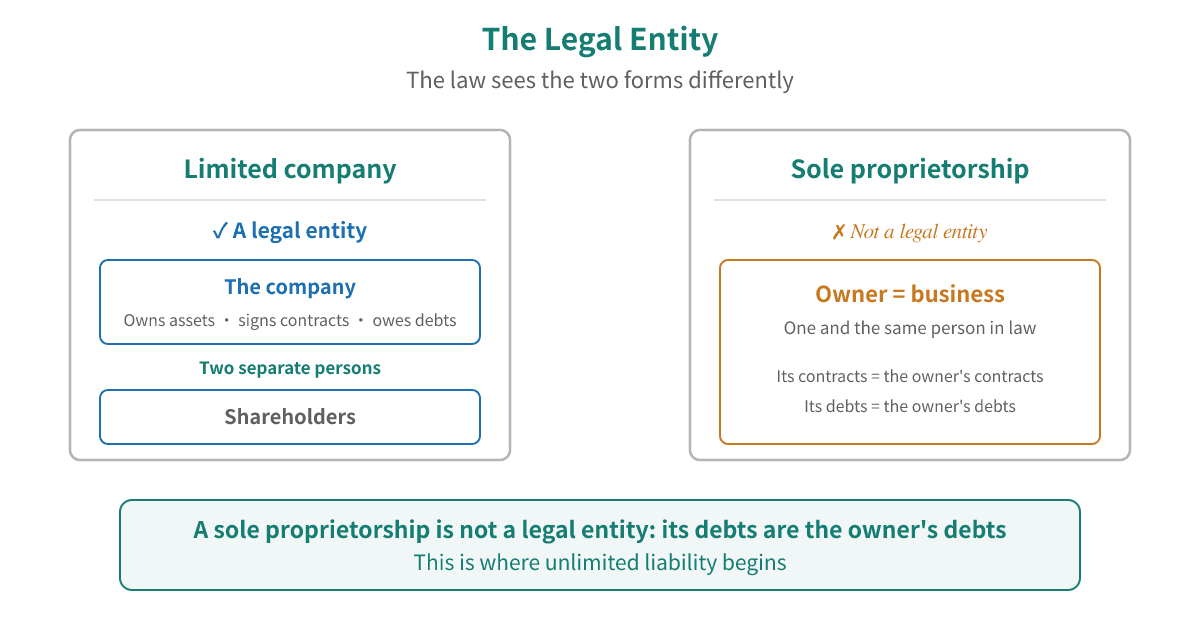
This is the single most important sentence in the article: a sole proprietorship is not a legal entity. What is a legal entity? The law recognises two kinds of "person". One is a natural person — a flesh-and-blood human being like you. The other is an organisation the law treats as a person in its own right: a legal entity. A legal entity can own assets, sign contracts, borrow, sue and be sued, all in its own name. The classic example is a limited company: the company itself is a "person", separate in law from its shareholders.
A sole proprietorship is the opposite. In accounting we apply the business entity concept and keep the business's records separate from the owner's own affairs. In law the two were never separate at all — the shop is not a legal entity, so a contract signed by the shop is signed by the owner, and a debt owed by the shop is owed by the owner.
Legal entity: an organisation the law treats as a person in its own right, able to own assets, enter into contracts, and sue and be sued in its own name. 1. A limited company is a legal entity: in law the company and its shareholders are two different persons. 2. A sole proprietorship is not: in law the business and the owner are the same person.
The price of not being a legal entity: unlimited liability
Precisely because a sole proprietorship is not a legal entity, when the business fails the creditors do not stop at the shop — in law there is no separate "shop" to stop at. The debt was the owner's debt from the very beginning, so the creditors pursue the owner directly, and there is no ceiling on how much they can claim. That is unlimited liability.
Unlimited liability: debts the business cannot repay must be settled out of the owner's personal property, with no upper limit on the amount. 1. The owner's savings, property and car can all be claimed against. 2. This is the greatest risk in a sole proprietorship and a partnership.
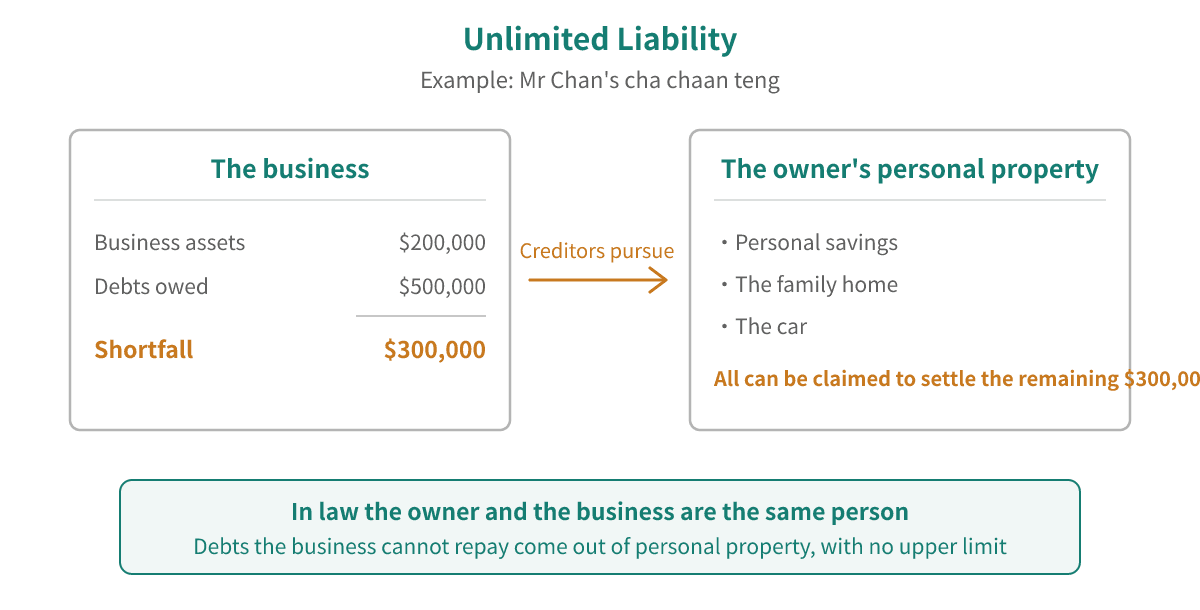
The figure works through an example. Mr Chan runs a cha chaan teng with $200,000 of assets in the business, but it owes suppliers and the bank $500,000 in total. The business cannot cover $300,000 of that, and the creditors do not simply write it off. They can require Mr Chan to meet the shortfall out of his personal savings, the flat he lives in and his car. In other words, what he stands to lose is not just the capital he put into the shop but everything he owns. That is what "unlimited" actually means, and it is the point the exam tests most often.
The advantages
- Simple and cheap to set up: one business registration certificate is enough, with no incorporation, so both the time and the cost are the lowest of the three forms.
- Fast decisions: there are no shareholders and no partners to consult, so the owner can change direction the moment an opportunity appears.
- All the profit: whatever the business earns belongs to the owner and is not shared.
- Privacy: the law does not require the accounts to be published, so competitors cannot see what the business earns.
- Close to customers: the business is small and the owner serves in it personally, which makes a personal service and long-term relationships easy to build.
- Easy to wind up: to stop trading, cancel the business registration and settle the debts.
The drawbacks
- Unlimited liability: debts the business cannot repay come out of the owner's personal property.
- Limited capital: the only funds available are one person's savings and borrowing power, which makes expansion difficult.
- Hard to borrow: the business is small and has little to offer as security, so a bank may refuse a loan.
- Short life: when the owner dies, retires or goes bankrupt, the business ends immediately in law.
- One person does everything: buying, selling, keeping the books and hiring all fall to the owner, with no specialist division of work and a great deal of pressure.
- Small scale, higher costs: buying in small quantities earns no bulk discount, which makes competing on price with a chain very hard.
Continuity: in law a sole proprietorship and its owner are the same person, so when the owner dies, retires or goes bankrupt the business ends at once. There is no continuing existence beyond the owner.
How does the exam ask it? Forms of ownership is comparison territory: the typical HKDSE question asks you to explain the advantages or disadvantages of one form over another — "Explain two advantages of a sole proprietorship over a partnership", or a scenario in which an owner plans to turn a sole proprietorship into a private limited company and you must explain what the change would bring. Every point has to be written as a comparison to earn its mark. Do not write "it is simple to set up"; write "a sole proprietorship takes less procedure and cost to set up than a limited company". Do not write "it is risky"; write "a sole proprietor bears unlimited liability and personal property can be claimed against, while a limited company's shareholders are liable only up to the capital they put in". Two reminders: name the form you are comparing against, because an advantage with no comparison attached earns nothing; and tie each point back to the scenario — the scale, the capital, the risk — before moving on to the next.
The advantages and the drawbacks of a sole proprietorship are usually two sides of the same fact: because there is only one person it is fast and free, and because there is only one person it is small and exposed. The most direct way to address the capital and the risk is to bring in another person. The next article is about partnership — which of these problems get better once there is a partner, and which new ones appear. Keep an eye on our blog!
Learn more: DSE BAFS tutoring
To republish this article, please email [email protected].