
The last article dealt with which costs to leave out: a sunk cost always drops away. This one deals with the other half. The costs that do count come in two kinds. One hurts when you hand the money over. The other never makes you open your wallet, and is a cost all the same. They are the explicit cost and the implicit cost.
Article three defined cost as the highest-valued option given up in making a decision. Since the definition is about what is given up, money does not have to change hands for something to be a cost. An explicit cost is money actually paid out. It has a receipt, and it shows up in the accounts. An implicit cost is what you give up by using a resource you already own — your time, your savings, your own shop — measured by that resource's highest-valued alternative use. Nobody invoices you for it, and you have genuinely given something up.
1. Explicit cost: money actually paid out for a decision, often called the money cost. 2. Implicit cost: the highest-valued alternative use given up when a decision uses a resource you already own. The most common example is the cost of your time. 3. The total cost of a decision = explicit cost + implicit cost.
Take an example and work it out. May currently works for a company on a salary of $280,000 a year, and has $400,000 in savings on a fixed deposit earning $12,000 of interest a year. She decides to resign, put those savings into a snack shop, and run it for a year.
Start with the explicit costs — the money she actually writes cheques for during the year. Rent is $180,000, stock is $300,000, staff wages are $150,000, and utilities and sundries come to $30,000. That is $660,000 in total. Every one of those figures appears in the accounts, and she is well aware of all of them, because each one really left her hands.
Now the implicit costs — what she gives up by using her own resources. First, she resigned, so she gives up the $280,000 salary. Her time this year goes into minding the shop and cannot go into a job as well. Second, she took $400,000 of savings and put it into stock and fitting out the shop, so she gives up the $12,000 of deposit interest. Together that is $292,000. Nobody bills her for that $292,000 and it appears nowhere in the accounts, but it is genuinely gone.
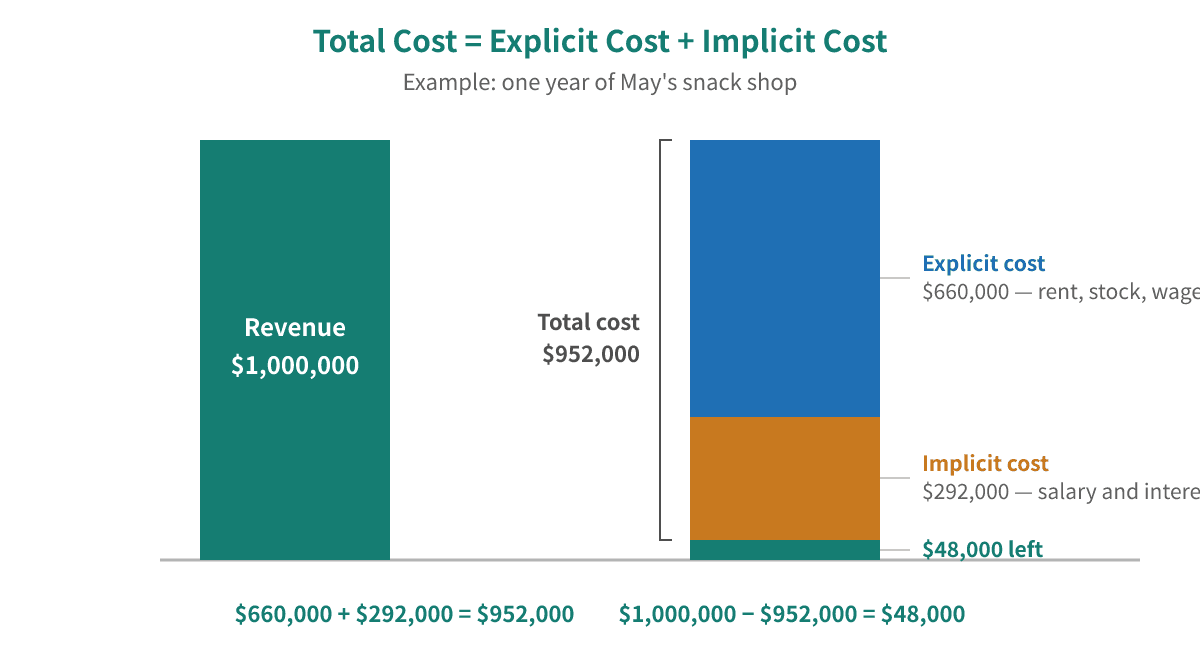
The figure puts the year's numbers side by side. Explicit and implicit cost stacked together come to a total cost of $952,000. The shop's revenue for the year is $1,000,000, so $48,000 is left. Notice that the implicit block is nearly half the size of the explicit one. Counting only explicit costs, May would think she had made $340,000 for the year and be delighted. Counting the implicit costs too, the real return is $48,000 — barely better than staying in her job.
How to spot an implicit cost: 1. Ask which resources you already owned that this decision uses — time, money, property, equipment. 2. Then ask what that resource could otherwise have done, and what the highest-valued of those uses is worth. That figure is the implicit cost.
Two mistakes come up constantly. The first is thinking that if no money is paid, there is no cost. Suppose the shop is in a property owned by May's father and she pays no rent. Plenty of people then treat rent as zero. Wrong: the property could have been let for $180,000, and that $180,000 is an implicit cost that must be counted in full. The second is treating the owner's own labour as an explicit cost. An owner working in the shop does not pay themselves a wage, so their labour is an implicit cost. Hire an assistant, and the wage paid to the assistant is an explicit cost. The same job falls into a different box depending on who does it.
One boundary against the last article: an implicit cost is not a sunk cost. A sunk cost is already gone and is the same whether you act or not, so it drops out. An implicit cost is the opposite — it depends entirely on which option you choose. If May does not open the shop, she does not give up the $280,000 salary. Anything that changes with the decision has to be counted.
With the two kinds of cost sorted out, the next article uses May's figures again to look at accounting cost and economic cost — why the shop earns $340,000 in an accountant's eyes and only $48,000 in an economist's, why the two figures differ so much, and which one the exam wants.
Learn more: DSE Economics tutoring
To republish this article, please email [email protected].