

In the last article we defined cost and opportunity cost, and we said that a rational decision is one whose marginal benefit is greater than or equal to its marginal cost. Knowing the definition is one thing; using it to answer a question is another. This article works through two everyday examples and one common exam question so you can see how benefit and cost are actually applied.
In practice we do not put two piles of numbers side by side and compare them at once. We work through three steps. First, list every option. Second, measure the benefit and the cost of each option. Third, compare them one unit at a time: as long as marginal benefit (the extra benefit from one more unit) is greater than marginal cost (the extra cost of that unit), keep going. That last step is the one students most often skip. An economic decision is rarely "do it or not". It is usually "how many units should I do".
Marginal decision rule: compare marginal benefit with marginal cost one unit at a time, until the two are equal. 1. Marginal benefit greater than marginal cost: add that unit, and net benefit rises. 2. Marginal benefit less than marginal cost: drop that unit, and net benefit rises.
Here is the first example. Ming is deciding how many tutorial lessons to take. Each lesson costs $300, so the marginal cost of one more lesson is always $300. We measure marginal benefit by the most he is willing to pay for each lesson. The first lesson takes him from knowing nothing to knowing a formula, and he would pay $700 for it. The second is worth $500 to him, and the third $300. By the fourth the material starts to repeat, and he would only pay $150. Now compare lesson by lesson. First lesson: $700 is more than $300, so take it. Second: $500 is more than $300, so take it. Third: $300 equals $300, which just qualifies, so take it. Fourth: $150 is less than $300, so stop. Ming should take three lessons.
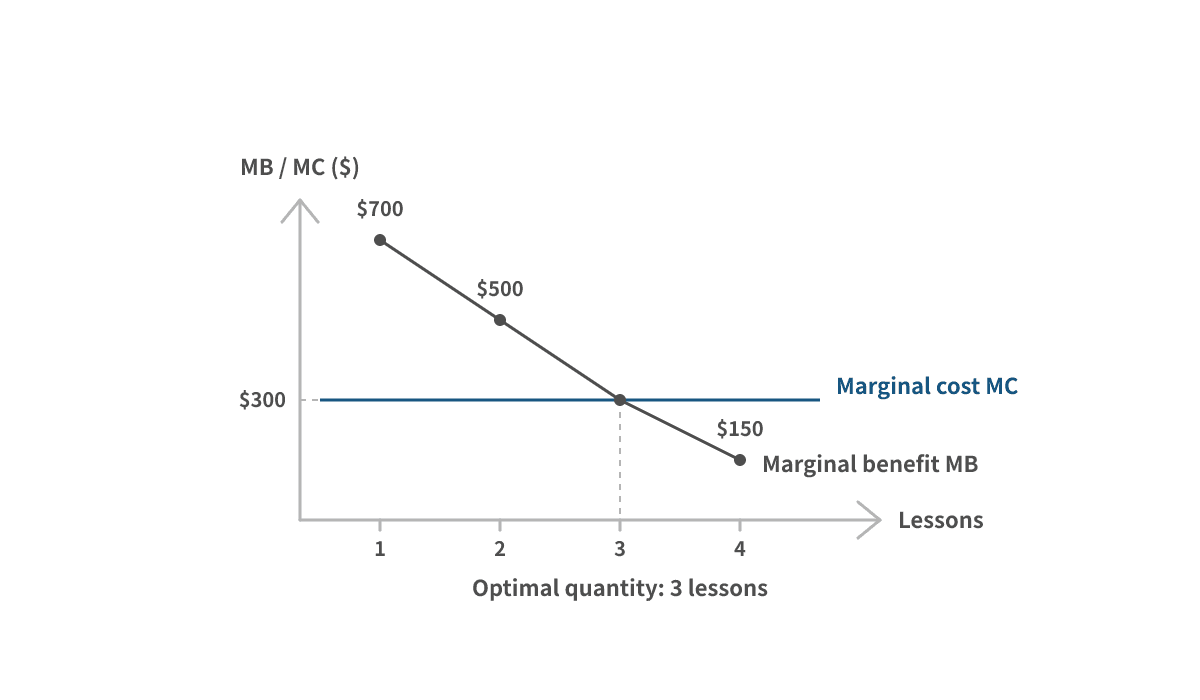
The figure joins the marginal benefit of the four lessons into a downward-sloping line. Because every lesson costs the same, marginal cost is a flat line at $300. The two lines meet at three lessons, and that is the optimal quantity. Note that at the third lesson marginal benefit exactly equals marginal cost, so taking it or skipping it makes no difference. The fourth lesson is a loss: taking it would cut net benefit by $150.
Optimal quantity: the quantity at which marginal benefit equals marginal cost, where net benefit is at its maximum.
The second example does not ask "how many". It asks you to choose one of two options. May can take a summer job or enrol in a summer course. They clash, so she can only do one. The benefit of the job is the $12,000 wage, and its explicit cost is $1,000 for transport and meals. The benefit of the course is what she learns, which she values at $9,000 at most, and its explicit cost is the $4,000 fee.
Net benefit: the benefit of an option less the explicit cost of that option. 1. Among mutually exclusive options, a rational person chooses the one with the highest net benefit. 2. The highest net benefit among the options given up is the implicit cost of the option chosen.
Compare net benefits: the job gives $12,000 less $1,000, which is $11,000; the course gives $9,000 less $4,000, which is $5,000. So she should take the job. The other method uses the definition of cost from the last article: the cost of taking the job is the explicit cost of $1,000 plus the implicit cost, which is the $5,000 net benefit of the course she gives up, for a total of $6,000. Her benefit is $12,000, which exceeds $6,000, so again she should take the job. The two methods always give the same answer, and even the same margin: $11,000 less $5,000 and $12,000 less $6,000 both come to $6,000. In an exam, pick one method and carry it through. The mistake to avoid is mixing them — counting the forgone course as a cost, and then comparing against the course a second time. That is double counting.
Finally, here is how the exam asks it. A cha chaan teng currently closes at ten each night. If it stays open one more hour, it takes in an extra $800 and pays an extra $600 in wages and electricity. Should it stay open? Many students answer "because the restaurant makes money", and get no marks. The answer that earns marks is this: the marginal benefit of the extra hour, $800, is greater than its marginal cost, $600, so it should stay open — and it should keep extending until the marginal benefit of one more hour equals its marginal cost. When a question asks about the margin, do not answer with totals.
You may be wondering: if the restaurant has already paid a full year's rent, does that rent count as a cost? In the next article we look at sunk cost — a cost that should never enter a rational decision.
Learn more: DSE Economics tutoring
To republish this article, please email [email protected].