

The last article ended on a question. If a cha chaan teng has already paid a full year's rent, does that rent count in the cost of staying open one extra hour? It does not. Why? Because that rent has become a sunk cost.
The last two articles kept insisting on one word: marginal. When you make a decision, you count only the benefits and costs that change because of that decision. A sunk cost is the opposite of that. It is money already paid that cannot be recovered. Whether you go ahead or not, it sits there, exactly the same to the last dollar. Because it does not move with your decision, it cannot make one option better than another — so it drops out of the comparison entirely.
Sunk cost: a cost already paid that cannot be recovered. 1. A sunk cost does not change with any later decision. 2. So a rational decision never counts a sunk cost.
You do not need to memorise how to spot one. Just ask: would this amount be different if I chose A rather than B? If it is the same either way, it is sunk. Say you bought a concert ticket for $800 and it can be neither refunded nor transferred. On the day it pours with rain, and you are deciding whether to go. The $800 is gone either way. So the real comparison is the benefit of going (seeing the show) against the cost of going (the fare, getting soaked, those few hours). The $800 has nothing to do with it.
Back to the restaurant. Suppose this year's rent of $240,000 was paid in one go, with no refund and no chance to sublet. The owner is deciding whether to stay open from ten until eleven: one more hour brings in $800 and costs an extra $600 in wages and electricity. Notice that the $240,000 is identical under both options — staying open and closing.
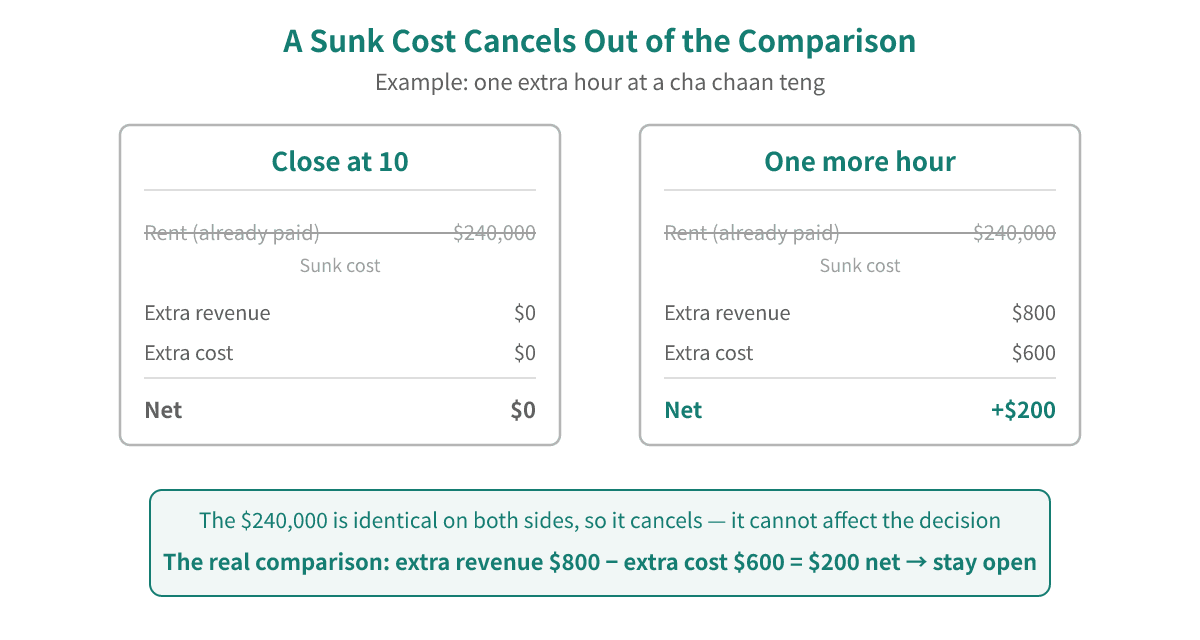
The figure puts the two options side by side. The $240,000 appears on both sides, so subtracting one from the other cancels it, and it has no effect on the answer at all. That is what "ignore it" actually means: not that the money never existed, but that it disappears from the comparison by itself. What is left is $800 against $600. Marginal benefit exceeds marginal cost, so the restaurant should stay open. Even if the shop is losing money this year, the answer is the same.
Sunk cost fallacy: carrying on with a decision that is not worth making, because you do not want to lose the sunk cost you have already paid. 1. What is lost is lost; carrying on only loses more. 2. Every decision looks forward, and counts only the benefits and costs that can still change.
The fallacy is everywhere in ordinary life. You pay $300 to see a film and fifteen minutes in you realise it is dull. Stay and the $300 is gone; walk out and the $300 is gone just the same. There is only one difference: staying costs you another hour and a half, and leaving saves it. The rational move is to leave. But plenty of people think "I already paid, it would be a waste not to watch" — and that sentence is what makes them lose an hour and a half on top of the money they had already lost.
There is one boundary to watch, though. Whether an amount is sunk depends on whether it can be recovered, not on when it was paid. Suppose you spent $8,000 on a computer, used it for a year, and could resell it today for $3,000. Only $5,000 of that is truly sunk. The $3,000 is recoverable, so it must be counted when you decide whether to keep the computer or sell it. In the same way, if half the concert ticket is refundable, that half is not a sunk cost.
How does the exam test this? Usually with a scenario that deliberately mixes one or two sunk costs into the figures, to see whether you take them out. For example: a company has already spent $500,000 on market research and is deciding whether to launch a new product; launching needs another $2,000,000 and is expected to bring in $2,300,000. The $500,000 is spent and stays out of it. Compare only $2,300,000 with $2,000,000, and the company should launch. When you answer, write the reasoning down: "the $500,000 is a sunk cost, it does not change with this decision, so it is not taken into account". The marks are for saying it. Getting the arithmetic right is not enough.
That is half of cost sorted out: which amounts count and which do not. The next article takes the other half. A cost that does count can still be split into an explicit cost and an implicit cost. Both names appeared once in article three; next time we take a real business and work through it item by item.
Learn more: DSE Economics tutoring
To republish this article, please email [email protected].