

Last time, we used the factor theorem to write a polynomial as a product of factors. A factor divides a polynomial with no remainder. Now we compare two polynomials. How much do they share? What is the smallest collection of factors that contains everything either polynomial needs? These questions lead to the highest common factor and lowest common multiple. First factorise, then compare. Matching terms in expanded expressions will not reveal repeated factors reliably.
A shared factor or a common multiple?
Highest common factor (HCF): a common factor of the greatest possible degree that divides every original polynomial exactly. Degree means the highest power of the variable after expansion. 1. Every factor included must occur in all the originals. 2. The smallest available number of copies limits how many we can take. Handle the numerical part using the HCF of the integers.
Lowest common multiple (LCM): a non-zero polynomial of the least possible degree that every original polynomial divides exactly. 1. Include every factor needed by any original. 2. Take enough copies to meet the largest requirement. Handle the numerical part using the LCM of the integers.
Keep the division directions clear: divide each original by the HCF, and divide the LCM by each original. Our examples have integer coefficients, the numbers multiplying the powers of the variable. Extract the integer common factor before factorising the brackets fully. Choose a positive numerical part using integer HCF and LCM rules. We compare factor counts, not values obtained by substituting a particular number.
Factorise both expressions completely
Find the HCF and LCM of and . Their expanded forms hide repeated factors. Extract the numerical factors first. Then use the previous article's method to find a linear factor. A perfect square expression, a product of two identical factors, will help finish the second factorisation.
- Start with . Substituting 1 inside the bracket gives , so is a factor. Division gives .
- Factorise the quadratic: . Therefore . The square records two copies of the same factor.
- For the second expression, . Substituting 1 gives . Divide by to obtain .
- The quotient is a perfect square: . Thus . This time the other bracket occurs twice.
Split the numerical parts too: and . Each tile below represents one factor. Columns line up the same copy of the same factor. A dashed space means that copy is absent; it does not mean multiplying by 0. An absent factor has exponent 0.
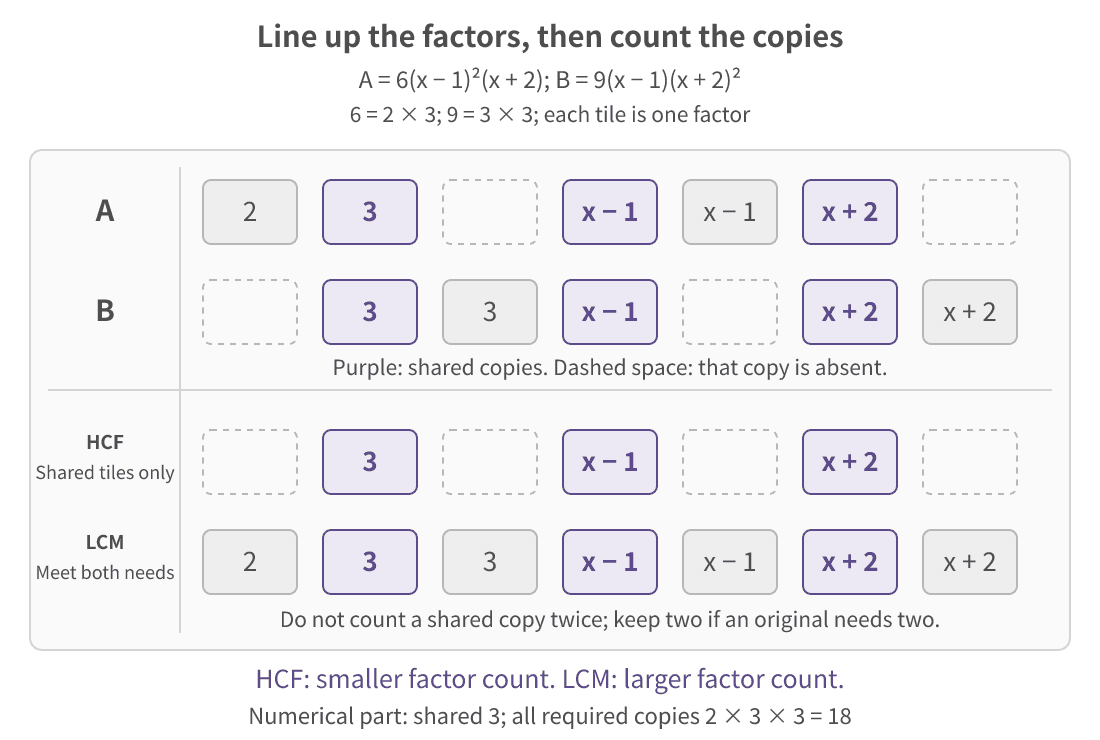
The HCF row keeps only tiles present in both originals. The LCM row keeps any tile needed by either original. A shared copy need not be counted twice. However, if an original already needs two copies, the LCM must keep two. This explains the smaller-power and larger-power rules.
Choose the required number of copies
- For the HCF, start with the numbers. The HCF of 6 and 9 is 3. We cannot choose 6 because it does not divide 9 exactly.
- Compare : the first expression has two copies and the second has one. Both can supply only one copy.
- Compare : the first expression has one copy and the second has two. Again, take one. Multiply the chosen factors.
Why not add another ? The second original would not have enough copies, so the result would no longer divide it exactly. Adding another would exceed the first original's supply. The HCF must include all shared copies while staying a factor of both originals.
- For the LCM, the numerical part is 18, the LCM of 6 and 9. It has one copy of 2 and two copies of 3, enough to meet each number's needs.
- For , the first expression needs two copies. Include .
- For , the second expression needs two copies. Include . Both originals can now divide the result exactly.
Factor-count rule: factorise fully, then compare the exponent of each factor. An exponent records its number of repeated copies. 1. For the HCF, choose the smaller exponent. 2. For the LCM, choose the larger exponent. Treat an absent factor as having exponent 0. A factor found in only one original is excluded from the HCF but included in the LCM.
Check by division
Divide each original by the HCF. Then divide the LCM by each original. All four quotients below are polynomials, with no factor left in a denominator. This confirms both division directions. These are statements about polynomial division, not instructions to evaluate a fraction where its denominator is zero.
Another quick check is . For each factor, the smaller exponent plus the larger exponent equals the sum of the two original exponents. The numerical parts also satisfy . This relation applies to two non-zero polynomials; do not apply it directly to three. Simply multiplying the originals usually counts shared factors twice, so their product need not be the LCM.
Use this order: factorise fully, compare copies, multiply the chosen factors, and check by division. Leave the answers in factorised form so the shared structure stays visible. Next time, we begin linear equations in one unknown and word problems: turning conditions into an equation, then solving for the unknown step by step.
Learn more: DSE Mathematics tutoring
To republish this article, please email [email protected].