
Last time, we compared the highest common factor and lowest common multiple of polynomials by identifying their factors. Now we use algebra to find an unknown number. Two difficulties often arise: why we can rewrite an equation in a particular way, and how to turn a written condition into an equation. We will work through both, starting with the meaning of the equals sign.
Keep both sides equal
A linear equation in one unknown can be written as after simplification. There is one unknown, ; are constants and . The highest power of the unknown after simplification is 1. A solution is a value of the unknown that makes both sides equal when substituted into the equation.
Properties of equality: adding or subtracting the same expression on both sides preserves equality. Multiplying or dividing both sides by the same non-zero number also preserves equality. Each step in solving an equation must keep its original solutions. Changing only one side generally breaks the equality.
Example 1: solve . The equals sign says that the expressions on either side have the same value. It does not mean “keep calculating from left to right”. The 3 outside the bracket multiplies everything inside it. We then remove matching parts from both sides until the unknown stands alone.
For now, write out each operation instead of using a rule about moving terms. Understanding what happens on both sides will help when the equation contains negative signs, brackets or an unknown on the right.
- Use the distributive law, which multiplies each term inside the bracket: . The constant is , not 2.
- Subtract from both sides: .
- Collect like terms, terms with the same variable part: . Three copies minus two leave one on the left. The unknown terms on the right cancel.
- Subtract 6 from both sides: . The solution is .
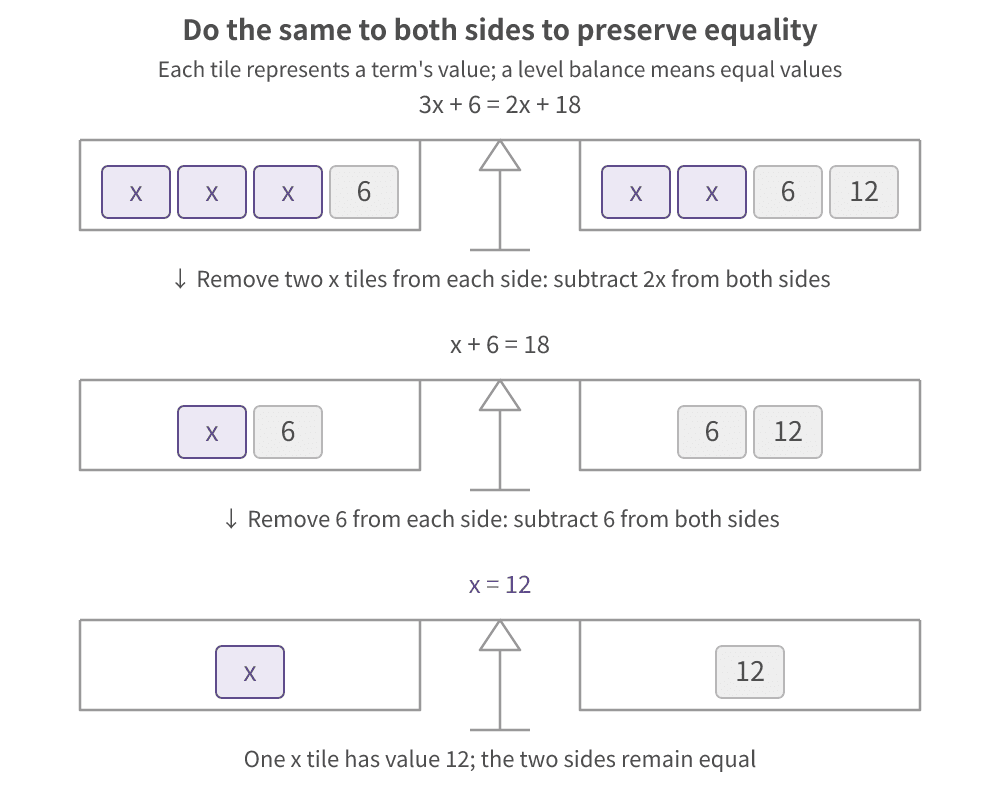
Reading the diagram: each tile represents the value of its term. A level balance means that the two sides are equal. Purple tiles show the unknown. First remove two unknown tiles from each side. Then remove 6 from each side. These are the two subtraction steps above. “Move a term and change its sign” is a shortened way of recording the same operation on both sides. Finally, substitute into the original equation: both sides give 42.
Turn a word problem into an equation
Example 2: a student cinema ticket costs HK$20 less than an adult ticket. Ching buys 3 adult tickets and 2 student tickets for HK$210 in total. Find the price of each type. Choose one ticket price as the unknown, then express the other price using that same unknown. We can solve this with one unknown.
Forming an equation means connecting two equal quantities with an equals sign. 1. State what the unknown represents and its unit. 2. Express the related quantities using it. 3. Identify the equality. Here, the total cost of the tickets equals the amount paid.
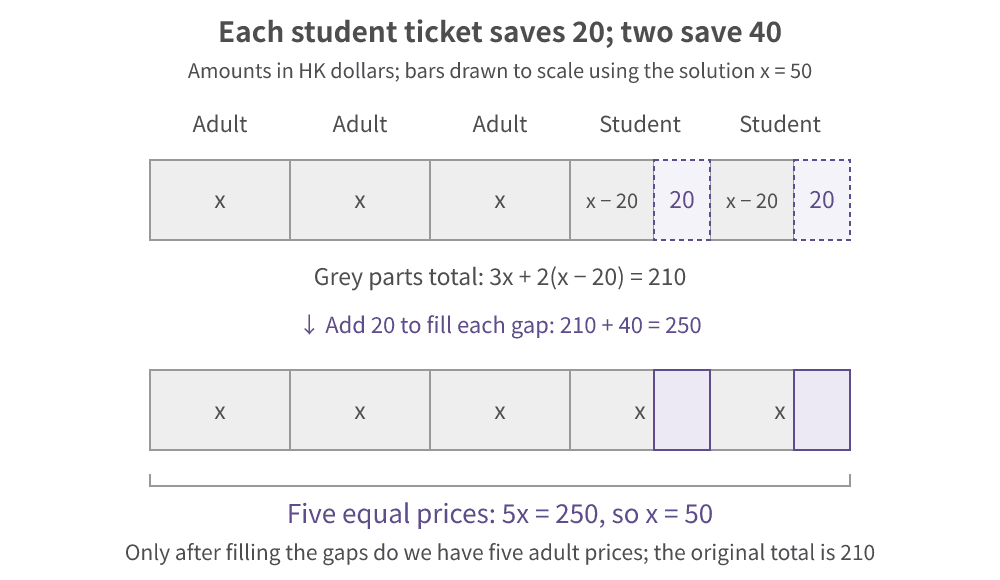
Reading the diagram: grey bars show the amounts paid. The two purple dashed gaps represent HK$20 saved on each student ticket. Let the adult price be HK$. The student price is HK$. For two student tickets, multiply the whole bracket by 2. The saving applies to each ticket. Add the costs of all five tickets to form the equation.
- Expand the bracket, including the saving on both tickets: .
- Collect like terms: .
- Add 40 to both sides to fill the two price gaps: .
- Divide both sides by 5: . The student price is .
An adult ticket costs HK$50 and a student ticket costs HK$30. State both requested prices with their units. Then check the original situation: the price difference must be HK$20, and 3 adult tickets plus 2 student tickets must cost HK$210. Checking the total alone would leave one condition unchecked.
The bars explain why we add 40. Filling the two gaps creates five equal adult prices, so the total must increase too. The diagram is drawn to scale using the final prices to make this relationship visible. When forming the equation, we use the stated saving of 20 per ticket. We do not measure the picture to guess an unknown price.
Check signs, denominators and meaning
- When subtracting a bracket, apply the minus sign to every term: .
- To clear numerical denominators, multiply both sides by their lowest common multiple. Multiply every term. For example, multiplying by 2 gives . Subtracting 6 gives . Check: .
- The answer must fit the situation. A number of people must be a non-negative whole number; these ticket prices must be positive. If an answer is impossible, check the meaning of the unknown, the direction of comparisons and the equation. Do not simply round it.
Use a consistent order: define the unknown, identify equal quantities, perform the same operation on both sides, and check every original condition. Understanding those steps is more reliable than memorising rules for moving symbols.
Next time, we study simultaneous linear equations. With two unknowns, we combine two conditions to find their values. Substitution and elimination will use the same principle: preserve equality by carrying out the same operation on both sides.
Learn more: DSE Mathematics tutoring
To republish this article, please email [email protected].