
Last time, we solved equations in one unknown and a ticket-price problem. Each step kept the two sides equal by applying the same operation to both. With two unknowns, one condition is usually not enough. We now combine two conditions, then use substitution or elimination to reduce the problem to one unknown.
Simultaneous linear equations are linear equations involving two unknowns that must hold at the same time. A solution is a pair of values, written in a fixed order as . Substituting that same pair must make the two sides of every equation equal.
Example 1: solve the equations below. The pairs and both satisfy the first equation: their values add to 7. The second equation also requires twice plus to equal 11. We need a pair that passes both tests.
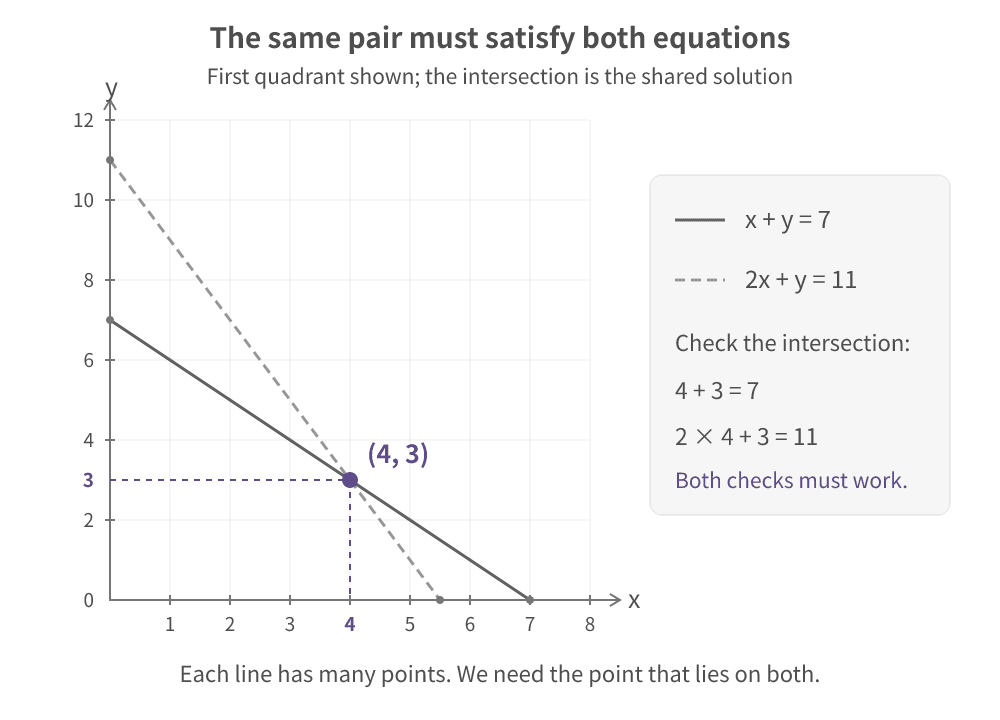
Diagram: every point on a line satisfies its equation. Only the first-quadrant portions are shown. The purple intersection lies on both lines and is therefore the simultaneous solution. The graph shows what we are looking for. Algebra will give us exact values without measuring the picture.
Substitution: replace an unknown with an equal expression
Substitution: 1. Use one equation to express one unknown in terms of the other. 2. Replace that unknown in the other equation with the whole expression. 3. Solve for one unknown, substitute back to find the other, and check both original equations.
- Subtract from both sides of equation (1): . This is the same relationship in a different form.
- Replace in equation (2), using brackets around its replacement: .
- Multiply every term inside the bracket by 2: . Keep the minus sign on the second term.
- Collect like terms to leave one unknown: .
- Subtract 14 from both sides: . There is still a minus sign attached to the unknown.
- Divide both sides by : . Both minus signs disappear.
- Substitute back into the earlier expression: . Now both unknowns have been found.
The answer is . Substitute the same pair into both original equations. Both checks below work. Checking the first equation alone is insufficient: passed that test too, but it failed the second.
Elimination: make matching terms cancel
Elimination: 1. Make the coefficients of one unknown equal or opposite in the two equations. 2. Subtract or add the equations to cancel that unknown. 3. Keep an original equation and use it with the new equation to find both values. When multiplying an equation, multiply every term on both sides.
Example 2: neither equation below has an unknown already on its own. Isolating one would introduce fractions. Elimination lets us match coefficients first and keep the calculation simple.
Choose to eliminate . Its coefficients are 2 and 3, whose lowest common multiple is 6. Multiply both sides of equation (3) by 3, and both sides of equation (4) by 2. The constant terms must be multiplied too. This gives the following equations.
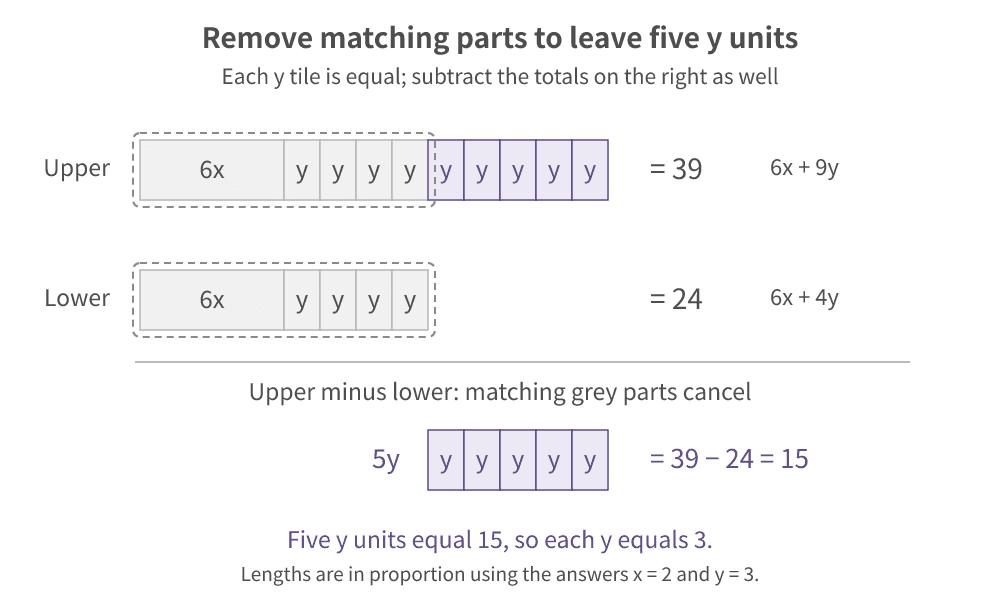
Diagram: subtract the lower row from the upper row. The dashed grey sections contain matching terms and four matching units. Removing them leaves five purple units. Subtract the totals on the right as well. The strips use the final values to show lengths in proportion. We solve using the equations, not by measuring their widths.
- Subtract the lower equation from the upper one. Bracket the whole expression being subtracted: .
- Remove the second bracket, changing the sign of every term inside it: . The last term changes sign too.
- Collect like terms: . Divide both sides by 5 to obtain .
- Substitute into original equation (3): , which simplifies to .
- Subtract 9 from both sides: . Divide both sides by 2 to obtain .
The second answer is . Check original equations (3) and (4). Checking only the equation produced by subtraction cannot test , because that unknown has already been eliminated.
- Substitution is often convenient when an unknown has coefficient 1 or negative 1. If isolating an unknown introduces fractions, consider elimination. Both methods are valid; choose the route with fewer fractions and steps.
- Look at the signs before eliminating. Subtract equal coefficients of the same sign, as in . Add opposite coefficients, as in . Subtraction is not always the right choice.
Two equations do not guarantee exactly one solution. For and , the second equation repeats the first condition. The lines coincide, giving infinitely many solutions. Change the second equation to . Subtract twice the first equation from the second to get the contradiction . The lines are parallel, so there is no solution. If all unknowns cancel, examine whether the remaining equality is true.
Next time, we use simultaneous equations in word problems. We will define two unknowns from quantities and prices, form two equations, choose a method to solve them, and state the requested quantities with their units.
Learn more: DSE Mathematics tutoring
To republish this article, please email [email protected].