
Last time, we learned substitution and elimination. Once the equations were given, we could solve them. A word problem adds an earlier step: decide what the unknowns represent and turn the conditions into equations. We will work from the words to the final answer, including checks, rather than guessing which numbers to multiply.
A mathematical model describes a situation using mathematical relationships. To model a problem with simultaneous linear equations: 1. Define two unknowns and their units. 2. Use two conditions to form two linear equations that must hold together. 3. Solve them and check whether the results make sense in the situation.
Ticket sales: separate the number sold from the money collected
Example 1: adult tickets for a performance cost HK$60 each. Student tickets cost HK$35 each. A total of 40 tickets are sold for HK$1800, with no other charges or discounts. How many tickets of each type are sold? The prices are known. The unknowns should represent the numbers of tickets.
Let be the number of adult tickets and the number of student tickets sold. The numbers add to 40. Adult tickets bring in Hong Kong dollars, and student tickets bring in Hong Kong dollars. These amounts add to HK$1800. Adding the two ticket prices alone would not give the money collected.
An equality relation states that two quantities are equal. Both sides of an equation must use the same units: ticket counts match ticket counts, and dollars match dollars. A total amount is a unit price multiplied by a quantity. Do not add a number of tickets directly to an amount of money.
The equations use different conditions. Many combinations add to 40 tickets; the income condition selects the correct combination. Multiplying the first equation by 2 would only repeat that condition, leaving the income unused. To solve by elimination, multiply the first equation by 35 so that the student-ticket terms match.
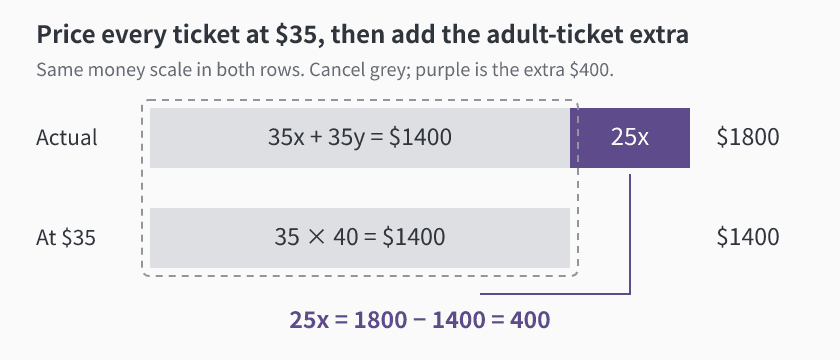
Diagram: pricing all tickets at HK$35 gives a starting amount of HK$1400. Each adult ticket adds HK$25. The total extra, HK$400, is therefore . Both strips use the same money scale. Their matching grey parts show what disappears in the subtraction below.
- Multiply every term on both sides of equation (1) by 35: . Remember to multiply the total on the right too.
- Subtract this equation from equation (2). Bracket the whole expression being subtracted: .
- Remove the brackets, changing both signs in the subtracted expression: .
- Collect like terms: . Divide both sides by 25 to obtain .
- Substitute into equation (1): . Subtract 16 from both sides to obtain .
Therefore, 16 adult tickets and 24 student tickets are sold. Name each type and include the unit instead of leaving two unexplained numbers. Check the original ticket count and the money collected:
Both conditions hold, and both counts are non-negative integers, as ticket counts must be. If a calculation gives half a ticket, do not round it to make an answer. Check the equations and arithmetic first. If both are correct, consider whether the original conditions can hold together.
Unit prices: put the price difference on the correct side
Example 2: two identical notebooks and three identical pens cost HK$36 altogether. Each notebook costs HK$3 more than each pen. There are no extra charges. Find each unit price. Let be the price of one notebook in Hong Kong dollars, and the price of one pen in Hong Kong dollars. These unknowns represent prices, not item counts.
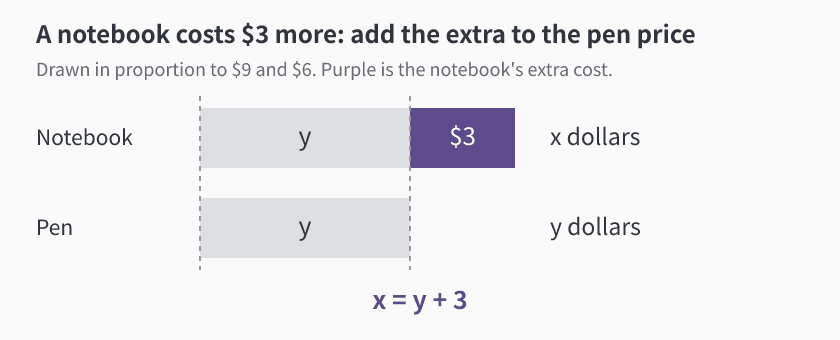
Diagram: add HK$3 to the cheaper pen price to reach the notebook price. The strips, drawn in proportion to the final prices, show , or equivalently . Do not add 3 to the more expensive item. Decide which quantity is larger before writing the equation.
- Equation (4) already expresses in terms of the other unknown. Substitute the whole expression into equation (3): .
- Each of the two notebooks costs HK$3 extra. Expand to get . The price difference must be multiplied by 2 too.
- Collect like terms: .
- Subtract 6 from both sides: . Divide by 5 to obtain .
- Substitute into equation (4): . Now both unit prices have been found.
A notebook costs HK$9 and a pen costs HK$6. Prices can contain decimals, whereas ticket counts must be integers. Whether an answer is acceptable depends on what the unknown represents. Check both the total cost and the difference:
Three checks before finishing
- Keep each unknown's meaning fixed. An unknown defined as a ticket count cannot become a price halfway through. State any new definition clearly.
- Match each equation to a condition. A total count adds quantities. A total cost adds unit prices multiplied by quantities. The word 'total' alone does not tell you what to add.
- Check the words as well as the equations. A solution can satisfy equations that were formed incorrectly. Recheck the totals, differences, units and allowed values against the question.
Once the words become two linear equations, the solving methods are familiar. Next time, we move to quadratic equations, which contain a squared unknown. We will learn completing the square and the quadratic formula, and see why there can be two solutions.
Learn more: DSE Mathematics tutoring
To republish this article, please email [email protected].