

Last time, we turned ticket and stationery problems into simultaneous linear equations. Now we meet equations containing a squared unknown. Moving terms alone will not finish the job: two different numbers can have the same square. We will use completing the square to understand the two answers, then learn the quadratic formula for equations that are difficult to factorise.
A quadratic equation is an equation in one unknown that, after collecting like terms, can be written as , where are real numbers and . A root is a value of the unknown that makes the original equation true.
Completing the square: what do we need to add?
Example 1: solve . This equation can be factorised, but it is useful for learning completing the square. Our aim is to write the side containing the unknown as the square of one expression. The crucial step is to add the same number to both sides, so that the equation stays true.
Completing the square uses to rewrite a quadratic expression as a perfect square. When the squared term has coefficient 1, halve the linear coefficient and square the result to find the number to add. Add that number to both sides of an equation.
- Add 7 to both sides to move the constant: .
- The linear coefficient is 6. Half of it is 3, and . We need to add 9, rather than 3.
- Add 9 to both sides: .
- Write the left side as a square: . Taking square roots gives , because both positive 4 and negative 4 square to 16.
- Subtract 3 in each case: or . The answers are or .
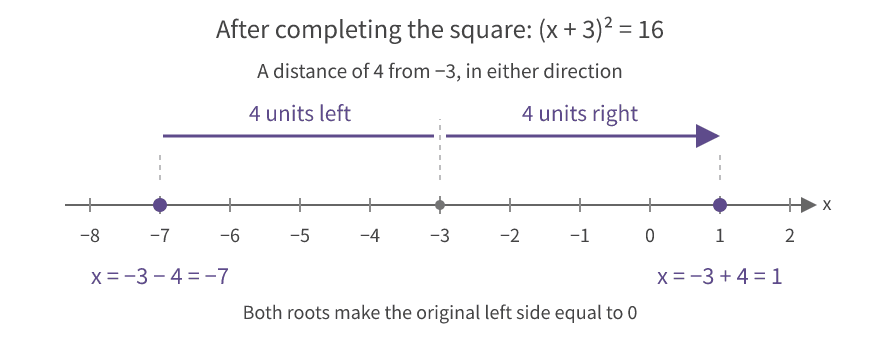
Diagram: is the signed displacement from negative three to . Its square is 16, so the distance is 4. Either direction gives a root. Remember that denotes only the non-negative square root. The two signs arise when we solve the squared equation.
Both substitutions make the original left side equal to 0, so both answers pass the check. Nothing in this question says the unknown is a length or a count. Keep the negative root too. In a word problem, use the meaning of the unknown to decide which roots are allowed.
The quadratic formula: when the leading coefficient is not 1
For the general equation , divide both sides by , move the constant, then add the square of half the new linear coefficient to both sides. This gives the relationship below. Taking square roots and rearranging gives the quadratic formula. The formula packages the general completing-the-square method into one result.
The quadratic formula gives the real roots of , when and : . Divide the whole numerator by . Work out the plus and minus cases separately.
Example 2: solve . First write . Now read off . Each coefficient includes its sign. Reading the constant before making the right side 0 would give the wrong value.
- Substitute all three signed coefficients, using brackets for negative values: .
- Calculate inside the square root first: . Subtracting the negative product gives an addition.
- Evaluate the first part of the numerator and the denominator: .
- Simplify the square root: . Hence .
- State both roots: or . To three decimal places, these are approximately and .
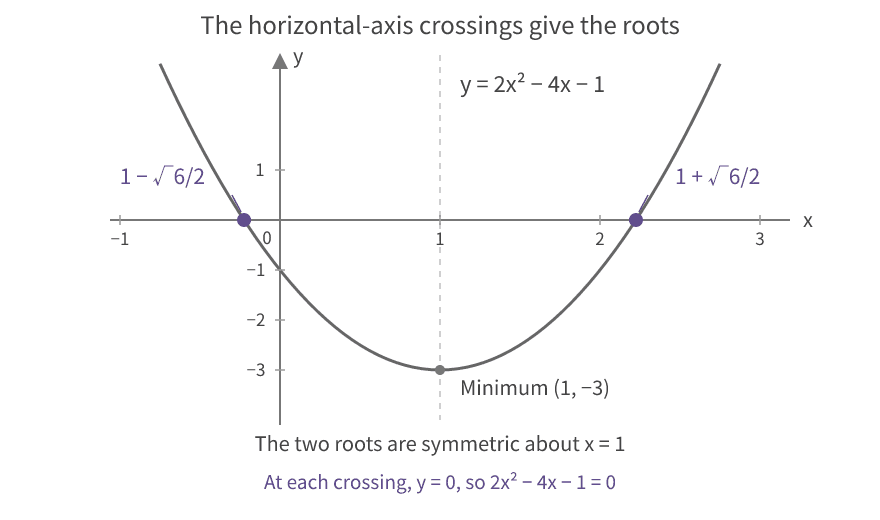
Diagram: where crosses the horizontal axis, . The horizontal coordinates are therefore the roots. They lie symmetrically about . To check both exact answers, use the equivalent expression :
The square-root forms are exact. The decimal answers are approximations. Keep the exact forms unless the question asks for an approximation. Substituting rounded values may give a result close to 0 rather than exactly 0, so use exact values for the check when possible.
Choosing a method and checking your work
- Factorise when the factors are easy to spot. Complete the square to see the link between a square and its two possible roots. Use the quadratic formula when factorisation is difficult.
- Before completing the square, if , divide every term by , including the constant. Do not change only the squared term.
- Before using the formula, make one side 0. Copy all three coefficients with their signs, and bracket negative coefficients during substitution.
- Check for a missing minus case after taking square roots. Make sure the formula's denominator divides the entire numerator. A negative number inside the square root means there are no real roots.
Both examples had two real roots, but some quadratic equations do not. Next time, we will use the discriminant, , to tell whether there are two distinct real roots, one repeated real root or no real roots, before solving the equation.
Learn more: DSE Mathematics tutoring
To republish this article, please email [email protected].