

Last time, we solved quadratic equations by completing the square and using the quadratic formula. Both examples gave two real answers. Does the plus-or-minus sign always produce two different answers? Today we will look inside the square root before solving. This tells us how many real roots there are and helps us find conditions on an unknown parameter.
For a quadratic equation , where are real numbers and , the discriminant is . Its sign determines the number of real roots. A real root is a real number that makes the equation true when substituted for the unknown.
Why does this work? The denominator is not zero. If the number inside the square root is positive, adding and subtracting its square root give different answers. If it is zero, adding and subtracting zero give the same answer. If it is negative, there is no real square root. The discriminant describes the roots; it is not itself a solution of the equation.
The three cases are: 1. : two distinct real roots, meaning two different real answers. 2. : one repeated real root. Both roots coincide, so the only real answer is . 3. : no real roots. No real number makes the equation true.
One family of equations, three different outcomes
Example 1: compare the real roots of when . Only the constant changes. We will calculate the discriminant, then solve or complete the square to confirm each prediction.
- When , the equation is . Its discriminant is , so there are two distinct real roots. Factorising gives , hence or .
- When , the discriminant is , so there is one repeated real root. Write the equation as . Taking square roots gives , so the only answer is .
- When , the discriminant is . Completing the square gives . A real square cannot be negative, so there are no real roots.
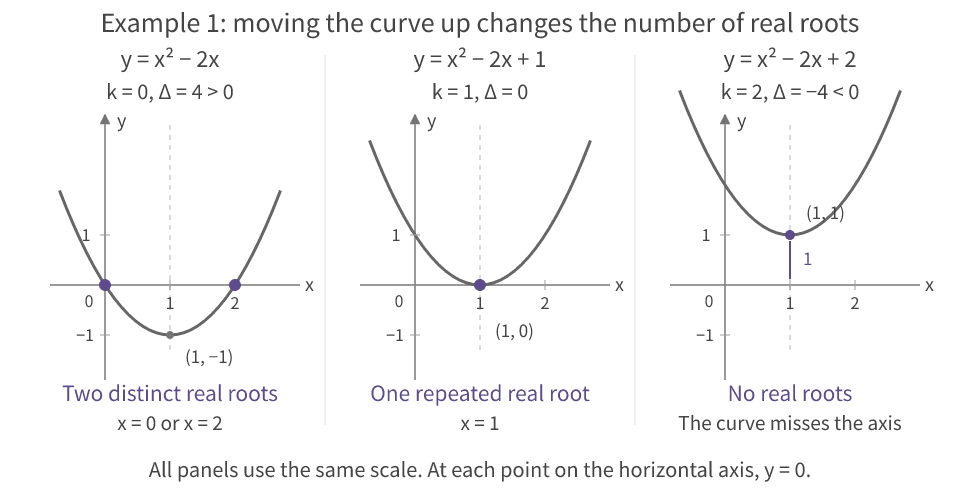
Diagram: each graph of is a parabola. Where it meets the horizontal axis, , so the horizontal coordinate is a root. As the curve moves up, it meets the axis twice, then once, then not at all. The middle curve only touches the axis, but the touching point still gives a root. These are the three outcomes in Example 1.
A zero discriminant does not mean a zero root: the middle equation has root 1. A repeated root is the same answer appearing twice, rather than two distinct answers. When the discriminant is negative, state that there are no real roots. The word ‘real’ specifies the number system in which we are working.
Finding the range of a parameter
Example 2: for , where is real, find the conditions for two distinct real roots, a repeated real root and no real roots. This time we need to cover every possible value, rather than test only three numbers.
- One side is already zero. Read the coefficients with their signs: . The leading coefficient stays at 1, so the equation remains quadratic for every .
- Substitute and simplify the discriminant: .
- Two distinct real roots require . Subtract 4 to get .
- Divide by negative 4 and reverse the inequality sign. The range for two distinct real roots is .
- A repeated real root requires . Rearrange to , then divide both sides by 4 to get .
- No real roots require . Subtract 4 to get .
- Divide by negative 4 and reverse the inequality sign again. The range for no real roots is .
Check the boundary by substituting and the repeated root into the original expression: . Completing the square also helps us check the full range:
A positive right side gives one answer on either side of the centre. A zero right side gives only the central answer. A negative right side gives no real answer. This agrees with all three graphs and helps us catch a reversed inequality in the parameter calculation.
‘Has real roots’ or ‘has at least one real root’ includes both distinct and repeated real roots, so the condition is . In Example 2, gives . Include the boundary value.
Mistakes to catch before you finish
- Make one side zero first. For example, rewrite as . Then , not positive 3.
- Bracket negative coefficients: , whereas . A sign error here changes the discriminant.
- If the question asks only for the number of real roots, calculate the discriminant and state the conclusion. Continue solving when the question asks for the values of the roots.
- If the leading coefficient contains a parameter, exclude values that make before using the quadratic classification. Those values remove the squared term.
We can now count real roots without first finding them. Next time, we will connect roots with coefficients. We will find the sum and product of the roots directly from the coefficients, then use those relationships to solve problems.
Learn more: DSE Mathematics tutoring
To republish this article, please email [email protected].