
Building on the discriminant: the sign of tells us how many real roots a quadratic equation has. But suppose we only need their sum or product. Do we have to use the quadratic formula to find each root first? We can often read the information straight from the coefficients. Expanding the factors will show us why.
A root is a value of the unknown that makes an equation true. In , are the coefficients of the squared and linear terms, and is the constant term. We require .
Why do coefficients tell us about roots?
Call the two real roots and . These Greek letters are simply names for the roots. If the root is repeated, count that value twice. We can write the quadratic expression in factor form and expand it as follows. Keep the factor in front so the squared term keeps its original coefficient.
Both forms represent the same polynomial, so matching terms must have equal coefficients. Thus and . Divide each relationship by . The minus sign in the sum rule comes from subtracting the roots in the two factors.
Sum and product of roots: for with real roots , 1. Their sum is . 2. Their product is . Count a repeated root twice. Both rules divide by .
Example 1: find the sum of squares without solving
The roots of are . Find . First, , so there are indeed two distinct real roots. The question asks for the sum of their squares, which differs from the square of their sum.
- Read the signed coefficients: . Hence and .
- Expand the square of the sum: . It includes a cross term as well as the two squares.
- Subtract the cross term from both sides: . The right side now uses only the sum and product we already know.
- Substitute and calculate: . The answer is .
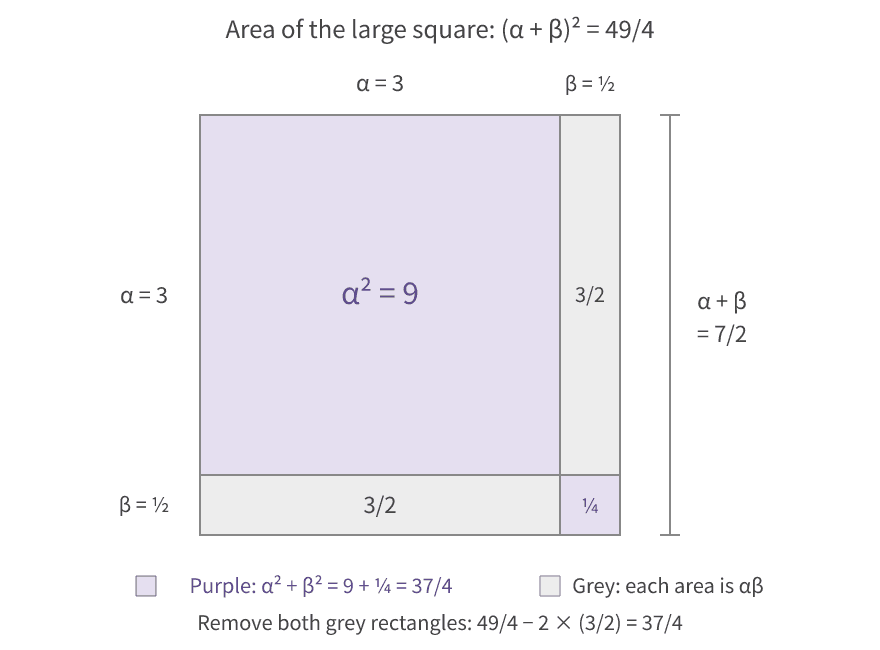
Diagram: draw an area model using this equation's roots, 3 and . The large square has area . Remove the two grey rectangles, each with area . The purple squares remain. We subtract twice the product because there are two cross-term rectangles.
For a check, find the roots now: , giving or . Each value makes a factor zero, so each satisfies the original equation. Directly, , as before. Finding the roots is a check here; the earlier calculation did not need them.
Example 2: form an equation from its roots
Forming an equation: if two roots have sum and product , the equation with leading coefficient 1 is . Multiplying the whole equation by any non-zero constant leaves its roots unchanged.
Find a quadratic equation with integer coefficients whose roots are and . Keep the exact square-root forms. Their matching plus and minus signs allow the square roots to cancel when we calculate the sum and product.
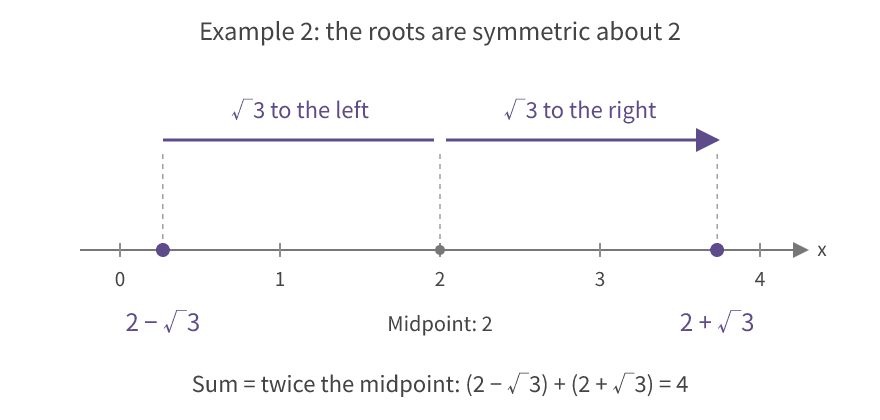
Diagram: the roots are each away from 2, in opposite directions. Their midpoint is 2, so their sum is twice 2. This shows why the square-root terms cancel in the first step below.
- Add the roots: . The positive and negative square-root terms cancel.
- Multiply using the difference of two squares: .
- Place the sum and product in the correct positions: . This is one valid answer. The linear coefficient is the negative of the sum.
- Check by completing the square: . Substituting either root gives , so both roots satisfy the equation.
The equation is not unique. For example, has the same roots. The question asks for one equation with integer coefficients, so the simplest one is enough. Also, choosing any two numbers as a proposed sum and product does not guarantee real roots. Check the discriminant when their existence has not been established.
Three points to check
- Make one side of the equation 0 before reading the coefficients. Moving a term may change its sign.
- The sum is , not . The product is . Keep the denominator in both rules.
- To find the sum of squares, subtract twice the product. To form an equation, use the negative of the root sum as the linear coefficient when the leading coefficient is 1.
We can now read root information from coefficients and work backwards to form an equation. Next time, we turn to linear inequalities in one unknown. We will show a range of solutions on a number line and explain why multiplying or dividing both sides by a negative number reverses the inequality sign.
Learn more: DSE Mathematics tutoring
To republish this article, please email [email protected].