

In Example 3 last time, we expanded and later took out as a common factor. We moved through both steps quickly. This time we go back to the start: how to add, subtract and multiply polynomials, and how to multiply out brackets. This is called expansion. Factorisation and quadratic equations both build on it. If this part is shaky, you will lose marks in every topic that follows.
Polynomial: an algebraic expression made of one or more terms joined by plus and minus signs. Each term is a number multiplied by letters, and every power of a letter is 0 or a positive whole number. 1. The number in a term is its coefficient. For example, the coefficient of is 3. 2. A term with no letter is the constant term. 3. The highest power among the terms is the degree of the polynomial.
For example, has three terms. The coefficients are 3 and , and the constant term is 2. The highest-power term is , so this is a polynomial of degree 2. Notice that the minus sign in belongs to the term. The coefficient is , not 5. When you subtract and change signs later, this is where mistakes start. What about or ? The power of the letter is not 0 or a positive whole number, so neither is a polynomial.
Adding and subtracting: only like terms combine
Like terms: terms with the same letters, each raised to the same power. For example, and . 1. To combine like terms, add or subtract the coefficients and keep the letter part unchanged. 2. Terms that are not like terms cannot be combined. and have the same letter but different powers, so is already in its simplest form.
For example, simplify . Adding is easy: just remove the brackets. Subtracting needs care. The minus sign subtracts the whole bracket, so every term inside changes sign, not only the first one.
- Remove the brackets. All three terms after the minus sign change sign: becomes , becomes , and becomes :
- Group the like terms:
- Combine the coefficients. The answer is
Multiplying: every term must be multiplied
Multiplication uses the distributive law: the term outside the bracket multiplies every term inside. For example, . To multiply the letters, use the laws of indices from the first article: . Multiply the coefficients and add the powers. The most common mistake is to multiply only the first term and write .
Expansion: multiplying out a product with brackets and writing it as a polynomial with no brackets. 1. The distributive law: . 2. To multiply two polynomials, multiply every term of the first bracket by every term of the second, then combine like terms at the end. 3. Two terms times two terms gives 4 products. Two terms times three terms gives 6. Count them to check nothing is missing.
Why every term times every term? Look at . Think of it as the area of a rectangle. The length is and the width is . Cut the length and the width into two parts each, and the rectangle splits into four pieces.
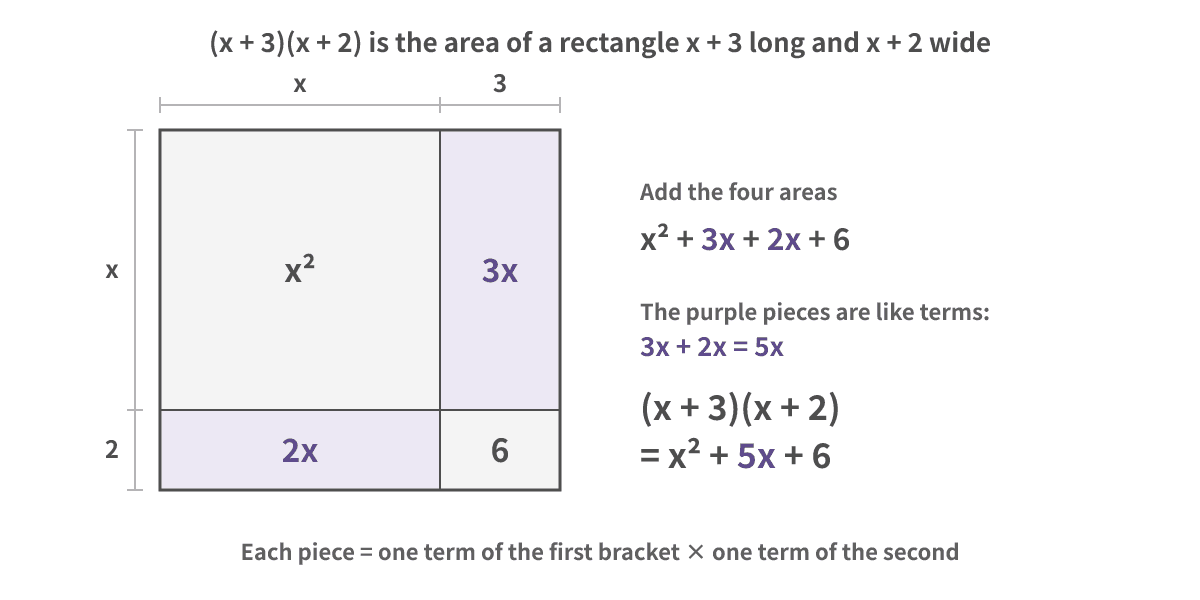
Add the four pieces: . Each piece is one term of the first bracket times one term of the second. Miss one pair and the rectangle has a hole in it. The middle pieces and are like terms, so combine them after all the multiplying is done.
Three identities to know
Identity: an equation that is true whatever values the letters take. The three used most in expansion are: 1. . 2. . 3. .
All three come from multiplying every term by every term, so you do not need to memorise them blindly. means . The four products are , , and . The two terms in the middle add to . In the third identity, the middle terms and cancel, so only two terms are left.
Example: one expression, two traps
Simplify . There are two places where most people go wrong, so we work in three steps. Step 1: expand with the first identity, where and :
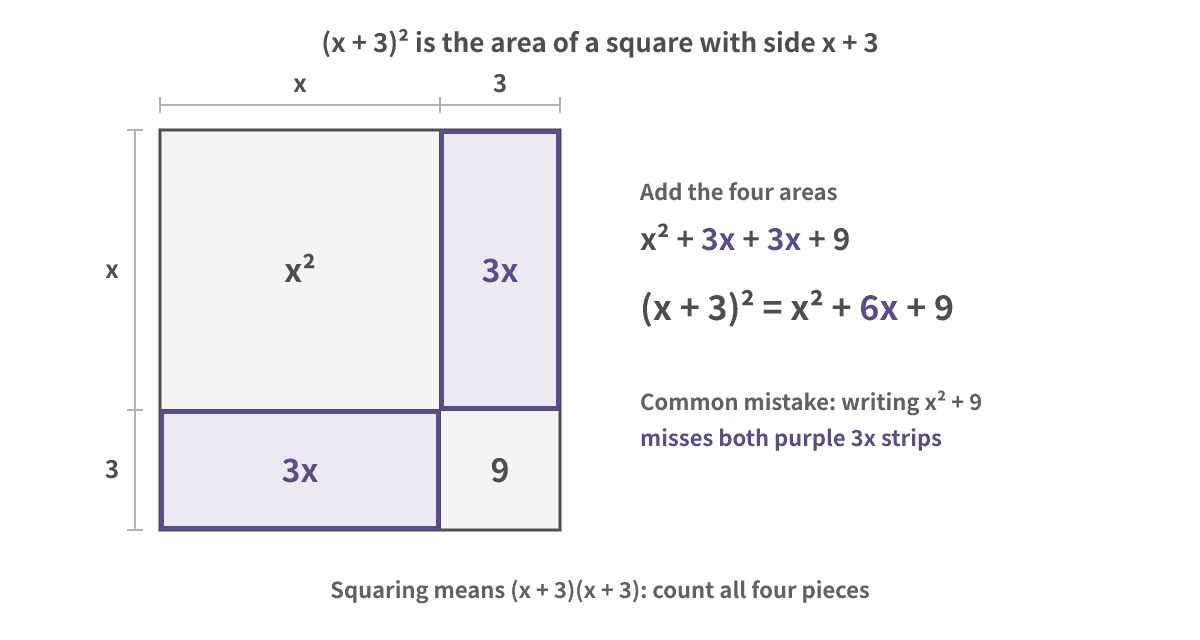
Here is the first trap. Many students see and write straight away. That squares each term inside the bracket separately. Look at the square: and 9 are only two corners. Without the two strips, the area is too small. Try a number: when , , but . The missing 6 is exactly the two strips.
Step 2: expand . Two terms times two terms gives 4 products. The minus sign stays with the 3 when you multiply:
Step 3: subtract. Here is the second trap. You are subtracting the whole product, so after expanding, put it back in brackets. Then change the sign of every term inside, combine like terms, and write the answer from the highest power down:
The answer is . Without the brackets, a student writes . Only the first term has changed sign, the other two have not, and the result is , which is wrong. Check: put into the original expression: . Put it into the answer: . They match. One number cannot prove an answer is right, but it often catches a mistake straight away.
To sum up: in adding and subtracting, only like terms combine, and a minus sign changes the sign of everything in the bracket after it. In multiplying, every term multiplies every term, so count the products. A square is two brackets multiplied together, so do not lose the middle term. Next time: factorisation by taking out common factors and by grouping. It is expansion done backwards — for example, taking out of to get back . It is like reading the length and width of a rectangle back from its area.
Learn more: DSE Mathematics tutoring
To republish this article, please email [email protected].