

Last time we ended with a question: how do we take out of to get back ? Expansion multiplies brackets out. Factorization goes the other way: it writes a polynomial as a product of factors. Solving quadratic equations and simplifying algebraic fractions almost always start with factorization. So this note covers the two most basic methods: taking out a common factor, and grouping.
Factorization: writing a polynomial as a product of polynomials. 1. Each part of the product is a factor. For example, and are both factors of . 2. Keep going until no factor can be factorized any further. This is factorizing completely. 3. Factorization and expansion undo each other. If you expand your answer, you must get the original expression back.
Common factors: find what every term has
Common factor: a factor that every term of a polynomial has. 1. The highest common factor (H.C.F.): for the number part, take the H.C.F. of the coefficients. For each letter, take the lowest power it has in any term. 2. Taking out a common factor: write the H.C.F. outside a bracket, divide every term by it, and write the results inside the bracket. 3. The bracket has as many terms as the original expression. Not one can go missing.
Back to . We work in four steps:
- Look at the coefficients. The H.C.F. of 6, and 8 is 2. Ignore the minus sign for now. It stays with its term inside the bracket.
- Look at the letters. All three terms contain , with powers 3, 2 and 1. Take the lowest, which is . So the H.C.F. is .
- Divide every term by : , , .
- Write the answer: . Check with . The original gives . The answer gives . They match.
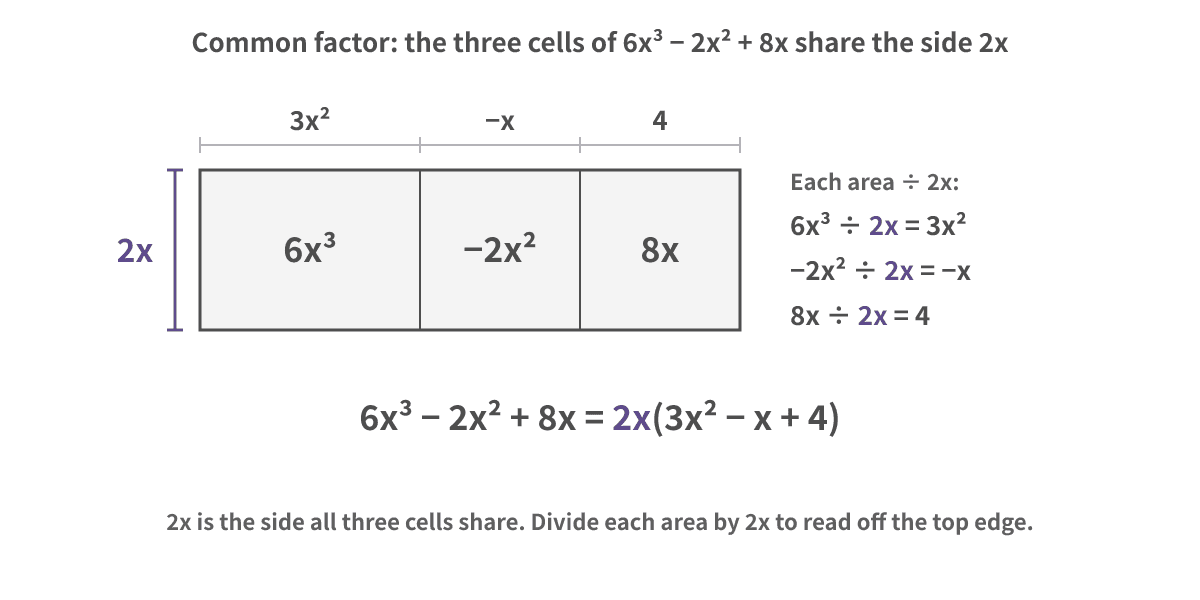
Think of the rectangle from last time. Expansion knows the length and width and works out the area. Taking out a common factor knows the area of each cell and the side that all three cells share. It works backwards to the length of each cell's top edge. If you take out only and write , the statement is true. But the three coefficients in the bracket still share a factor of 2, so it is not factorized completely, and you lose marks. Always take out the highest common factor.
Here is the first trap: one term is the common factor itself. Take . The H.C.F. is . The second term divided by is , not 0. So:
Many students see the whole second term taken out and think nothing is left. They write . Expand that and you only get . The has disappeared. Remember point 3: the original has two terms, so the bracket must have two terms. When a whole term is taken out, it leaves a 1 behind.
Grouping: four terms with no common factor
A common factor does not have to be a single term. It can be a whole bracket. In , both terms contain . Taking it out gives . Grouping sets up exactly this situation on purpose. If four terms have no common factor all together, split them into pairs. Take out a common factor from each pair, so that the two brackets left over are the same.
Factorization by grouping: split the terms into groups, take out a common factor from each group, then take out the bracket the groups share. 1. The brackets left in each group must be exactly the same before you can take them out. 2. If the second group starts with a minus sign, take the minus sign out with the factor. Every term in the bracket then changes sign. 3. If the brackets do not match, try grouping the terms a different way.
Example: the minus sign that catches everyone
Factorize . The four terms have no common factor all together, so we put the first two in one group and the last two in another:
- Group the terms. The second group starts with a minus sign, so the minus sign goes inside its bracket:
- Take out of the first group:
- Take out of the second group, not . and , so
- Both groups contain . Take it out:
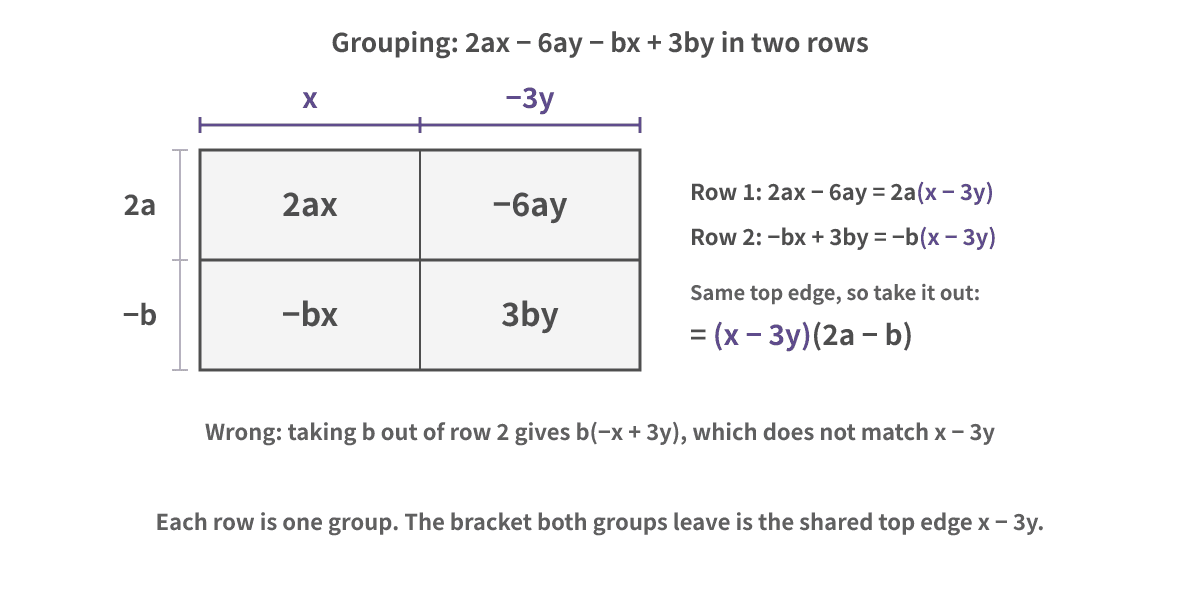
The trap is in step 3. If you take out from the second group, you get . That bracket has the opposite signs to in the first group, so you cannot take it out. The figure shows why. Both rows must share the same top edge , so the left side of row two has to be . Another common mistake is to group as . Removing that bracket gives . The sign of has changed, so this is no longer the original expression.
The answer is . The two factors can be written in either order. Check with . The original gives . The answer gives . They match.
If the two brackets do not match after grouping, you may not have made a mistake. The grouping itself may be wrong. Take . The first two terms, and , have no common factor, so you are stuck at once. Reorder the terms as and group again. As before, take out of the second group, minus sign included:
To sum up: first look for a common factor. If there is one, take out the highest, then count the terms in the bracket. If four terms have no common factor, try grouping. When the second group starts with a minus sign, take the minus sign out too. The two brackets must be exactly the same before you take them out. Next time: the cross-method. Last time we expanded to get . Going backwards, if we split the middle term into , grouping finishes the job: . The hard part is that a question never tells you how to split . The cross-method is how you find the split.
Learn more: DSE Mathematics tutoring
To republish this article, please email [email protected].