

At the end of the last article, we split the middle term of into . Then grouping gave . The right split makes it work, but the question never tells you the split. The cross-method is how you find it. There is no guessing, just steps to follow. Many quadratic equations start with this step, so it is worth practising until it is automatic.
Cross-method: a way to factorise a quadratic trinomial . 1. Split the first term into two factors and write them down the left of a cross. Split the constant term into two factors and write them down the right. 2. Multiply along the diagonals. The two products must add to the middle term . 3. When they do, read across: each row is one factor.
Leading coefficient 1: find two numbers
Start with the simplest case, where the coefficient of is 1. Expand the way we did two articles ago:
The constant term is times . The coefficient of the middle term is plus . So to factorise , find two numbers that multiply to 6 and add to 5. 6 can be or . is wrong. is right. So . The cross is a picture of this search:
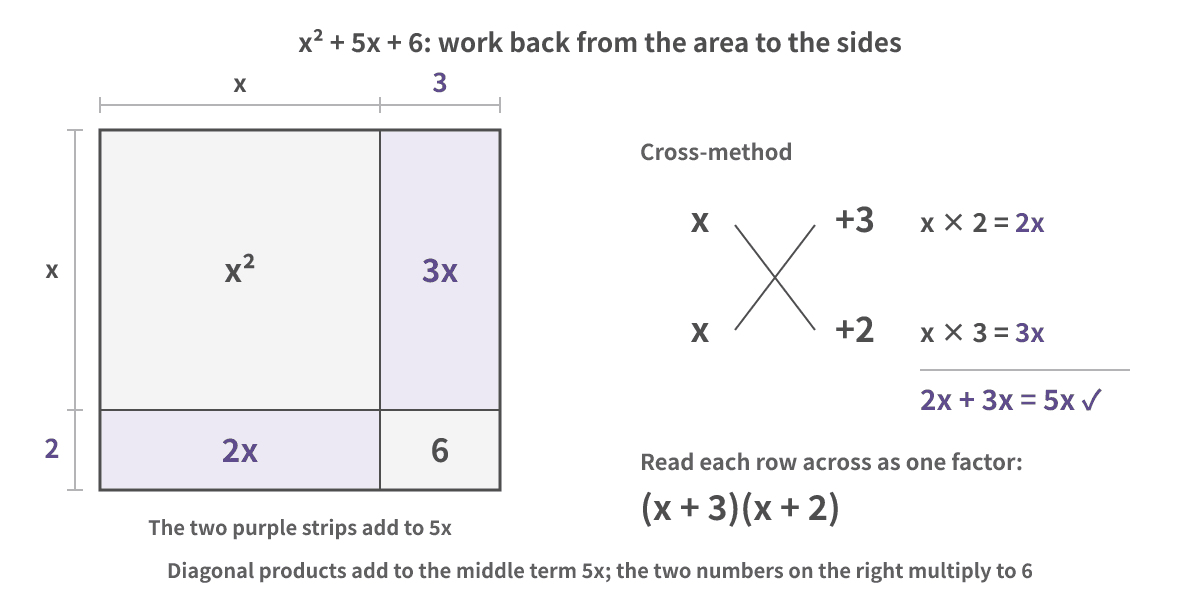
Compare it with the rectangle from the expansion article. and 6 are the two corners, and they are always there. What you have to find are the two strips, and they must add to exactly . The two numbers on the right of the cross are the unknown parts of the rectangle's sides. Why multiply diagonally? Because and are the areas of those two strips. They are the two middle terms you get when you expand.
Sign rule: when you factorise , the sign of tells you the signs of the two numbers. 1. If is positive, the two numbers have the same sign as each other and as . Both are positive if is positive, and both are negative if is negative. 2. If is negative, one number is positive and one is negative. The one with the larger size takes the sign of .
For example, take . Here is negative, so one number is positive and one is negative. , so the larger one is negative. Split 12 as : . That fits, so . Many students put the minus sign in the wrong bracket and write . Expand that and the middle term is . So always multiply the diagonals again to check.
Leading coefficient not 1: split both sides
When is not 1, for example , two numbers are not enough. The first term has to be split too: or . The constant splits into and , or and . How you split the left, how you split the right, and which number goes on top all change the middle term. So try the options one at a time, in order.
Example: put the constants in the right places
Factorise . 6, 7 and 3 have no common factor, so go straight to the cross-method:
- Split the first term: . Write and down the left of the cross.
- Split the constant: is negative, so one number is positive and one is negative. Try and .
- Trial 1, with on top and below. Multiply the diagonals and add: . That is not , so it is wrong.
- Trial 2: swap the two constants top and bottom. . That is right.
- Read across. The first row is and the second row is , so .
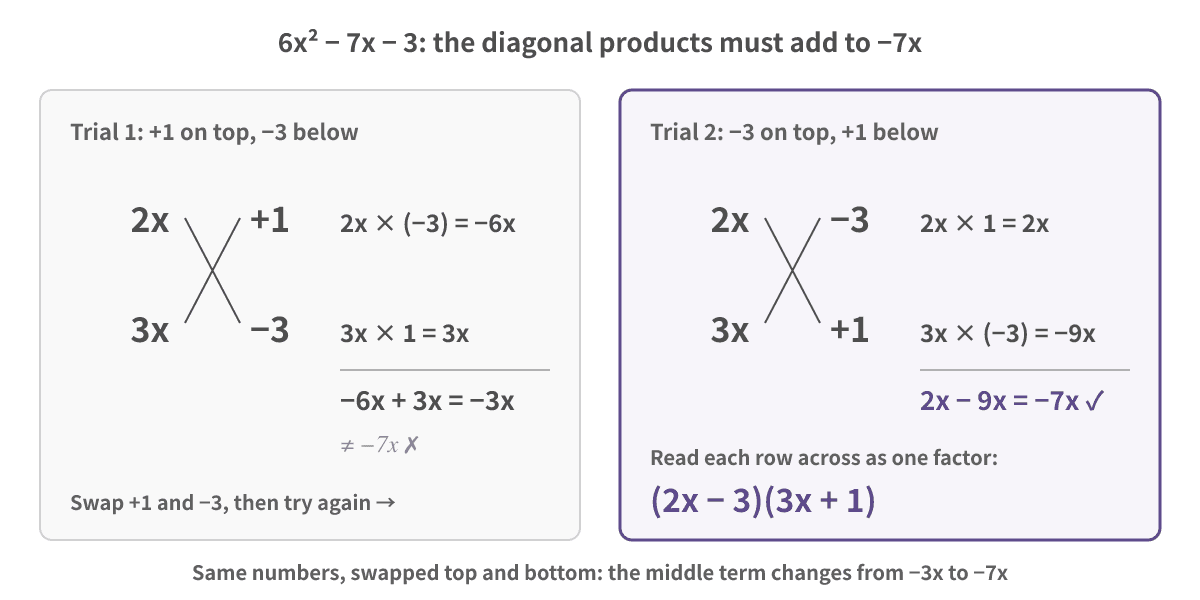
The trap is in steps 3 and 4. Both trials use the same numbers. Only the top and bottom are swapped, yet the middle term changes from to . Many students find and and write them down in that order: . That expands to , and the wrong middle term goes unnoticed. Another mistake is reading down a column, as if and made one factor. Remember: the diagonals are for checking, and the rows are the answer.
Check: put into the original expression: . Put it into the answer: . They match. You can also check with grouping from the last article. The cross tells you to split into , so
In other words, the cross-method is a way of finding how to split the middle term before you group.
Two last points. First, take out any common factor before you start. For example, . Going straight to the cross gives many more pairs to try, and it is easy to lose the 2 at the front. Second, not every quadratic can be factorised this way. For you need two whole numbers that multiply to 1 and add to 1. There are none, so the cross-method cannot factorise it.
To sum up: the cross-method is expansion done backwards. Split the first term on the left and the constant on the right. The diagonal products must add to the middle term. When they do, read across. The sign of tells you whether the two numbers have the same sign or opposite signs. If a trial fails, swap the right-hand numbers and try again. Next time: factorisation with identities. Expressions like and have a fixed pattern. The cross-method works on them too, but if you recognise them as and , you can factorise in one step.
Learn more: DSE Mathematics tutoring
To republish this article, please email [email protected].