

The previous article ended with . We can factorise its numerator using the difference of two squares, and its denominator using a perfect square identity. Now we will use those factors to simplify the fraction, then learn to add, subtract, multiply and divide algebraic fractions. The rules are the same as for ordinary fractions. The extra care lies in recognising which parts are added and which are multiplied.
Algebraic fraction: a quotient of two polynomials written as a fraction. A polynomial is an expression made by adding terms with non-negative whole-number powers of its variables. 1. The numerator is above the fraction line; the denominator is below it. 2. The denominator must not equal 0. Values that make it 0 are excluded from the original expression. 3. Keep these restrictions after simplifying.
Cancel whole factors
Cancellation: dividing the numerator and denominator by the same non-zero common factor leaves the value unchanged. A common factor multiplies the whole numerator and the whole denominator. 1. Factorise both first. 2. Terms separated by addition or subtraction cannot simply be cancelled. 3. In symbols, .
- Find the restriction first. The denominator is , so .
- Factorise the top as a difference of two squares and the bottom as a perfect square: .
- Since , divide the top and bottom by one factor of . The answer is . There were two copies of the factor in the denominator. One remains.
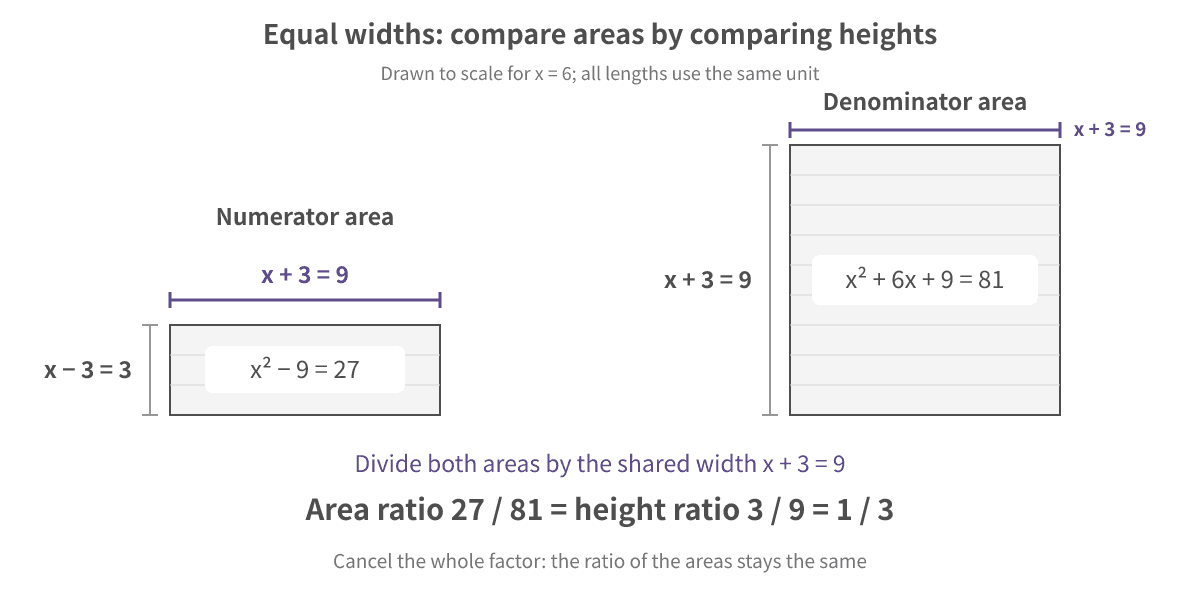
The figure is drawn to scale for . The numerator has area , and the denominator has area . Both have width 9, so . This also checks our answer at that value. The area model uses so all lengths are positive. The algebra works for every value allowed by the original expression.
Compare this with . The top is a sum. Its is a term, not a factor of the whole numerator, so you cannot cancel it against the denominator. At the original equals 2; wrongly cancelling to get 3 fails immediately. Also, still requires . An answer of 1 does not make division by 0 valid in the original expression.
Add and subtract using a common denominator
Taking a common denominator means rewriting fractions as equivalent fractions with the same denominator. 1. Multiply each numerator and denominator by the same non-zero factor. 2. Once the denominators match, add or subtract the numerators and keep the denominator. 3. The least common denominator contains every factor needed by the denominators, using the highest power of each factor that occurs.
For example, denominators and have least common denominator . Do not multiply in an extra copy of a factor you already have. Now calculate . Different denominators mean different-sized parts, so first make the parts the same size.
- Both denominators must be non-zero: . Use common denominator .
- The first denominator needs a factor of . Multiply both top and bottom: .
- Multiply the second numerator and denominator by : .
- Subtract the numerators, putting the entire second numerator in brackets: .
- The minus sign changes the sign of every term in the second bracket: .
- There is no common factor to cancel. The answer is .
Check at . The original gives , and our answer gives . For addition, use the same common denominator. The numerator becomes , giving the answer . Keep the denominator unchanged.
Multiply factors; divide by multiplying by the reciprocal
Multiplication and division rules: 1. Multiply numerators together and denominators together. Factorise first so you can cancel common factors. 2. To divide, multiply by the reciprocal of the divisor. Its reciprocal swaps its numerator and denominator. 3. Every original denominator must be non-zero, and the divisor itself must also be non-zero. Record these restrictions before taking the reciprocal.
For multiplication, take . The original denominators require . Factorise the numerator, then cancel the common factors:
Keep those restrictions even though the answer has no denominator. Now calculate . Here we must also check when the divisor equals 0.
- The original denominators require . The divisor must be non-zero, so , giving the extra restriction .
- Take the reciprocal of the divisor only, and change division to multiplication: . Leave the first fraction unchanged.
- Factorise to expose the common factors: .
- Cancel the non-zero common factors. The answer is .
Check at : the original gives , and the answer gives . Use this order each time: record restrictions, factorise, then choose the operation. For addition and subtraction, find a common denominator. For multiplication and division, cancel factors. Finally, see whether the answer simplifies further. Next time we will use the remainder theorem to find the remainder of a polynomial division by substitution.
Learn more: DSE Mathematics tutoring
To republish this article, please email [email protected].