
Last time we simplified algebraic fractions by factorising, and kept the rule that a denominator cannot be 0. Now we turn to polynomial division. If a question asks only for the remainder, must we work out the whole division? The remainder theorem gives us a shortcut: substitute one value. To choose that value correctly, first understand what remains after division.
Polynomial division: the dividend equals the divisor multiplied by the quotient, plus the remainder. 1. We write the dividend as and the quotient as . 2. A non-zero remainder must have lower degree than the divisor. The degree is the highest power of the variable in a non-zero polynomial. 3. For a linear divisor, the remainder is a constant, a number that does not depend on the variable. It can be 0.
Why does one substitution give the remainder?
In integer division, leaves 2 after making three groups of 5. Polynomial division also lets us rebuild the dividend. If the divisor is and the remainder is , we have this identity, an equation true for every value of the variable:
Remainder theorem: when a polynomial is divided by , the remainder is . 1. Find the value that makes the divisor 0. 2. Substitute it into the original dividend. The notation means the value obtained by replacing every in with .
The whole product of divisor and quotient becomes 0. Only the remainder survives, so we do not need to find the quotient. We are substituting into an identity involving multiplication and addition. We are not dividing by 0. The rule about non-zero denominators still holds.
See the same example through long division
Find the remainder when is divided by . First use long division. In each round, divide the leading term of what remains by the leading term of the divisor. Multiply back, then subtract the whole product.
- Divide the leading terms: . Multiply back: . Subtract to leave .
- Next, . Multiply back: . Subtract the entire bracket: . Subtracting a negative changes its sign.
- Finally, . Multiply back: . This leaves .
- Stop because the constant remainder has lower degree than the linear divisor. The quotient is and the remainder is 9. In the last subtraction, subtracting negative 4 means adding 4. The remainder is not 1.
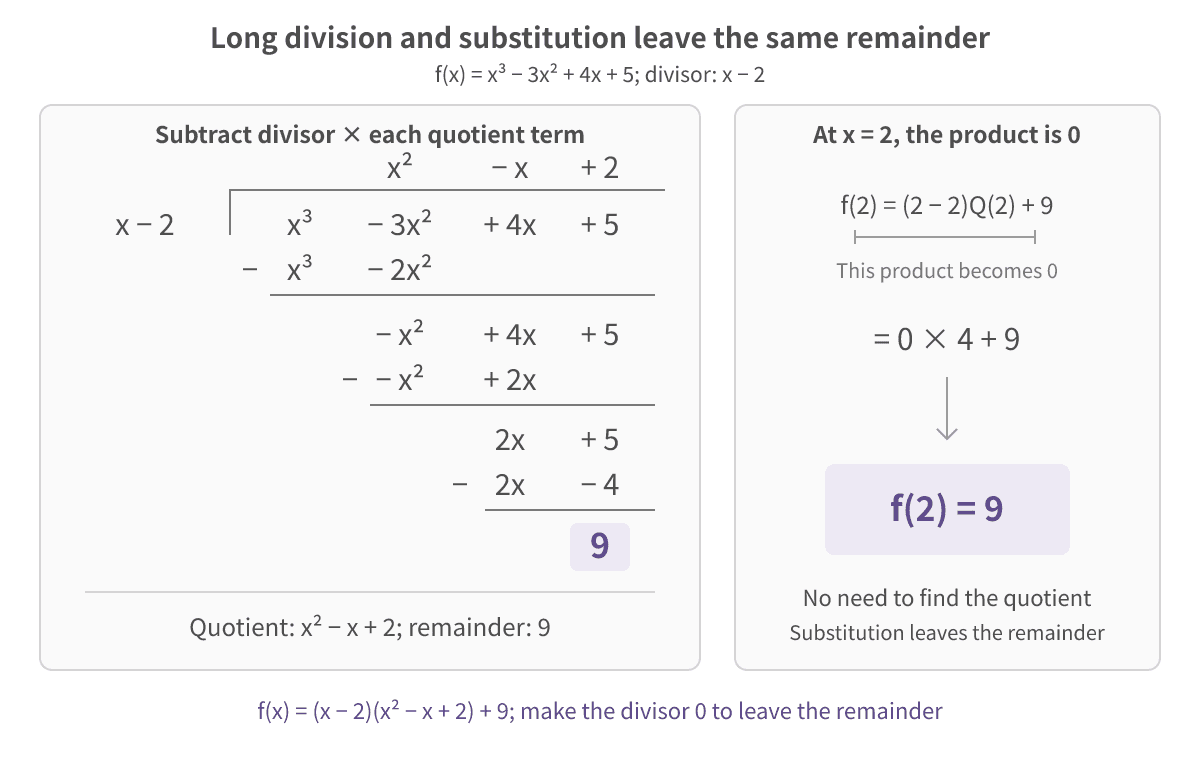
The left panel shows the three rounds above. The right panel explains why we can skip finding the quotient. To check the division, expand . Adding 9 restores the dividend. If we need only the remainder, substitute directly. The answer is again 9:
What if the linear divisor looks different?
General rule for a linear divisor: for , solve to get . The remainder is . Use the value that makes the whole divisor 0. Do not simply copy its constant term, the term without the variable.
- Divide the same dividend by . Solve to get . The remainder is . Put negative substitutions in brackets. Squaring and cubing a negative number give different signs.
- For divisor , the value making it 0 is still . The remainder is still . Do not divide the remainder by 2.
Indeed, . Doubling the divisor halves the quotient, while the remainder stays 9. Solving for the value that makes the divisor 0 handles both a plus sign and a leading coefficient other than 1.
Use a known remainder to find an unknown coefficient
A coefficient is the number multiplying a power of the variable. Suppose leaves remainder 4 when divided by . Find the unknown coefficient . The remainder gives an equation, so there is no need to guess the quotient.
- Find the substitution: . The given condition is therefore .
- Substitute into every term of the dividend: . Combine the constants to get the answer .
- Check with this coefficient in the original polynomial: . This matches the stated remainder.
Keep the scope of the rule clear. Dividing by means substituting 0, so the remainder is the constant term. Other linear divisors need their own substitution value. For a quadratic divisor, the remainder may contain a linear term; one substitution does not generally determine it. Next time we will study the factor theorem and its applications: how a remainder of 0 identifies a factor.
Learn more: DSE Mathematics tutoring
To republish this article, please email [email protected].