

Last time, the remainder theorem let us find a polynomial remainder by substitution. Now consider a remainder of 0. Nothing is left over, so the polynomial equals the divisor multiplied by the quotient. This gives us a way to find a factor by testing a number. We can then turn a cubic, a polynomial of degree 3, into a linear factor multiplied by a quadratic.
Why does a zero remainder reveal a factor?
Factor theorem: for a polynomial , is a factor if and only if . A factor divides the polynomial with no remainder. 1. A substitution giving 0 proves that the corresponding linear expression is a factor. 2. A known linear factor tells us that the corresponding substitution gives 0. The theorem works in both directions.
This is the division identity from the previous article. An identity holds for every value of the variable. If , the remainder disappears, leaving . Conversely, if we already have that product, substituting must give 0. Substitution confirms a factor, but it does not yet find the quotient .
Root: a number that makes the equation true. If , the root is and the corresponding factor is . A root is a number; a factor is an expression.
From one factor to a complete factorisation
Factorise . Start by testing simple integers. The coefficients, the numbers multiplying the powers, are integers, and the leading coefficient is 1. Any integer root must therefore be a positive or negative divisor of the constant term 6, the term without the variable. Our candidates are . We must still test them. The list does not make every candidate a root, and a polynomial need not have an integer root.
- Try negative 1 first. Put a negative substitution in brackets: . The result is not 0, so is not a factor.
- Try positive 1: . Therefore is a factor. We can now find the quotient.
Divide the original polynomial by using long division. In each round, divide the leading terms, multiply back by the divisor, and subtract the whole product. Watch the second round: a minus sign before a bracket affects every term inside it.
- First round: . Multiply back: . Subtract: .
- Second round: . Multiply back: . Subtract: .
- Third round: . Multiply back: . Subtract: . The quotient is and the remainder is 0.
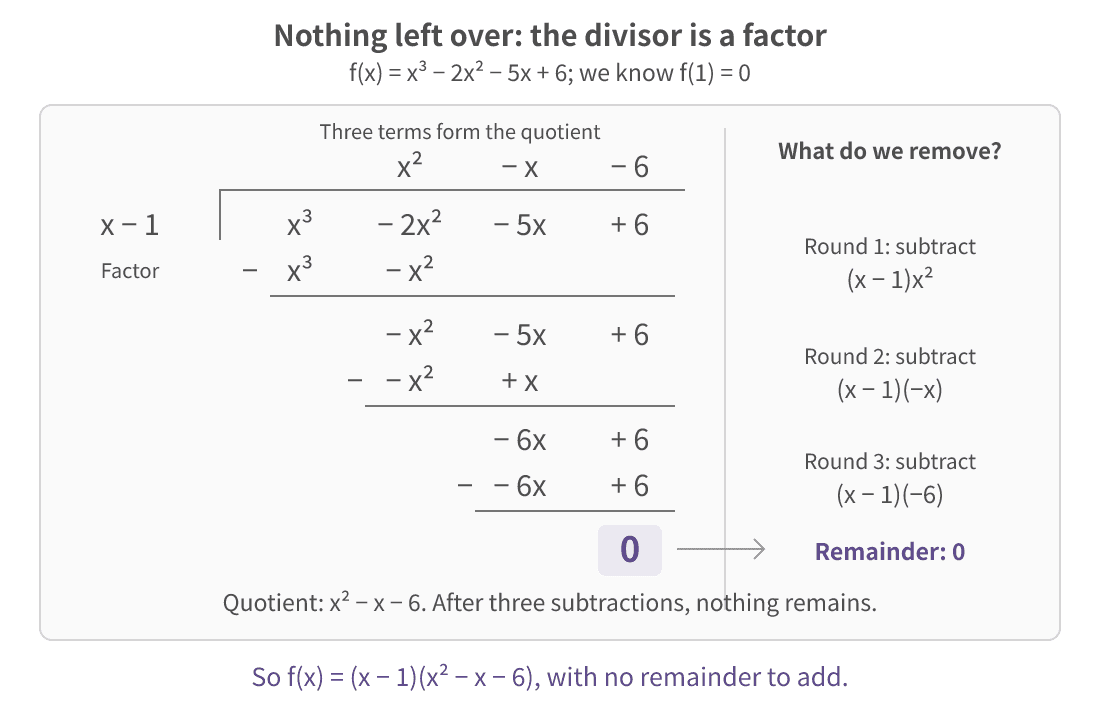
The diagram aligns terms of the same degree. Its three subtraction lines match the three rounds above. The final 0 means the product is exact. Multiply the divisor and quotient to check the signs and coefficients:
We have not finished factorising: the quadratic quotient can be split further. Use the cross method from earlier in the series. We need two numbers with product and sum . They are and 2. The complete answer is:
If asked to solve , set each factor equal to 0 separately. This gives . A zero product means at least one factor is 0; the factors do not all need to be 0 at the same time. Check the roots in the original polynomial: .
Use a known factor to find an unknown coefficient
Let . Given that is a factor, find the unknown coefficient . We do not need the quotient here. Turn the zero remainder into an equation. First find the number that makes the whole linear factor 0; do not simply substitute 1 because the constant term is negative 1.
- Solve . The condition is therefore .
- Substitute into every term: .
- Evaluate powers, then combine constants: .
- Multiply both sides by 4: . This is the required coefficient.
Check with the coefficient in place: . This satisfies the factor condition. A linear factor with a leading coefficient other than 1 follows the same process: make the factor 0, then substitute that value into the whole original polynomial.
Remember the two stopping points. A non-zero remainder means the divisor is not a factor. After finding one factor, check whether the quotient can be factorised further. Next time, we will use factorised expressions to find the highest common factor (HCF) and lowest common multiple (LCM) of polynomials.
Learn more: DSE Mathematics tutoring
To republish this article, please email [email protected].